The Splendid Sketches of Vernon Howe Bailey
Views: 3
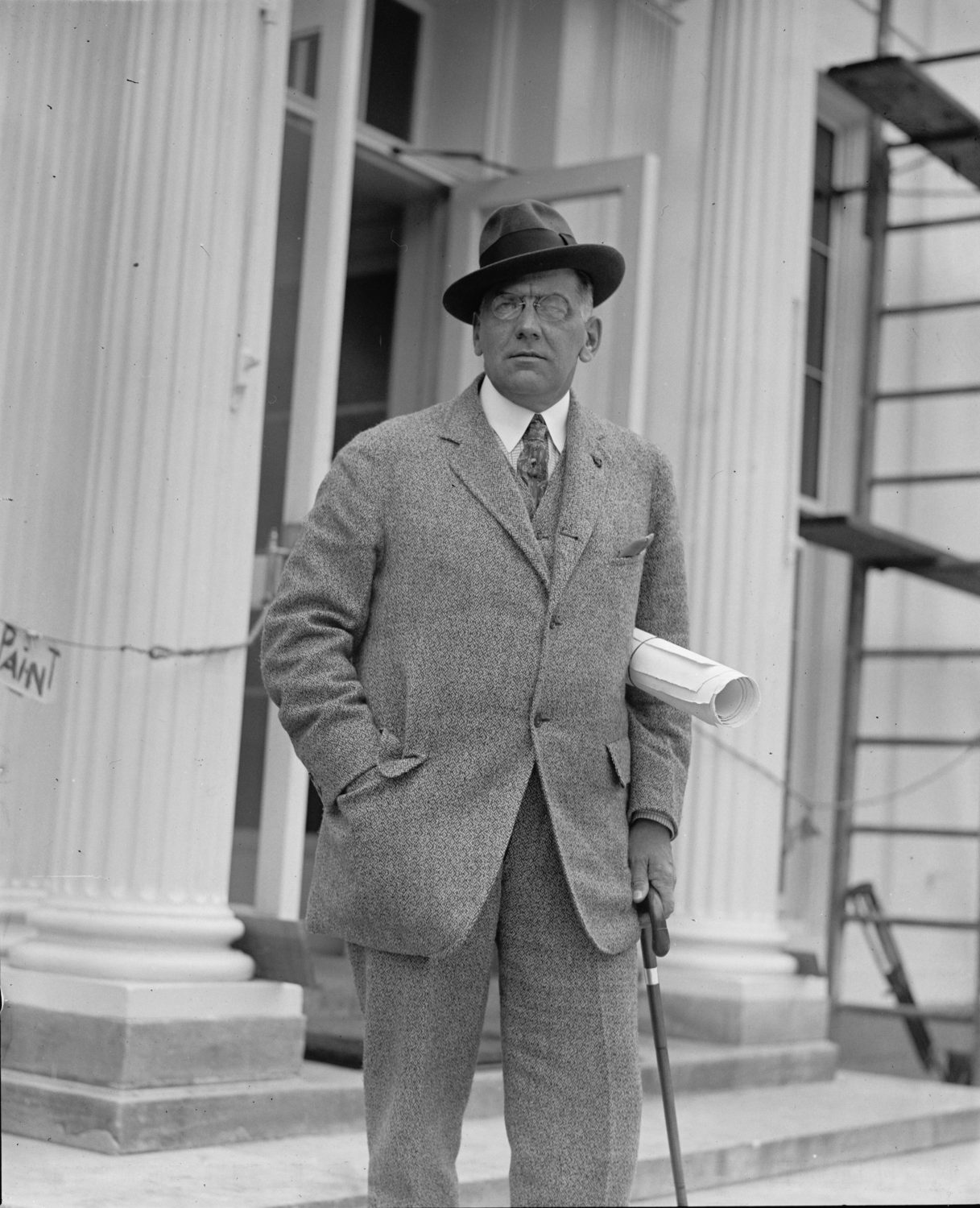
Vernon Howe Bailey, May 15, 1924, Courtesy of Library of Congress.
BY MICHAEL PERLMAN
CHAIRMAN, REGO-FOREST PRESERVATION COUNCIL
mperlman@queensledger.com
Great art transcends the hands of time, and lies in the fingertips of current and future generations to become stewards of artistic works and preserve the legacy of artists. Step into the world of Vernon Howe Bailey, an exceptionally skillful and imaginative illustrator and watercolor painter, who achieved fame throughout New York and even nationally and internationally, but today this preservation artist is unknown by many audiences. If you are fortunate to encounter his massive inventory of art in books, museums, or publications, you may feel as if his spirit is guiding you. Street scenes, bridges, landmarked buildings including skyscrapers, as well as demolished properties that span towns and cities have been preserved for posterity through his distinctive eye that offers a definitive yet dream-like ambiance.
This columnist recently stumbled upon Bailey’s detailed artist-signed illustration of Station Square from 1934, and saw buildings and landscapes under a Renaissance mentality. The center of his illustration titled “Forest Hills, Queens,” focused on the towering yet graceful Tudor-style Forest Hills Inn that opened in May 1912, and is now a co-op. His work captured the ivy that once made its way up the facades at eye level. In the background is The Raleigh, which features a clock tower and was erected as residences, adjoining the Inn through an overhead bridge. As a result of preservation-based restrictive covenants, Forest Hills Gardens, inspired by Sir Ebenezer Howard’s Garden City movement, can be valued and commemorated in its largely intact state, and you can stand in Vernon Howe Bailey’s footsteps and produce a creative work of your own. Additionally, the spirit of Forest Hills Gardens’ principal architect Grosvenor Atterbury and landscape architect and urban planner Frederick Law Olmsted, Jr. would take pride.
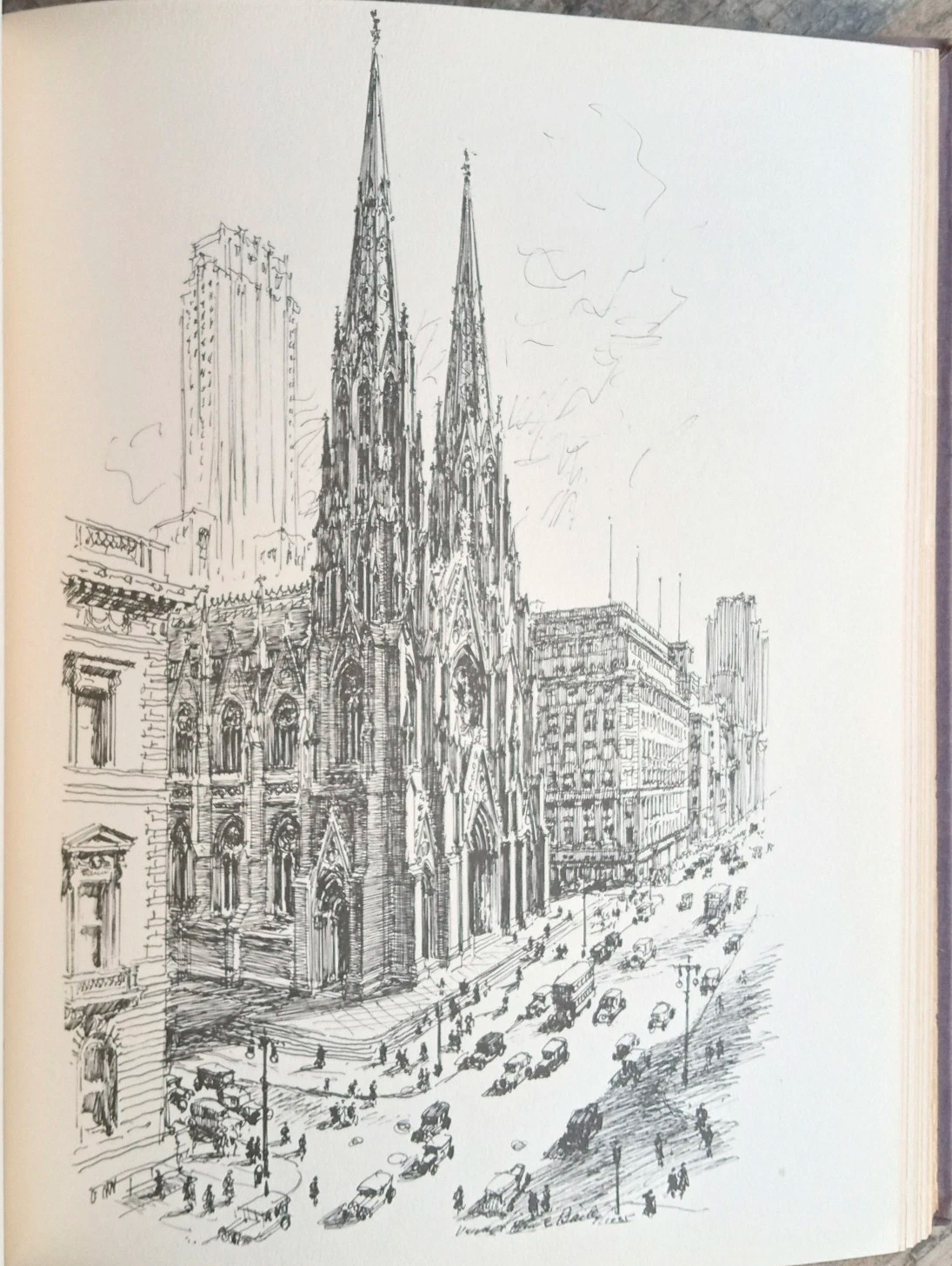
St. Patrick’s Cathedral by Vernon Howe Bailey.
“The view is near the railroad station, the buildings from the center to the right being those of the Forest Hills Inn. The tower is nine stories tall. A subsidiary of the Russell Sage Foundation originally planned to erect and sell houses in Forest Hills Gardens for $6,000 each for the use of families of modest means. However, the rapid rise of building costs and the lack of housing created by the World War forced the builders to charge much higher amounts for developed property,” read an excerpt of the August 1, 1934 edition of The New York Sun. This was part of Bailey’s column titled “Intimate Sketches of New York,” and was number 133 in the series. It continued, “The builders generally adopted English types of architecture, with peak roof styles predominating.”
Vernon Howe Bailey was born on April 1, 1874 in Camden, New Jersey and passed away on October 27, 1953 in his apartment at the Devonshire Hotel at 542 West 112th Street in Manhattan. His obituary noted that his first wife, Lillian Cate Bailey, passed away in 1900, and he was survived by Edith O’Brien Carr Bailey, his second wife. Bailey pursued his studies at Pennsylvania Museum School of Industrial Art at age 15, followed by Pennsylvania Academy of the Fine Arts, which is where one of floral drawings would be featured in their annual exhibition as of age 16. He continued his studies at Royal College of Art in London, and an aterlier-style art school Académie Delécluse and Académie Bilouil in Paris. He served as a member of the art staff with The Philadelphia Times as of 1892 and The Boston Herald in 1894. He contributed to several leading magazines, including Scribner’s Magazine, Collier’s, The Century Magazine, and Harper’s Weekly. In 1905, his American Cities series of illustrations was published in Everybody’s Magazine, which consisted of the last drawings of San Francisco a week prior to the catastrophic fire. In 1901, he began traveling internationally to sketch King Edward VII’s coronation for the Herald. He navigated across London, Paris, Berlin, and Italian cities. His prominence would also bring him to Grand Central Station to produce the first drawings. He was commissioned to launch a series that would capture the spirit of the St. Louis Exposition. With a civic-minded approach, he was a member of the Society of Colonial Wars and the Sons of the American Revolution.
With great confidence in Bailey, he made history in 1917 upon America’s entry to WWI as the first artist authorized by the government to depict the Navy Yards in his illustrations, in addition to gun shops and munition plants. He also achieved a record as the initial artist to visit and paint the American fleet at sea. He participated in a similar endeavor for WWII.
Curators of the largest international cities engaged diverse audiences through his artwork. As of 1921, his Spain tour resulted in his entire collection of related drawings being purchased by the Hispanic Society of America, and the Hispanic Museum coordinated an exhibition. Then in 1925, his second Spain tour resulted in his book, “Little Known Towns of Spain: Watercolors and Drawings,” which feature 150 works. He was the recipient of the Royal Decree of Thanks from King Alphonso XIII.
The Summit stated, “In 1927 and 1928, he went on a painting tour of Italy, and his exhibition in Rome was held under the auspices of the American ambassador Henry T. Fletcher and was opened by Count Volpi, Minister of Finance in Italy. His exhibition in Madrid was under the Duke of Alba.” In 1932, another significant achievement was when he became the first authorized artist to comprehensively paint the Vatican. That included the Pope’s private apartments, galleries, museums, new buildings, and Vatican City development. For approximately one year, he created nearly 100 drawings and paintings, which resulted in much praise from the Pope.
As of 1934, The New York Sun began featuring his illustrations for his daily column, “Intimate Sketches of New York.” By May 1935, it was reported that he completed this memorable series of 381 sketches, which received wide acclaim, and resulted in his exhibition at the Waldorf-Astoria Hotel. He previously exhibited in national museums and in Rome, London, and Paris. He also pursued another significant column, “Sketches of New York Suburbs.”
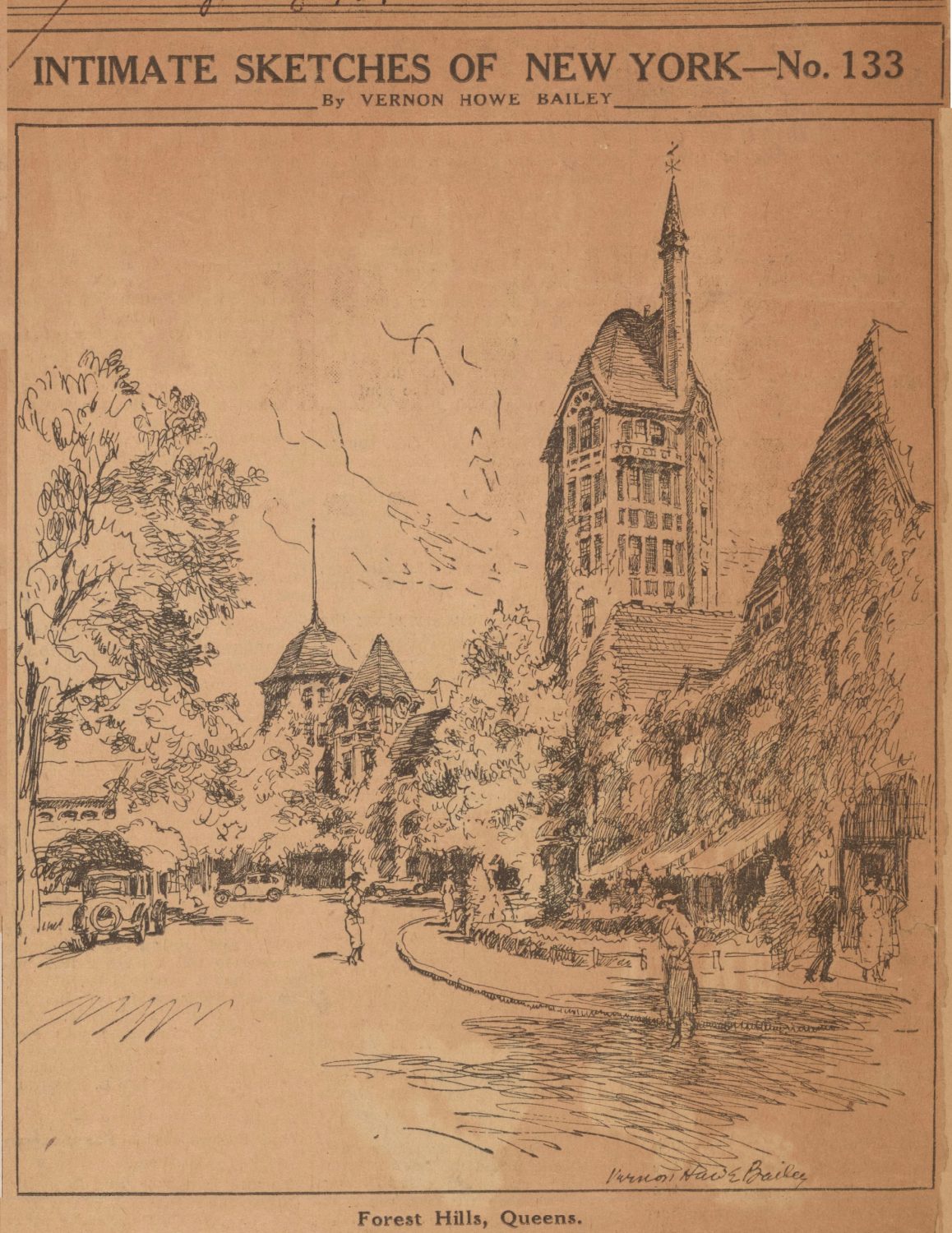
Forest Hills Inn Station Square illustration by Vernon Howe Bailey August 1st, 1934.
Publisher Charles Scribner’s Sons, which brought the works of highly influential authors to fruition, published 122 of his illustrations in a 1935 book that spontaneously lived up to its title, “Magical City: Intimate Sketches of New York.” These subjects and numerous others sparked the interest of museumgoers. His artistic works in the 10 inches by 8 nches book, graced by a striking Jazz Age style skyscraper cover, were narrated by Arthur Bartlett Maurice, a notable litterateur, student of New York highways, and a critic. The book was signed to William Thompson Dewart, president of The Sun and a New Yorker devoted to the welfare and beauty of his city. Among the illustrations were Central Synagogue, Metropolitan Museum Entrance Hall, Queensboro Bridge and General Electric Tower, Colonnade Row, Madison Square, Columbus Circle, Spuyten Duyvil, Fifth Avenue south of 54th Street, Saint Paul’s Chapel, The Colony Club, The Plaza, Rockefeller Center, Sherman Square, MacDougal Alley from MacDougal Street, U.S. Custom House, Pennsylvania R.R. Station interior, Columbia University Boathouse, Church of Saint Jean Baptiste, 14th Street Theatre, The Billopp House; Staten Island, The Players, Fifth Avenue north from the Hotel Gotham roof, No. 100 Bedford Street, Coenties Slip, and The Empire Theatre.
Bailey’s imprint upon culture and the art world is revitalized through the voice of scholars and critics. The front flap pinpointed how New York had two magics. An excerpt read, “One is daring, brilliant, sky-piercing, dominating in its sweep and mass. It is the new magic. The other is modest, retiring, a little grimy and down-at-heel, perhaps hiding its distinctive charm and beauty in out of the way corners, or in the shadow of some manifestation of the newer necromancy. That is the magic of old New York.” It then references Bailey as better than any man alive, who knew how to catch these elusive spirits, transferring both magics to the paper. “He has caught the buildings and vistas of New York in their most exciting moods, and has shown what real beauty lies in the structures that so many thousands pass every day with hardly a glance.”
“Photographers have shown many startling aspects of New York’s tall buildings, but from the pencil of Vernon Howe Bailey, conceded to be the leader in the field of architectural drawing, come many pictures which prove that Manhattan’s skyscrapers are among the most interestingly beautiful to be found anywhere,” wrote Seymour Marks for his “Pens and Margins” column in reference to “Magical City” for The Nassau Daily Review, published on May 20, 1935. “For one who can appreciate excellence of architectural detail and for one who can enjoy beautiful effects of white, black and halftones, this book should prove a treasure. But one need have no cultivated artistic tastes, nor any technical knowledge of architecture to benefit from it. For the person who does not know New York, it is as good a pictorial guidebook as any I have seen, and for the man nurtured in the shadows of the metropolis’ own big buildings, here are presented aspects of his home city which he certainly cannot get by the casual observations of everyday contact.”
In 1928, “Skyscrapers of New York” was another popular book by Vernon Howe Bailey. It featured an introduction by Cass Gilbert, who was among the first celebrity architects known for New York City skyscrapers such as the Woolworth Building and Cincinnati skyscrapers, as well as Washington D.C.’s United States Supreme Court building. The introduction stated, “The changing skyline of New York is one of the marvels of a marvelous age. An epoch that has produced the submarine boat and the airplane, the telegraph, the telephone and the radio in rapid succession; developed electric light and power, forged steel by machinery, spanned rivers and valleys with bridges and viaducts of unprecedented size, joined the Mediterranean to the Red Sea and the Atlantic Ocean to the Pacific, has explored the Arctic and the Antarctic to the uttermost ends of the earth, is indeed a marvelous age. The skyscraper is a creation unique to this epoch. In its aspiring lines, we hold the very symbol of a bold, adventurous people; restless, eager, and confident in their strength and power.” Among his featured illustrations were The Bush Tower, The Woolworth and Transportation Buildings, Fred F. French Building and Delmonico Building from Fifth Avenue and 46th Street, The Hotel Warwick, American Radiator Company Building, Park Avenue and The Ritz Tower, southward from Central Park including The Savoy-Plaza Hotel, The Sherry-Netherland, and the Crown Building.
Bailey was recognized for his series of firsts besides his unique talent. For the Summit, New Jersey-based publication, The Summit Herald and Summit Record in May 1936, Francis S. Swales praised Bailey for his vivid, spirited style that distinguishes his work, capturing the eye of architects, draftsmen, and students. “He is an illustrator, schooled to represent that which he sees and to do so in the simplest and most direct manner. He was the first illustrator that I can recall who chose to make his final sketches for publication, or exhibition, in the medium of soft lead pencil. Up to that time the pencil sketch had been regarded by most as suitable only for preliminary studying, and the final sketch was made in ink, wash and color.” He stayed in Hotel Suburban in Summit to focus on depictions of Northern New Jersey. That was preceded by his Westchester series.
Bailey and his power of the pencil and the brush would take him to unique settings. No environment seemed to be too distant. In 1930, he produced art alongside Schenectady plant General Electric Company workmen. The May 6 edition of the Schenectady Gazette read, “In the midst of great masses of metal castings, surrounded by mighty machines that shape these castings for their places in powerful turbines, beneath 100-ton cranes that roll overhead with their loads while above all is heard is the roar, the tapping, the hammering, the screech and the hum of industry, there sits an artist before his easel. With the calm serenity which comes from love of the job in hand, he is perpetuating in color his impressions of the men at work on machines that will lessen the work of man.”