Preserving The Legacy of Architect Leo Stillman
Views: 0
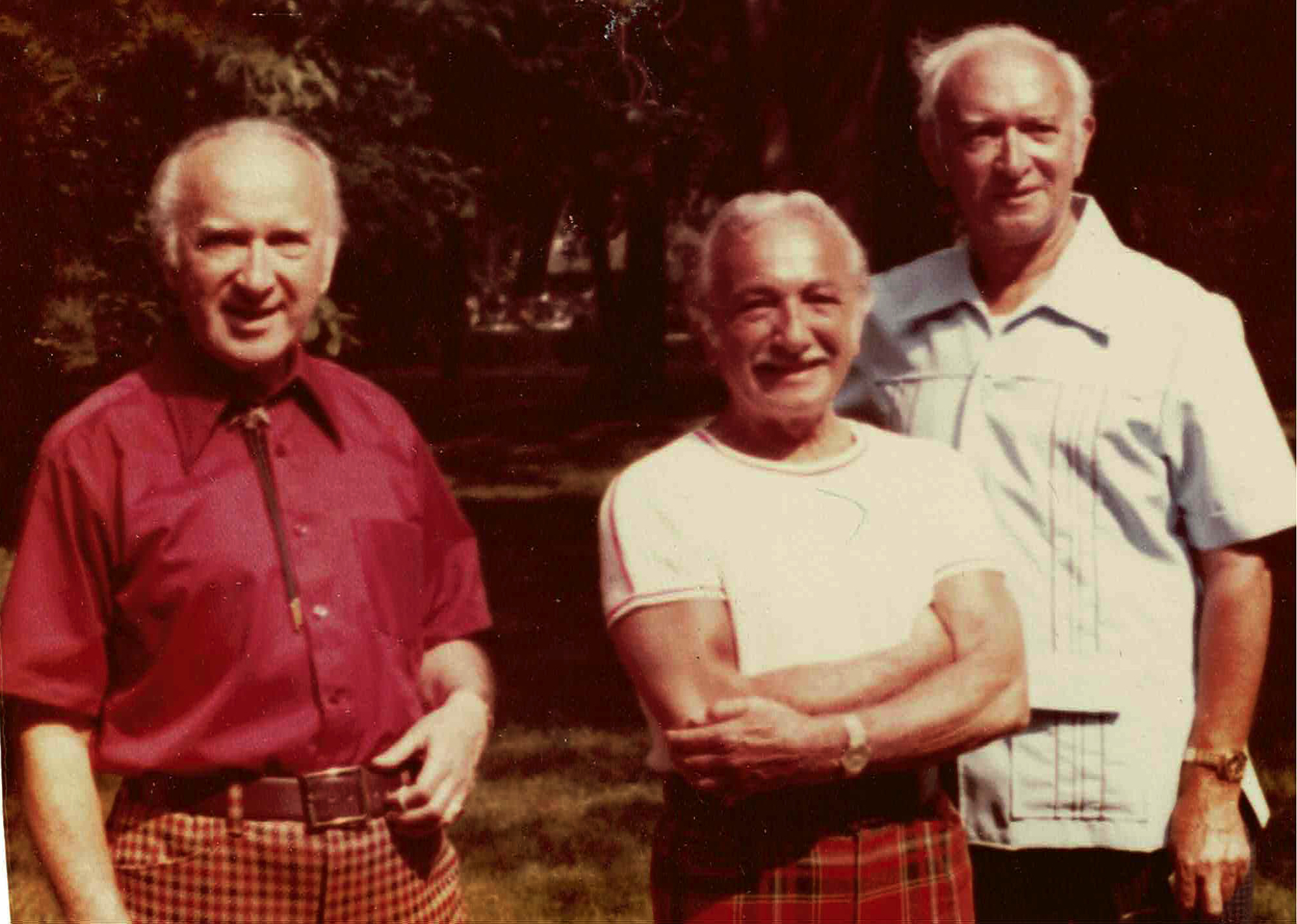
Brothers Robert Stillman, Edward Stillman, & Leo Stillman circa 1970s.
By Michael Perlman
Most desirable communities are home to historically distinctive properties that become landmarks in the eyes of the majority. Some properties established a new standard locally and citywide, which is the case of Walden Terrace, an architecturally and culturally significant post-WWII residential model of urban planning, overlooking 98th Street, 63rd Drive, 99th Street, 64th Avenue, and 64th Road in Rego Park. While gazing upon its sleek International-style façades and communal space on a lush landscape, a spirit unfolds based on its sense of place. That inspires current generations of local residents to delve deeper into the stories that bear harmony with the footsteps of earlier generations, and rediscover the architect behind the foundation of a creative and close-knit ambiance.
After conducting a genealogical search, this columnist became acquainted with Manalapan, New Jersey resident Andrea Lercher-Chomko, the granddaughter of prestigious architect Leo Stillman, as part of an initiative to further commemorate his legacy, preserve significant properties, and shine a collective light upon influential architects and builders who placed Forest Hills and Rego Park on the map. That inspired her to become further engaged with her grandfather’s memorabilia in the form of historic building photos and family portraits, as well as travel to explore Walden Terrace for the first time.
“I’ve always wanted to see the buildings that my grandfather designed, but never got the chance until March, when I took the ride to Queens to see Walden Terrace,” said Andrea. “I was taken aback at how emotional I felt when I got there. I walked up and down every road between the buildings, taking pictures and tearing up. I stopped this one man to tell him that my grandfather designed this building. He got so excited. He told me that he was the superintendent at another apartment building in the area, and his friend lives in one of the apartments and they are beautiful, and that people enjoy living there to this day.”
This twelve-building garden-style apartment complex at eight stories was designed for families with a middle income in 1948 by Leo Stillman. The AIA Guide To New York City, initially published in 1968, deemed Walden Terrace a highlight. It is also featured in the Historic District Council’s “Six To Celebrate 2020” publication, “A Guide To Historic New York City Neighborhoods – Rego Park.” He was acclaimed for his Art Deco projects of the 1930s, followed by his innovative use of poured concrete in apartment building development in the 1940s.
In the vicinity, he also designed The Forester at 99-21 67th Road in 1947 and The Delano at 99-15 66th Avenue in 1954, which are classic examples of Mid-Century Modernism, contrasting with earlier local styles such as Tudor and Georgian Colonial. Distinctive facades featured curved brick posts with triangular stone motifs supporting abstract light poles, recessed areas, streamlined railings, and entry surrounds and parapet detail with square motifs, bearing synergy with the eras’ automobiles.
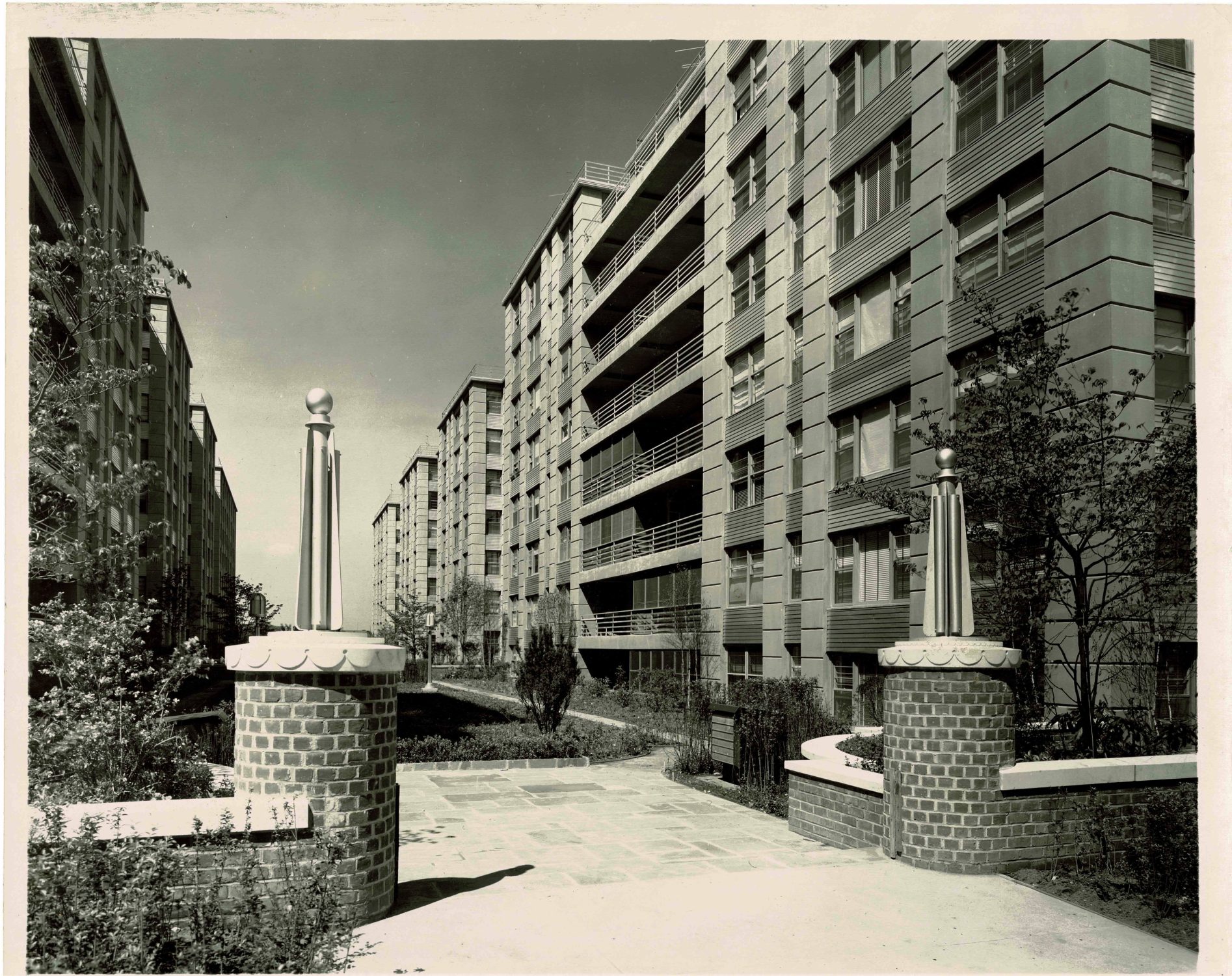
Walden Terrace central garden & playground.
Building names were regal, tranquil, historical, and civic-minded. Leo Stillman, spread his glory citywide, and was especially noted for dropped living rooms and six-story apartment houses situated in clusters overlooking a courtyard, such as Park Terrace Gardens in Manhattan and Oxford Knolls in the Bronx. An outstanding example of his work in the Renaissance Revival style with elaborate polychrome terra-cotta details is the landmarked 825 Gerard Avenue, erected in 1928. Stillman’s works can be found in the Grand Concourse Historic District. Other notable projects include Fountain Garden Apartments at 4499 Henry Hudson Parkway, the Colonial column-adorned 350 East 54th Street in Manhattan, the Art Deco style 675 Academy Street in Manhattan, The Boswell; an Art Moderne residence at 84-10 34th Avenue in Jackson Heights, a Mid-Century Modern gem with a portico, terraces, and corner windows known as The Presidential at 601 Kappock Street in Riverdale (twin of The Bonnie Crest at 629 Kappock Street), and The Barclay at 144 East 84th Street, a signature example of a modern high-rise that defined luxurious living in 1960s Upper East Side.
Leo Stillman was born on December 21, 1903 to Joseph Stillman (1860 – 1931) and Bessie Silverman (born 1862). He was the youngest of 12 siblings, consisting of four sisters and eight brothers. He immigrated to America at age three in 1906 from Stabtzer, a Jewish community in the Russian Empire of Minsk Governorate, also known as Steibtz in Yiddish. Today it is part of Belarus. Raised in the Bronx, he is believed to have resided around Prospect Avenue. He lived on Gerard Avenue by Yankee Stadium with Andrea Chomko’s grandmother and their daughter. He later relocated to New Rochelle, New York and then Hollywood, Florida around 1972, and passed away on October 18, 1989.
In 1928, Leo married Frances Brown-Stillman, who was born on January 4, 1902 and passed away on June 17, 1943. Then he married Beatrice Cooper-Stillman around 1945, and she passed away in 1984.
Leo was very much a scholar in his pursuits. He graduated from public school in January 1918 upon turning 14, and his diploma referenced that he earned the approbation of the principal and teachers, and was entitled admission to any high school in the City of New York. From 1918 to 1920, he attended Morris High School in the Bronx, and graduated with straight A’s. He continued his studies at the Vocational School for Boys, where he was admitted in November 1920 on a transfer. His field of study was architectural drawing, and was a high achiever in courses including woodworking shop, English, history, civics, and industrial geography, trade mathematics, health education, applied science, and physical training and hygiene. He studied at the College of the City of New York between 1924 and 1926 under the Division of Vocational Subjects and Civic Administration and the Department of Construction, Engineering and Design. In the mid-1920s, he attended the Beaux-Arts Institute of Design.
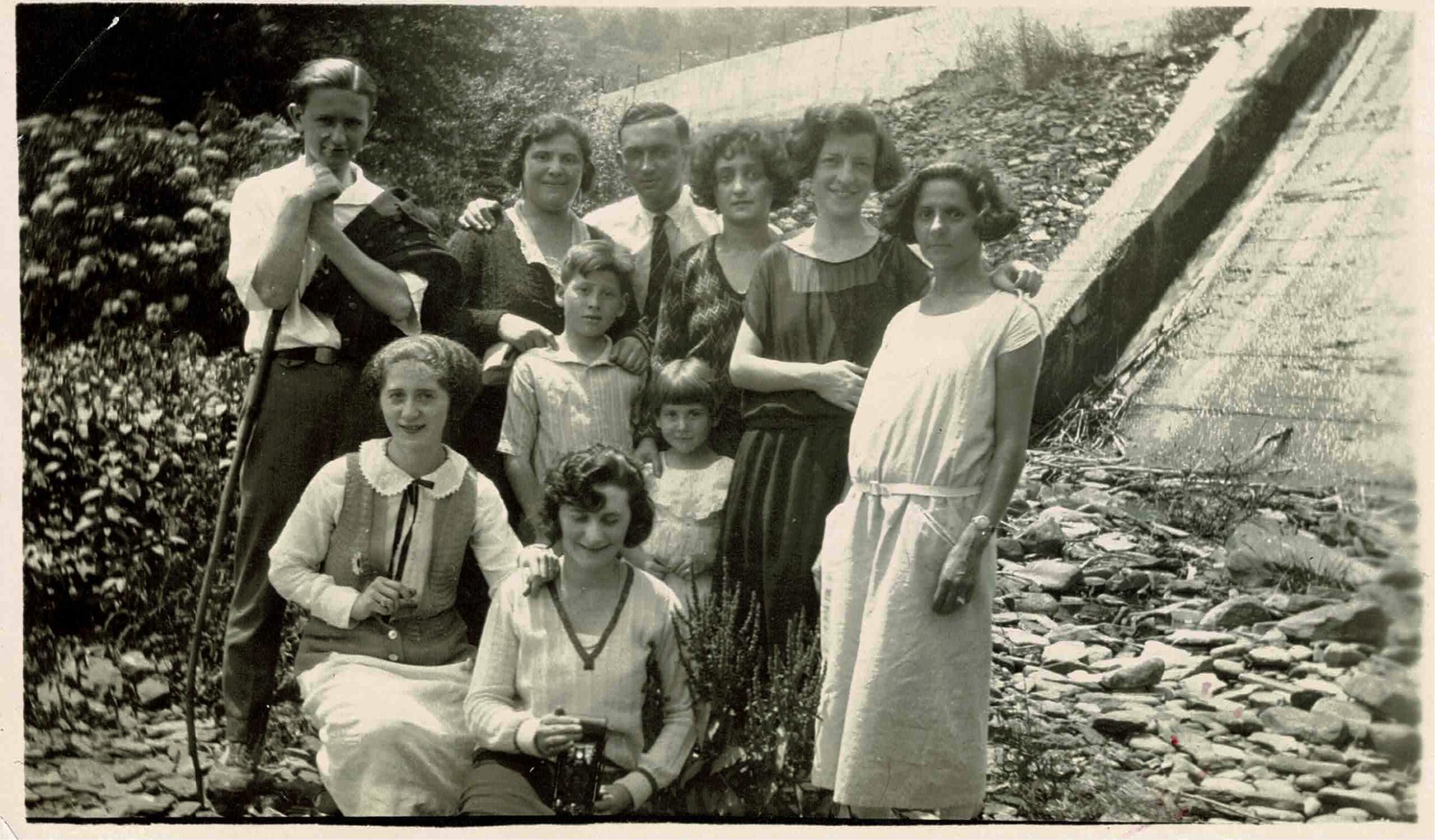
Leo Stillman in back row, center & his family including his siblings.
Leo Stillman and Frances Brown-Stillman had a child, Carol Stillman-Lercher (1928 – 2013), who married the late Edward Lercher (born 1926). The couple’s grandchildren are the late Frederick Alan Lercher (born 1955) and Andrea (born 1957). Frederick’s son is Daniel (born 1988), and Andrea’s children are Elizabeth Chomko (born 1984) and Sarah Chomko (born 1986). Andrea was raised in Glen Cove, New York.
Walden Terrace, a co-op with rental opportunities, features 880 apartments situated in rows, where most overlook a central garden and playground with curved corner posts accessible from the street. This superb example of mid-century urban planning was deemed a novelty. The facades are an elegant example of sleek lines displayed in horizontal and vertical bands. Streamlined terraces and Art Deco planters alongside granite entry surrounds draw distinction. The central section of a percentage of picture windows once featured striking glass blocks, and the lobbies once elevated residents’ spirits with European palatial murals, which may await rediscovery.
Walden Terrace was advertised for its dropped living rooms with room-sized railed dining galleries, all rooms off large foyers, large streamlined balconies, parquet floors, poured reinforced concrete to achieve fireproof construction, cross-ventilation, as well as being 20 minutes from Radio City on the Independent Subway. The buildings consist of 2 to 5 rooms and garages, and were also advertised for their free gas, electricity, and master TV. Rents ranged from $85 to $175. Accessibility to the finest shops, schools, and places of worship was another draw.
Among its early residents were actor, comedian, composer, and saxophonist Sid Caesar (1922 – 2014), born Isaac Sidney Caesar. As of 1949, he resided at 98-10 64th Avenue, and could be spotted shopping along Queens Boulevard in the 1950s. He was Coach Calhoun in “GREASE.” Another notable resident was actress Ina Balin (1937 – 1990), who won a Golden Globe for “From the Terrace” starring Paul Newman. At 98-34 63rd Drive, it was the childhood home of TV, film, stage, and voice Hank Azaria (born 1964), who is best known as the voice behind Moe Szyslak on “The Simpsons.”
A significant percentage of the tenants were WWII veterans, according to a June 27, 1948 New York Times article. Based on 440 heads of families queried as to how they earned a living, 77 owned a business, 332 were engaged in various kinds of business activity, and 31 were professional men in the legal, accounting, and engineering fields.
On January 11, 1948, The New York Times stated, “In planning the buildings, Leo Stillman, architect, and Victor Mayper, engineer, used these large window areas not only for utilitarian qualities, but also to blend in with aluminum spandrels and the balconies in an unusual architectural décor against the façade background of limestone-finished concrete.” Walden Terrace was developed by the Nipark Realty Corporation, where David Rose served as president. He was an active investment builder since 1922 and erected over 5,000 apartments in Queens, Manhattan, the Bronx, and Connecticut. An ad from the same date read, “New 8-story fireproof buildings…Forerunner of a new trend in apartment design.”
A WWII-developed technique of fastening to concrete was utilized. No structural steel, including I-beams, angle irons, or girders was needed, resulting in a reservation of time and costs, according to the builder. He praised the rapidly poured concrete, partitions with large units of gypsum blocks and sheets of gypsum lath and sound insulation, factory assembled metal door frames and on-site machinery that fostered highly efficient structural work.
Walden Terrace photos were featured in a New York Times ad on April 10, 1949 titled “Such stuff as dreams are made on… a bold new architectural concept.” It listed numerous collaborators which resulted in a superb achievement, including concrete construction by Moccia Construction Corp, masonry by Sam Ralph, painting and decorating by Metro Decorating Co, ornamental iron by L.K. Iron Works, and aluminum spandrels and balcony rails by Reynolds Metal Company. An excerpt read, “Now Walden Terrace is an actuality. Not long ago it was a thick batch of architectural drawings and engineering data… the builder’s concept expressed on paper… developed by Leo Stillman, the architect, Victor Mayper, the engineer, Moreno & Robinson, the landscape architects, and Mark Rafalsky & Co, the renting agents, with imagination and with skill… with bold creativeness and enormous technical mastery.” It later referenced, “a dramatic and daring architectural achievement that will influence design and construction for long decades to come!”
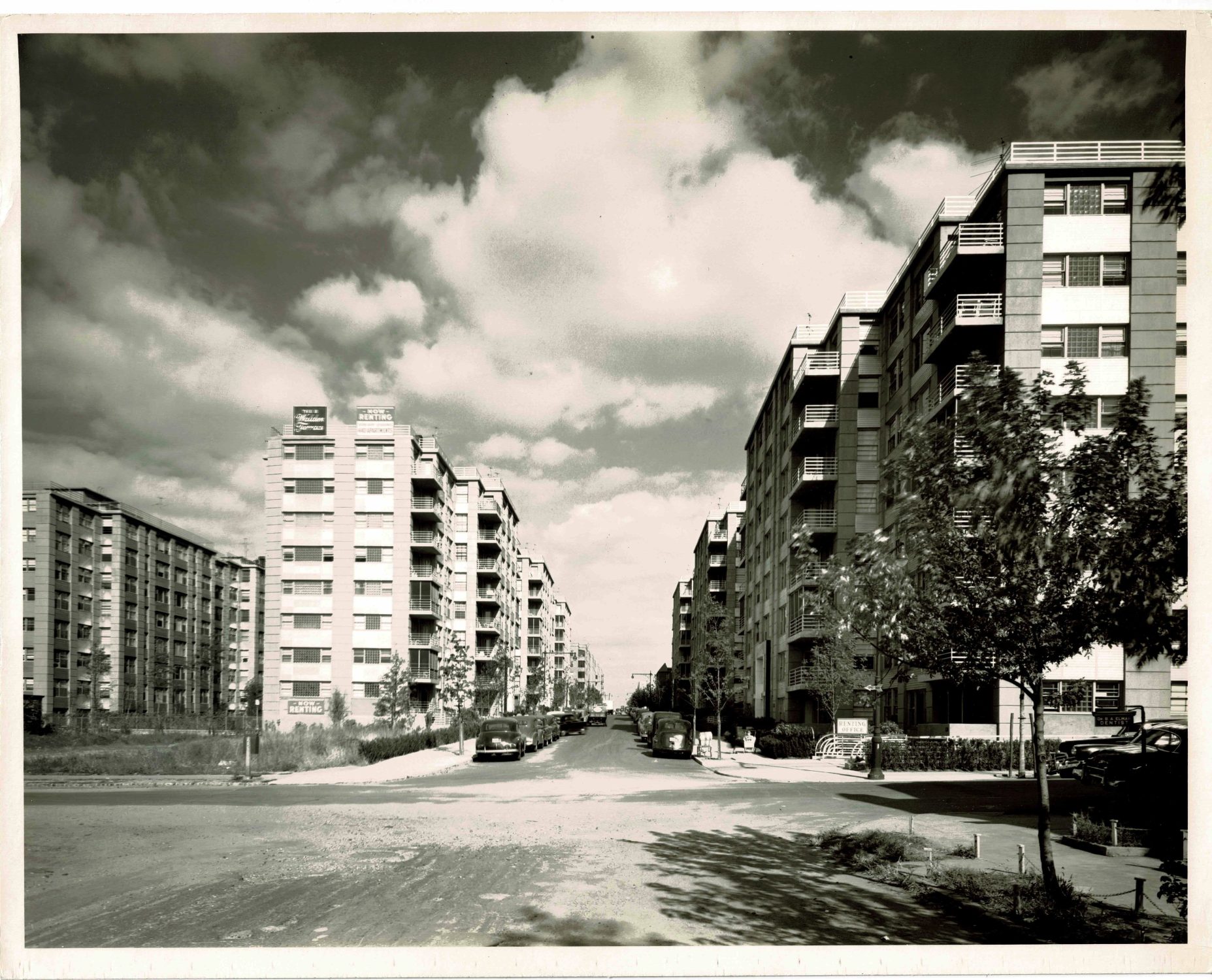
Walden Terrace, Photo courtesy of Andrea Chomko.
Leo Stillman encountered challenges, but with his brave demeanor, persevered, such as when New York City construction shifted to Military and infrastructure projects during WWII. “Around 1943, my grandfather went to St. Louis, Missouri to learn how to design helicopters with the intention that my mother and grandmother would move to St. Louis. He was in the middle of finding an apartment when my grandmother unexpectedly passed away. My mother was only 14 years old at the time. My grandfather came back to New York City as a widower. I know this was devastating to my mother and grandfather. I cannot imagine that changing course like that was an easy decision, but his work continued to thrive despite his tragic loss. Now that I am a mother and grandmother, these are the questions that I would have liked to ask him.”
As generations progress, some history is forgotten, and therefore the power lies in the hands of current generations to become preservation stewards, or historians to embark upon urban exploration. Sometimes the pieces of the puzzle come together when one least expects it. After browsing historic photos and prospectuses of Walden Terrace and learning more about his achievements, including being an architectural forerunner, Andrea Chomko said, “I feel very proud to see all of my grandfather’s accomplishments, but I wish that I had been old enough to ask him questions about his younger self.” When he retired in 1969, she was 12. “I would have liked to ask him questions about what it was like growing up with 11 siblings, immigrating to the U.S., details about being an architect, and where he found inspiration. Truth be told, since he retired when I was so young, I never really had the chance to discuss his projects with him. However, knowing that he was a forerunner of his time, fills me with extreme pride. Being asked to participate in this article has given me the opportunity to take a deep dive back into my grandfather’s accomplishments, and I find it fascinating.”
In a humorous manner, she said, “A quick Google search of his name, and it states, ‘Leo Stillman… was a prominent Russian-born, New York City architect… he was highly prolific.’ Wow! I never thought of him like that. To me, he was just my grandfather!”
He was the recipient of numerous accolades, complementary to his ingenuity and beaming heart as a people’s person. Andrea’s collection includes a certificate which reads, “The Society of Fellows Anti-Defamation League Appeal designates Leo Stillman, 1981, as an Associate Fellow in recognition of generous support in helping to translate democratic ideals into a way of life for all Americans.” An illustration of an open book set in front of a development reads, “Inscribed in The Book of Builders; Leo Stillman; With deep appreciation for your outstanding service and cooperation to the Bronx Chapter of Hadassah; To help build The Hadassah Hebrew University Medical Center in Jerusalem ~ for the advancement of the medical sciences, and the promotion of healing, teaching and research for the benefit of all the people of Israel…”
An ornate Certificate of Service references the Talmud: “Whosoever preserves a life, it is as though he had preserved a full universe.” It read, “Awarded to Leo Stillman who moved by a profound and inspiring sense of responsibility towards the destitute victims of Nazism and by the urgency of the cause of Jewish survival overseas, enlisted and served in the battalions of mercy as a volunteer worker for the 1946 Life and Death campaign of the United Jewish Appeal of Greater New York. His selfless devotion helped the agencies of the United Jewish Appeal to lift European Jewry from despair, to give them new hope for a secure and dignified future, to transport them to havens of refuge in Palestine, in America and elsewhere, and to serve the welfare of their liberators, the men and women in the American Armed Forces.”
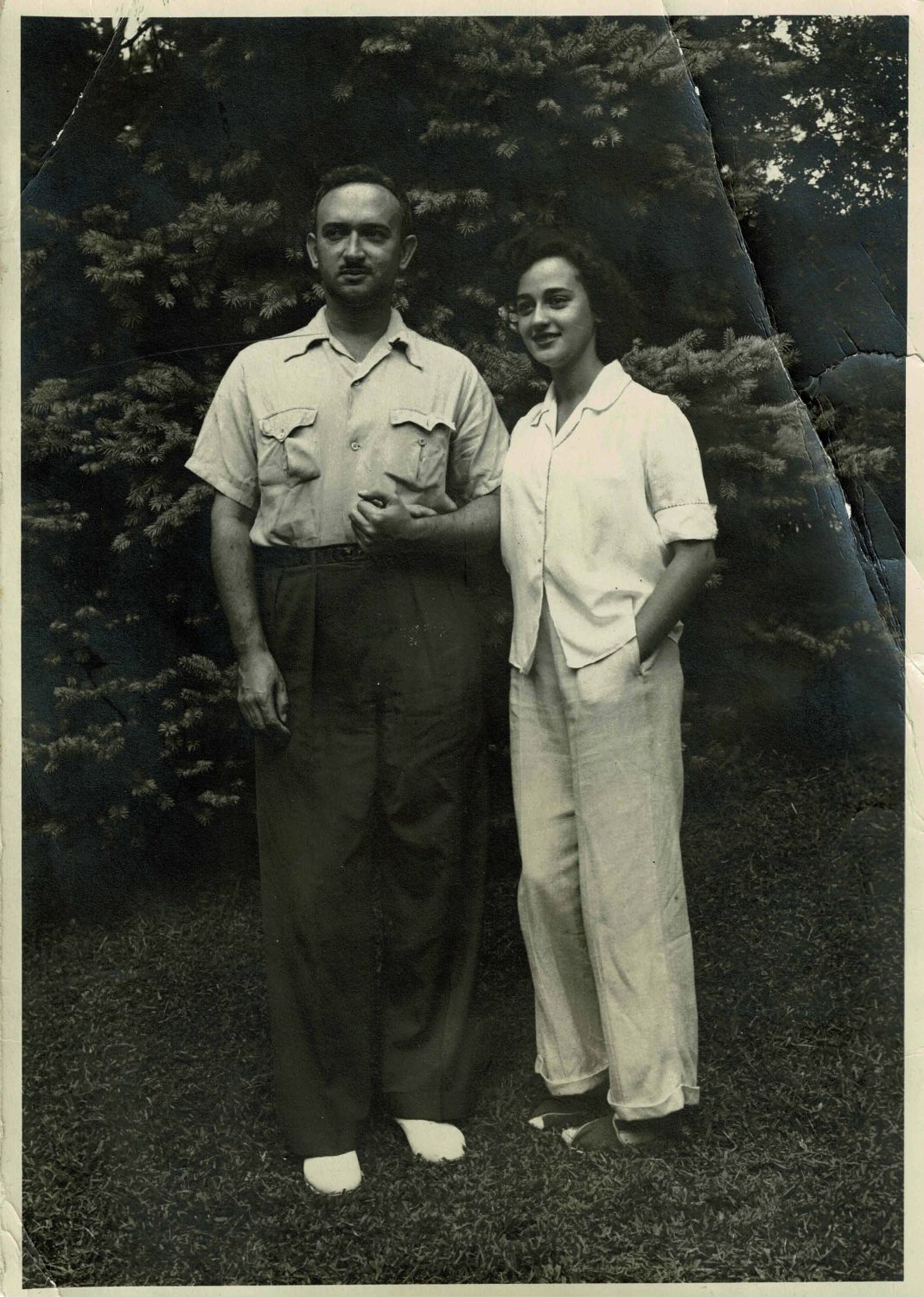
Leo Stillman around age 40 with his daughter Carol Stillman around age 15 in Larchmont, NY, Summer 1943.
Leo leaves an imprint upon current generations in regard to talents and personality traits alongside inspiration. Andrea explained, “My grandfather was a loving and caring person who loved my mother Carol, my grandmother Frances, my brother Fred and I, and all of his great-grandchildren. My cousin on Frances’ side, who knew him well in his younger years, described him as very handsome, dapper, always well-dressed, and always very kind to everyone.” Referencing personality traits, she and her children are very artistic and creative. “I have a BA in Fine Arts and my youngest daughter has minored in Fine Arts in college. My eldest daughter teaches history and enjoys teaching about architecture, and is also very artistic and creative. Even my grandchildren seem to have inherited the same traits, as they both enjoy arts and history, even at such young ages. In addition, my nephew is the spitting image of my grandfather. I look forward to teaching my grandchildren about the accomplishments of their great-great-grandfather as well.”
Andrea has much to be grateful for. “I always say, without a doubt, I am most grateful for the ones that I love. My mother taught me a lesson that she learned from her parents, which is ‘people, not things’ matter above all, and that is how I try to live my life. Although I was not blessed to meet my Grandmother Frances, my mother brought her to life for me. I felt I knew her. I know Leo loved her. My mom described her as a sweet, gentle, caring, and adventurous spirit. She and her friends hitchhiked across the U.S. to California when she was young, and then later to Washington D.C. to wish Woodrow Wilson a Merry Christmas. She documented all of this in her journal that I was able to read.” Once again referencing how WWII influenced Leo’s plan to move to St. Louis for work and her grandmother’s untimely passing, she said, “My grandfather and mother ended up staying in New York, where he continued his work until retirement. Perhaps if they had moved, maybe I would not be here or my life would be very different.”