Newcombe Square, Restored: Paying Tribute To The Honorable Richard S. Newcombe
Views: 15
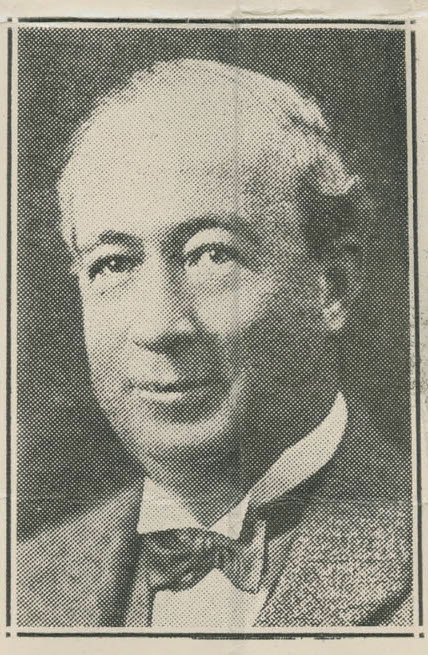
Richard S. Newcombe, circa mid-1920s.
By Michael Perlman
Chairman, Rego-Forest Preservation Council
Amidst the hustle and bustle of Queens Boulevard is the long-forgotten and neglected Newcombe Square, bordering Forest Hills and Kew Gardens. At 0.04 acres, this small but historic triangular pocket park between vehicle and bike lanes, is bounded by 80th Road (Quentin Street), Kew Gardens Road, and Union Turnpike. It was named in the late 1930s as a memorial for Richard Saville Newcombe (1880 – 1930), a lawyer who was also acclaimed as a leader that headed the Boy Scouts Sustaining Association of Queens, Commissioner of Public Works of Queens County from 1916 to 1918 under Borough President Maurice E. Connolly, a District Attorney elected in 1923 and reelected in 1926, and a Surrogate of Queens County. He resided in a Forest Hills Gardens stone Tudor rowhouse at 78 Greenway Terrace, which stands proudly. His death was untimely on May 7, 1930 at age 49.
Last week, a Newcombe Square photo by Richmond Hill resident and community advocate Paul Trust was uploaded to this columnist’s Facebook group, Forest Hills, Rego Park, Kew Gardens – “Our Communities.”
“It makes me feel depressed, especially considering it’s so close to Queens Borough Hall and the courthouse. It should be a shining example of a pocket part,” he said.
Members and passersby learned that Richard S. Newcombe was a Renaissance man with a huge heart for civic matters, but nearly everyone was unfamiliar with his influence upon New York City. They feel that the commemorative park is not respected, and merits a historically-sensitive restoration through parkgoer input, and by forming a public-private partnership with the Parks Department. Through Rego-Forest Preservation Council, this columnist began visualizing its future by conducting a site assessment and outreach.
A circa 1926 poster featured endorsements from Queens lawyers, judges, and the press, and referenced him as “A Real District Attorney” and urged keeping him in office. A Long Island Press endorsement on August 28, 1924 read, “District Attorney Newcombe has a broad conception of the duties and responsibilities of his office. His idea is not merely to punish violators of the law, but to exert every possible effort to prevent the violation being committed.” From the Bench, Supreme Court Justice William B. Carswell stated, “The administration of criminal law in Queens under District Attorney Newcombe is characterized by vigor, intelligence and discretion.”
New York City native Newcombe studied at Phillips-Andover Academy in Massachusetts and New York Law School, where he graduated in 1900 with a degree in legal education. After being admitted to the Bar within a year, he joined Otis & Pressinger, which was eventually followed by his work under Pressinger, Newcombe & Wigg, and he would pursue work on the Bench as of January 1, 1930. Through his private practice, his expertise lied in corporation and real estate law. He wed Rosena Reis in 1905 at St. Stephen’s Episcopal Church in New York City.
As a District Attorney, he prosecuted over 7,000 cases. As a case in point in 1927, he led the prosecution of Henry Judd Gray and Ruth Brown Snyder for the murder of Motor Boating magazine art editor Albert Snyder, her husband.
“Year Book 1930” by the New York County Lawyers’ Association featured a memorial by colleague Elmer Ellsworth Wigg, who wrote, “In 1929, he was the Democratic candidate for Surrogate of Queens County, and was elected to that important office by the largest vote ever given to a local official in Queens.” He was also remembered as a civic-minded member of numerous organizations, such as Pomonok, Seaview and Kew Gardens Country Clubs, Tuscacora Fishing Club of Arena, New York, the New York County Lawyers’ Association, New York Athletic Club, American Bar Association, and a member of the Masons and the order of the landmarked Elks Lodge No. 878 in Elmhurst. Additionally, he was a Flushing Bank director, and a Boulevard Bank organizer and director at 108-01 Queens Boulevard.
In recognition of his leadership in scouting among community service, the Boy Scout Camp on Long Pond in Suffolk County became known as “Camp Newcombe” in 1929, and would close in 1966. The memorial by Wigg left off with “His chief interest in life was his fellow man, and endowed with a rare sympathy and capacity for human friendship, he enjoyed the confidence and respect of his legion of friends and clients to an extent not granted to many.”
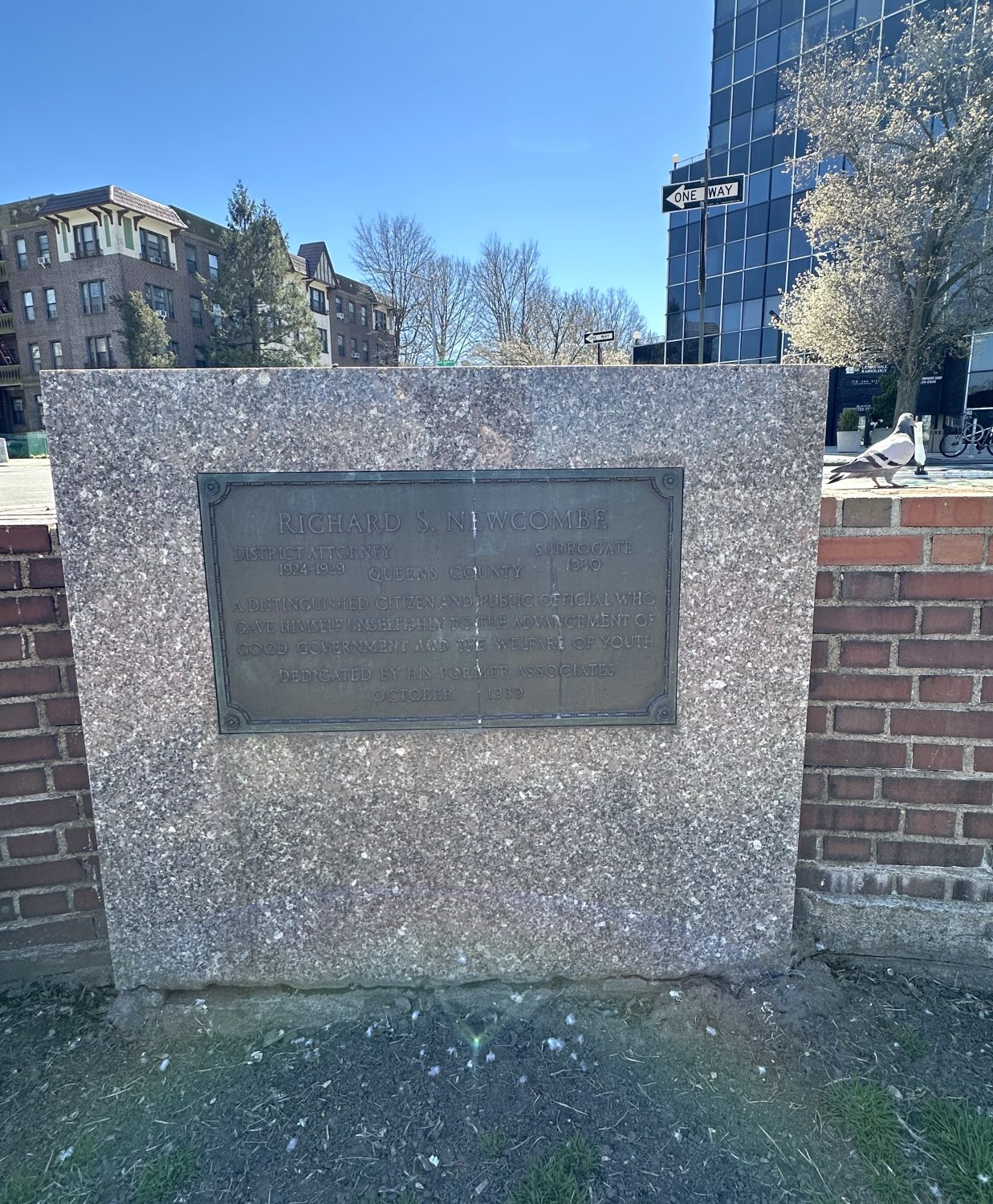
Bronze plaque honoring Richard S. Newcombe, dedicated 1939.
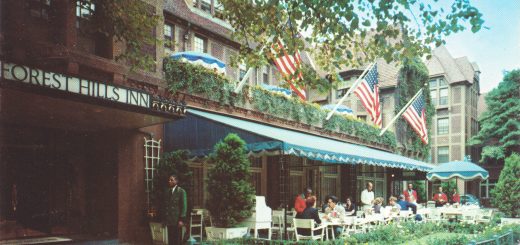
Today, the easternmost side of Newcombe Square continues to feature a bronze memorial plaque mounted to a granite slab, although it was not polished in decades. It is in the center of a horseshoe brick wall that currently has loose and mismatched bricks. This is situated in front of a semicircular brick pavement, which once featured two backless traditional stone benches, where a visitor would sit and reflect. The bearings for the benches are evident, in addition to a small beige circle in the center of the brick circle, which is believed to have accommodated an American flag. All evergreen bushes that surrounded the wall have vanished, and the lawn is largely bald. Walking westward, the park features a sign with an inaccurate historic summary, which is oddly turned in the opposite direction of the walkway that was believed to have been unpaved early on. The sign’s reverse is blank. A few remaining small trees are on a lawn that comes to an abrupt halt, where random patches of asphalt and cement were tossed. The park once offered additional charm in conjunction with the stately Kew Gardens Inn that formed its backdrop.
The traditional style plaque states, “Richard S. Newcombe, District Attorney 1924 – 1929, Surrogate 1930; Queens County. A distinguished citizen and public official who gave himself unselfishly to the advancement of good government and the welfare of youth. Dedicated by his former associates, October 1939.”
On May 10, 1935, five years after Newcombe’s passing, a commendable community initiative led by his friends was underway. The Long Island Daily Press informed readers that Forest Hills Station Plaza, the property’s former name, may be renamed Newcombe Square. It read, “At the annual dinner held in his memory last night at the Old Country Club, Flushing, William Zippel was appointed to confer on renaming the plaza. The entire prosecutor’s staff under Newcombe attended the dinner. Alfred Newcombe, brother of the Judge, Dr. John H. O’Connor, his brother-in-law, and Moses Symington, Masonic leader, were present as guests. District Attorney Charles P. Sullivan was toastmaster, and James A. Dayton, chief assistant under Newcombe, was chairman of the arrangements committee.”
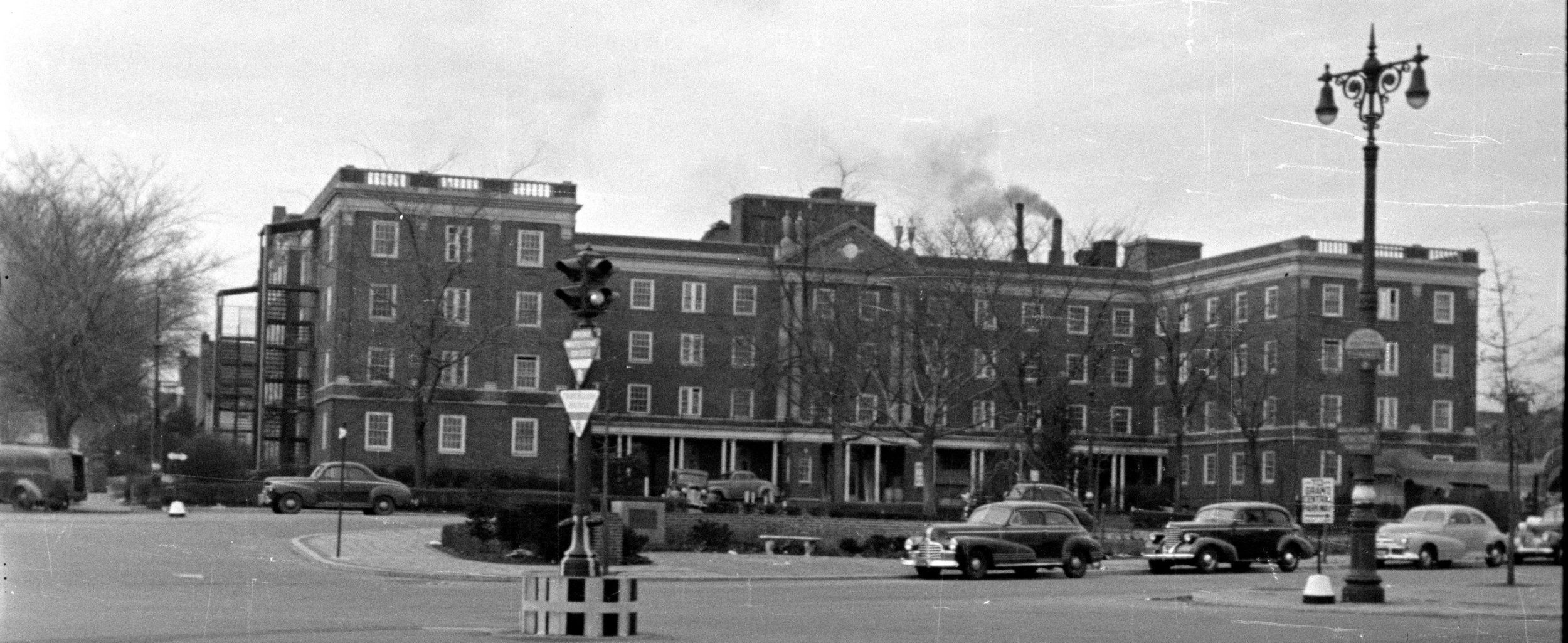
Newcombe Square in 1939 with Kew Gardens Inn in the background.
On October 16, 1936, The Richmond Hill Record reported, “City Court Justice Peter M. Daly, chairman of a committee which was formed to find a means of perpetuating Mr. Newcombe’s memory, suggested the site to Park Commissioner Robert Moses, who replied that it was ‘probably one of the most prominent places in Queens.’” Then in December 1936, the Board of Alderman adopted a resolution, which was sponsored by Alderman James A. Burke of Hollis. The upcoming step was Mayor Fiorello Henry La Guardia’s signature. The commemoration of Newcombe would continue when it was announced in January 1937 by North Shore Daily Journal that the Municipal Subway at Kew Gardens would be officially named “Newcombe Square-Kew Gardens,” if plans from former associates and friends, presented at a Pomonok Country Club dinner, were approved by city authorities and the Transit Commission. That would soon materialize.
Traditions remained strong, as indicated in the May 21, 1937 edition of The Richmond Hill Record, which read, “While he was District Attorney of Queens, Mr. Newcombe always entertained his staff on his birthday, and since his death, his associates have met on the same date each year.” Former assistants held their annual gathering with a Pomonok Country Club golf tournament in the afternoon and a clubhouse dinner.
On May 12, 1938, a sign designating “Richard S. Newcombe Square” was erected on Queens Boulevard and Grand Central Parkway. This was among the signs the Parks Department displayed. Parks Commissioner Robert Moses and Borough President George Harvey suggested the plot. William Robinson served as president of the Newcombe Boys, consisting of former associates, and sat alongside his predecessor, James A. Dayton at the annual dinner. The memorial’s committee sponsors included Supreme Court Justices Froessel and Daly, Thomas F. Thornton, Moses Symington, James F. Conroy, David M. Wolff, and William Dippel.
On November 17, 1939, the bronze tablet was unveiled by grand-nephew Richard Newcombe Billings in Newcombe Square, where Boy Scouts aided by pulling the covering. The ceremony was opened by Chief Assistant District Attorney James A. Dayton, who once served under Newcombe, and he discussed the esteem he was remembered by. On November 23, The Leader-Observer also referenced speaker Supreme Court Justice Charles W. Froessel as speaking in a serious vein of “the influence Judge Newcombe’s association had left on his fellow workers in the District Attorney’s office; of his kindly and sympathetic understanding; of his efforts on behalf of every good project in the Borough of Queens; of his generosity in giving not only of his talents, but frequently beyond in a financial way.” His Boy Scout leadership was also highlighted. Approximately 100 former associates attended the ceremony, which was followed by a Kew Gardens Inn luncheon, where Justice Peter M. Daly presided. Speakers included Borough President Harvey, Board of Transportation Commissioner Francis X. Sullivan, Councilman James Burke and former Alderman Joseph Mafera.
The Record referenced the Newcombe club’s success on July 21, 1938, since a month prior, the subway honored his legacy by renaming the station. An “Off The Record” editorial stated, “We like the idea of commemorating the people who help build a community. Somehow, with its new name, the subway station seems more than just a pretty pile of steel and tile.” The commemorative signage has since vanished. At the 15th annual dinner in May 1939, Justice Froessel announced that Newcombe Square would be enlarged to twice its size, and the Boy Scouts were planning the erection of a flagpole. In 1940, the Newcombe Boys began work to create a Newcombe bust and erect it on site, but that is also not visible nowadays. All of these forgotten features merit a rebirth.
Restoration and beautification supporters of Newcombe Square span several neighborhoods. Paul Trust, whose current civic engagements include the QueensLink, Neighborhood Advisory Board, and Richmond Hill Block Association. He also fought against the School Construction Authority for additional green space at his child’s Jackson Heights elementary school. “I wonder if a ‘Friends of Newcombe Square’ could be established. Regarding funding, there could be a GoFundMe, and you can contact Community Board 9 and local lawmakers. There are so many businesses on Lefferts Boulevard and Queens Boulevard, that I imagine some would be interested in funding a restoration. Perhaps a plaque could be placed on the property with their name.”
Trust already sees its rebirth. “The part that’s concrete could become an expanded lawn. I would love to see some shrubs and native trees, and the bricks restored and cleaned. I would love to see benches, and perhaps even a chess table or two. Parks are extremely important, and I love history, so integrate historical aspects wherever possible. Park design is a great way to enhance its impact.”
After viewing Paul Trust’s photo, Forest Hills resident Sonia Wong came forward, expressing interest in volunteering. As a garden designer with a passion for helping urban ecosystems thrive, she founded “Butterfly Grove Gardens.” She also draws from her experience with the Forest Hills Community Garden to transport some of their raised garden beds to Commonpoint’s food pantry. “Current conditions of Newcombe Square make me feel sad after learning about who it was named after. It should be better taken care of to respect the life and achievements of Richard S. Newcombe,” said Wong. “I would love to contribute my experience as a gardener to help restore Newcombe Square. Perhaps fundraising events can be hosted.
Embracing the historic preservation ethic, Wong explained, “It is quite important, since not only does it give a neighborhood unique character, but there are always important stories to learn from the past and see how it connects to the present.”
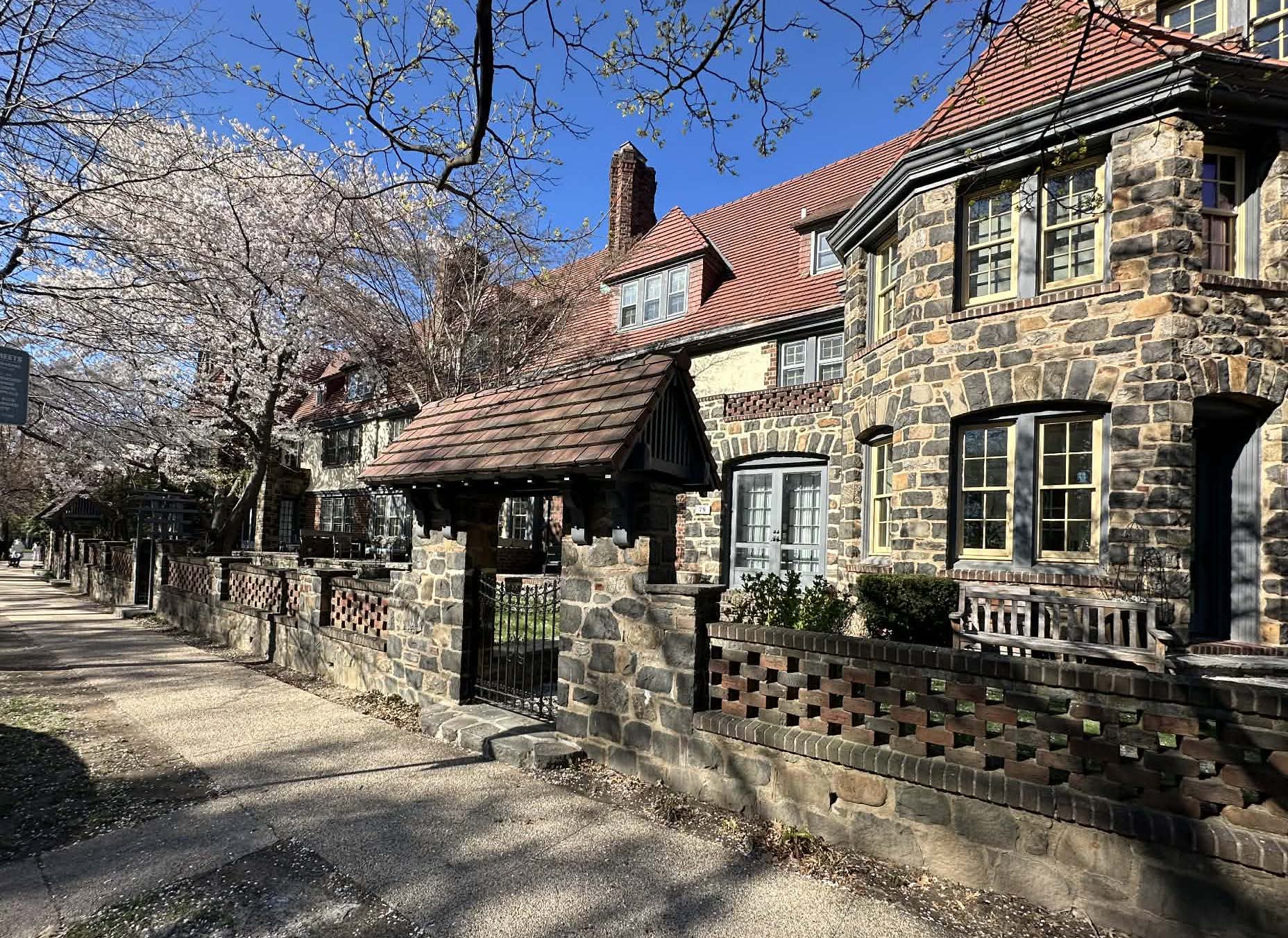
Richard S. Newcombe’s former home at 78 Greenway Terrace.
Rego Park resident Jennifer Verdon has been actively pursuing proposals to increase usable green space in Forest Hills and Rego Park and conducts outreach to NYC Parks, Community Board 6, and elected officials. She visualizes teamwork between the Parks Department, Partnerships For Parks, and residents. “Improvements could potentially be addressed through city maintenance, small capital allocations, and community stewardship. Broader policy discussions around funding public spaces, such as those raised by the Center for an Urban Future, may also provide longer-term context for how neighborhood green spaces are supported,” said Verdon.
“Understanding Newcombe Square as a small memorial space, I would focus on restoring and elevating what is already there, said Verdon, who recommended polishing the bronze plaque, reinstalling the American flag, reintroducing the “Richard S. Newcombe Station” sign, refreshing the brickwork and seating area, and improving plantings with simple, well-maintained greenery and seasonal flowers. “The goal would be to return the space to a condition that is respectful of its purpose. A well-maintained landscape can bear a strong impact, especially in a high-visibility location.”
Verdon reflected upon the loss of Parkside Memorial Chapel, which she praised for its strong architectural identity. “Such experiences highlight how quickly pieces of a neighborhood’s character can disappear, and because of that, I think it’s important to preserve what remains, and ensure that spaces continue to reflect the history they were meant to honor.”
Drawing upon her beekeeper role at Forest Hills’ Compost Collective, local resident Justine Mastanduno cannot emphasize enough the need for native plants in community gardens among greenspaces. “Everyone wants a manicured lawn and ornamental flowers from other parts of the world, but this doesn’t support life right here. Insects and birds are dying, so Newcombe Square is a perfect opportunity to help the ecological cause.”
Richard S. Newcombe’s spirit may be watching over in pride. Jackson Heights resident Cristina Furlong, said, “Newcombe Square would be a great opportunity for an Eagle Scout project. When I read that Newcombe was a leader of the Boy Scouts, I felt it could be great to reach out to the district, as well as the Greater New York Council on scouting. My son is a scout who is looking for a nice civic project.” She recalled attending a fundraiser luncheon with her son’s scout troop. “A total of $900,000 was raised in one luncheon. It seems like Newcombe would do that kind of fundraiser himself.