Deltiology Treasures Revive Thanksgiving Traditions: Exploring Early 20th Century Works of Art
Views: 547
By Michael Perlman
Historians believe that the first Thanksgiving meal dates to 1621, where 53 Mayflower pilgrims and 90 Wampanoag Native Americans at Plymouth shared an autumn feast for three days. In 1873, the first American picture postcard was designed, and in the early 20th century, Thanksgiving traditions came alive through highly stylized, graceful, and sometimes humorous hand-colored lithograph postcards.
Today, a significant number of postcards of the late 19th and early to mid-20th century are collectible works of art that often exist in good to excellent condition. Some feature handwritten messages and one-cent and two-cent stamps. Deltiology is the collection and study of postcards, which is derived from “deltion,” a Greek term for a writing tablet or letter. Therefore, a postcard collector is known as a deltiologist. Several decades ago, postcards could be found at a corner pharmacy, but today they can be purchased at a postcard show, estate sale, and eBay. Amazingly, topics represent nearly every theme imaginable, capturing the history of hometowns and hobbies to holidays.
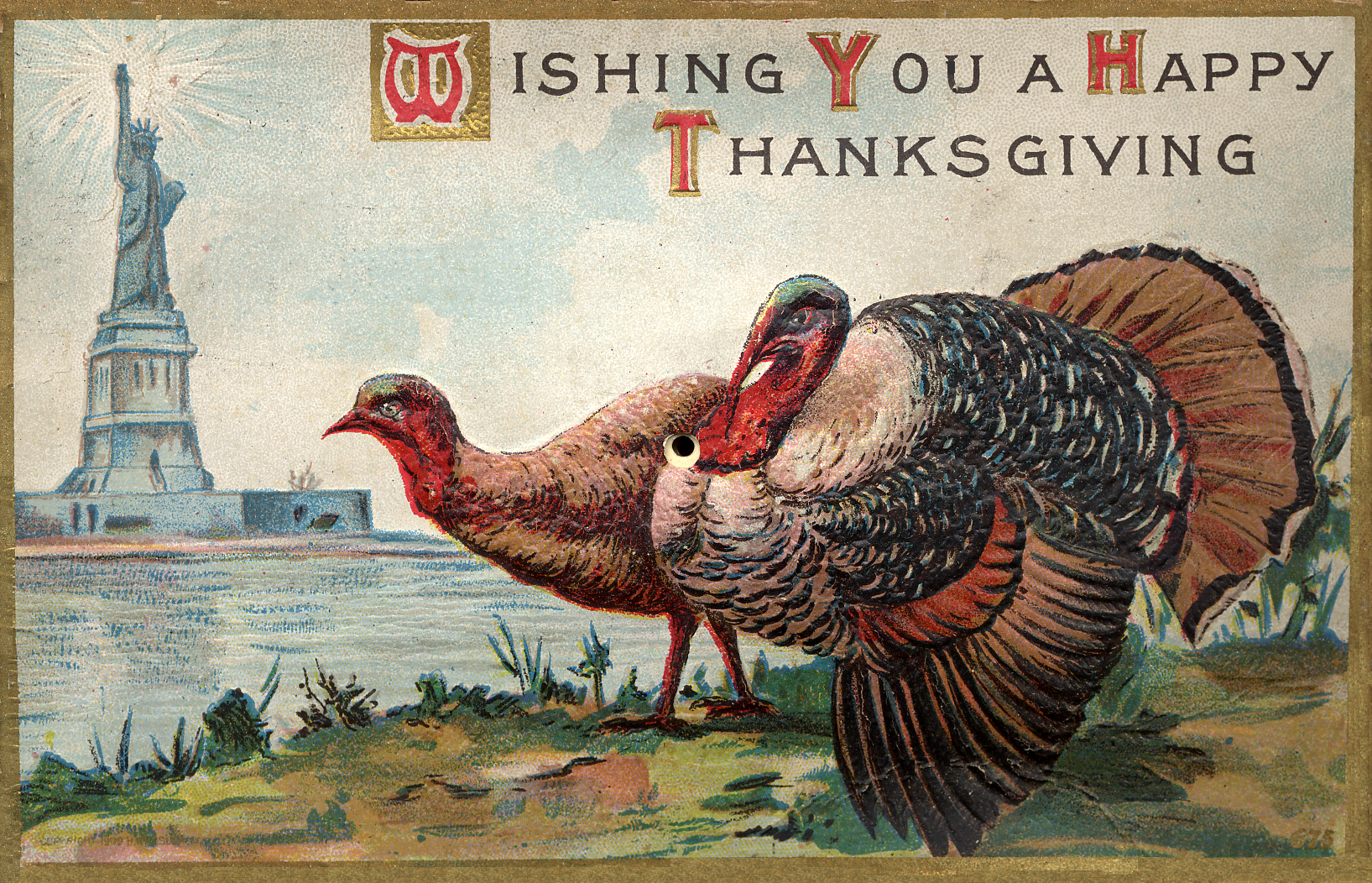
As a deltiologist, it is timely to explore the artistry and history associated with Thanksgiving postcards by pinpointing highlights. Mechanical postcards are most interactive and were cleverly engineered, which is why such postcards continue to operate approximately 120 years later. In one postcard, a collector lightly presses the stomach of one of two elaborately illustrated turkeys, and it produces a “gobble.” Steps away is the Hudson River with lustrous rays from the Statue of Liberty in the background. The application of color evokes the feeling of a watercolor painting.
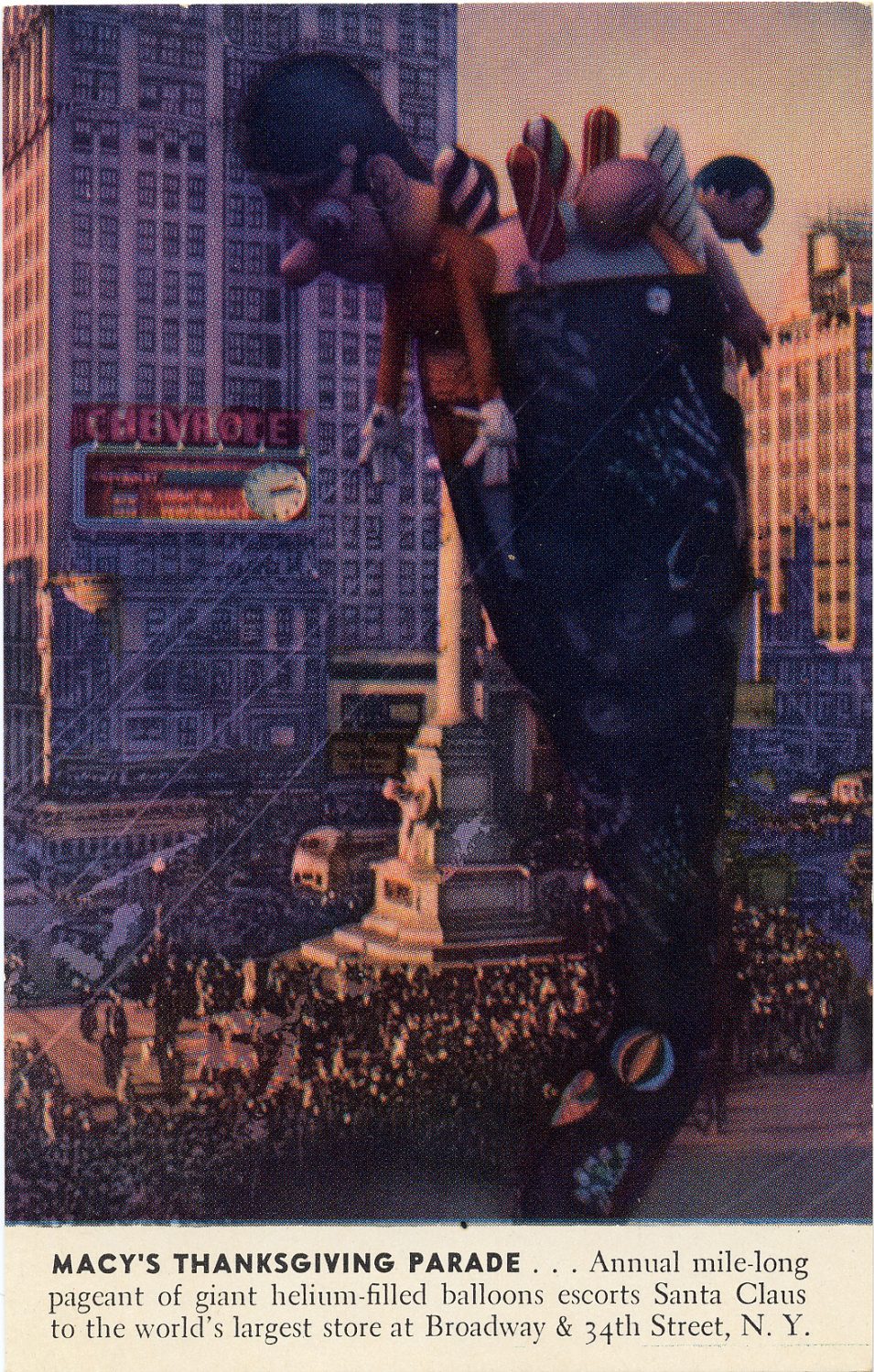
The “Macy Color Views of New York” postcard series captures the magic of the Macy’s Thanksgiving Day Parade as of 1939, a year that is more recent than nearly all Thanksgiving postcards. This chrome postcard features a toy soldier float making its way alongside the Columbus Monument. A caption reads, “Annual mile pageant of giant helium-filled balloons escorts Santa Claus to the world’s largest store at Broadway & 34th Street.” Since postcards are the catalyst for historic research, a viewer learns that the Macy’s Parade originated in 1924 and once featured animals from the Central Park Zoo. Then floats were introduced and would be released into the air with a return address. If one was fortunate enough to find it after the parade, they were a prizewinner.
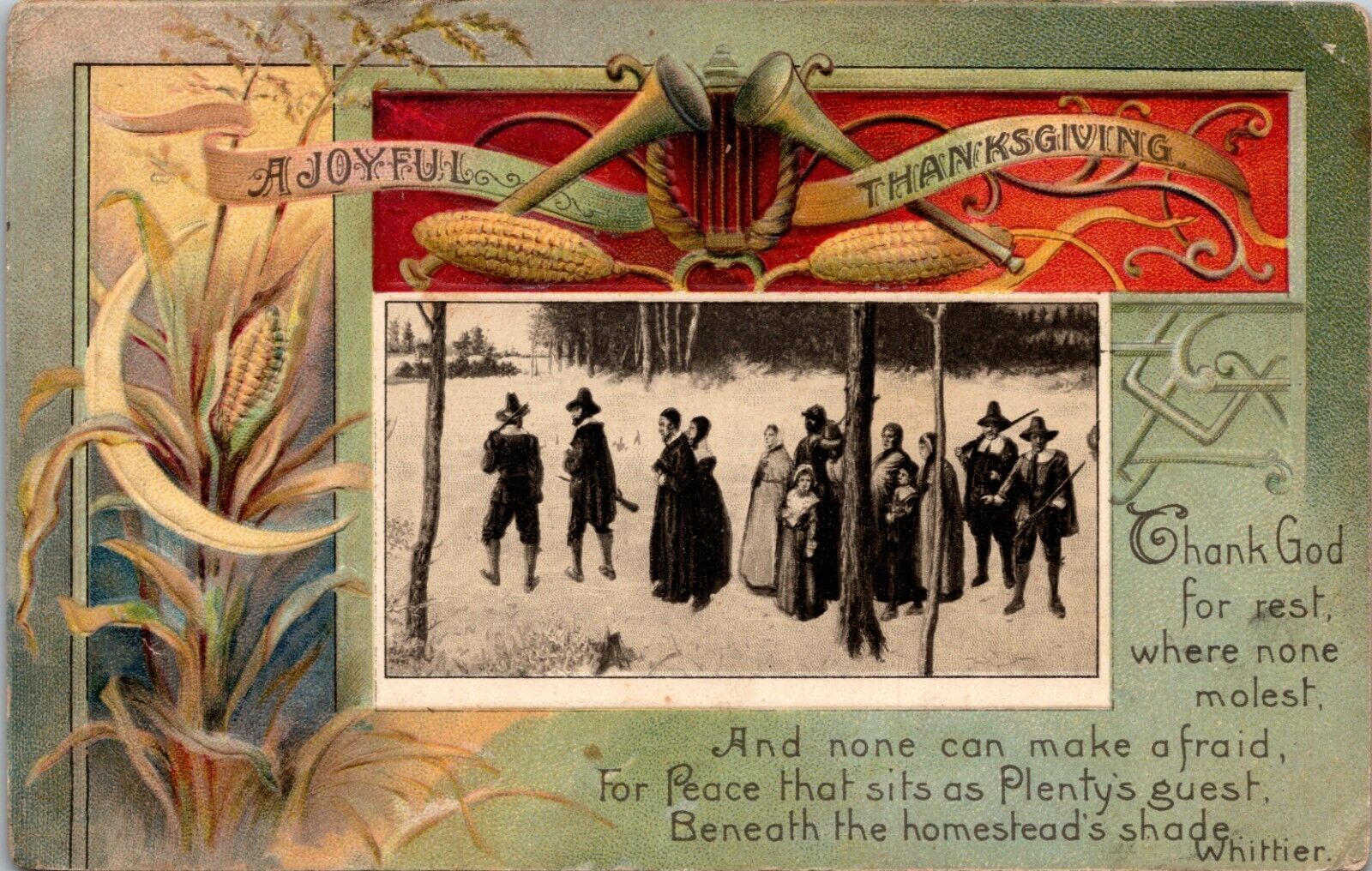
John Winsch (1865 – 1923) of Stapleton, New York was co-manager of Art Lithographic Publishing Company. He copyrighted his artist signed greeting cards, where many were published in sets, and produced approximately 4,000 designs between 1910 and 1915. He was acclaimed for his Thanksgiving and Halloween postcards. He also used European artists, who worked with his German printers. Winsch postcards sometimes evoke Edwardian romanticism.
Some of Winsch’s postcards feature poetry such as that of John Greenleaf Whittier (1807 – 1892). An excerpt from his work, “Peace Autumn,” reads: “Thank God for rest, where none molest, And none can make afraid, for Peace that sits as Plenty’s guest, Beneath the homestead’s shade.” He was noteworthy as an American Quaker poet, an advocate for abolishing slavery and a founder of “The Atlantic Monthly.” His friends included Mark Twain and Frederick Douglass. His poetry reflected rural life, religion and nature.
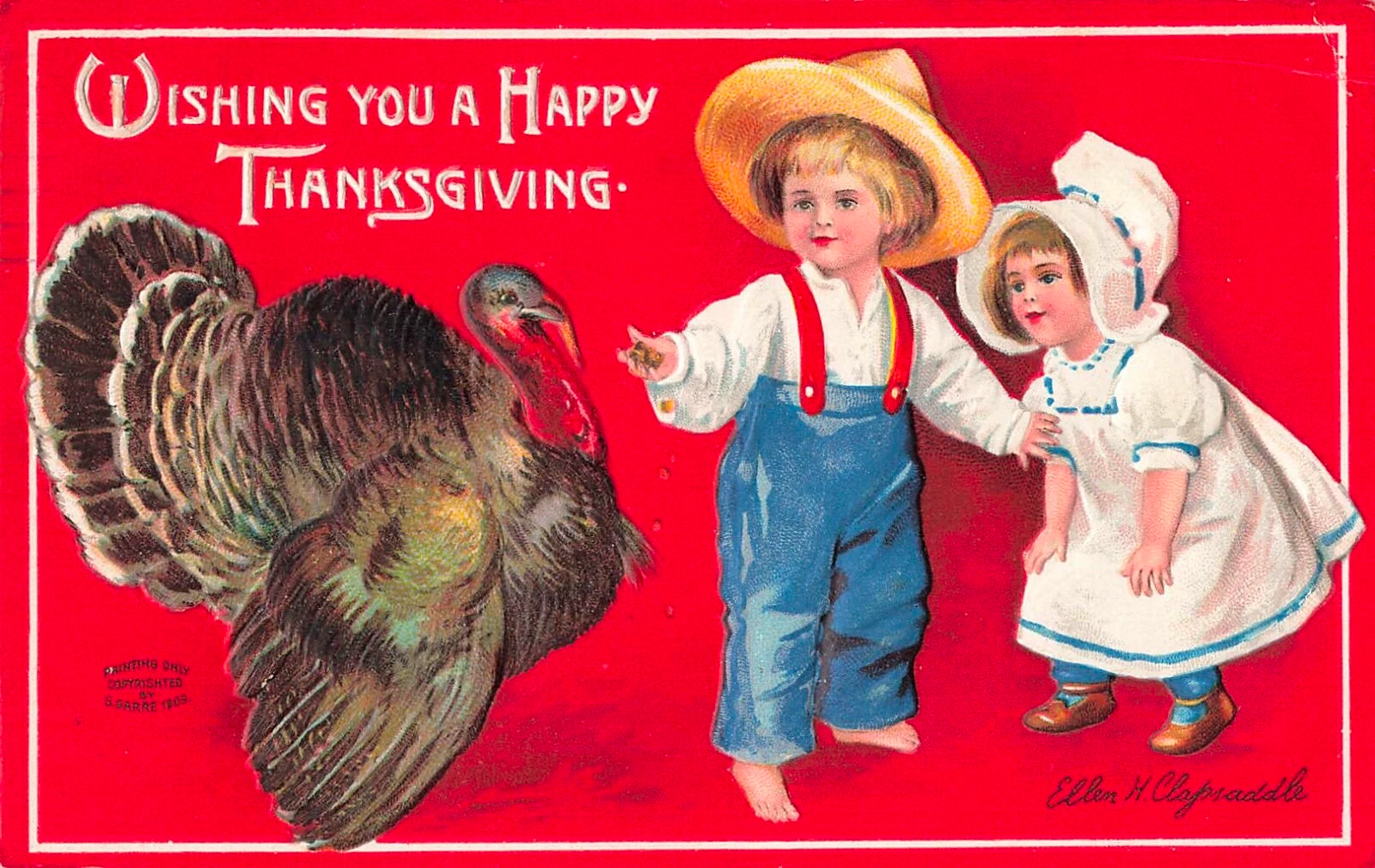
Born in South Columbia, New York, Ellen Hattie Clapsaddle (1865 – 1934) would be recognized as a significant illustrator and commercial artist, and is regarded as a most prolific postcard and greeting card artist of her era. One of her specialties was illustrations of children. She was the great-granddaughter of Major Dennis Clapsaddle, a Revolutionary War hero. During the golden age of souvenir postcards, spanning 1898 to 1915, artistic designs were highly prized, and she is credited with over 3,000 known designs. Her residences included Manhattan’s Prince George Hotel and 125 East 30th Street. She designed postcards for firms including International Art Publishing Company, Wolf Publishing Company, and Raphael Tuck & Sons. In one of her signed graceful and whimsical postcards, children in traditional attire are feeding a turkey. This card was printed in Germany and the painting only was copyrighted by artist Samuel Garre, commonly written as S. Garre, who was the manager of Art Lithographic Publishing Company, which once operated an office at 106 Duane Street. The Philadelphia-based Wolf & Co and S. Garre founded the International Art Publishing Company, Ltd, which operated at 3 and 5 Waverly Place.
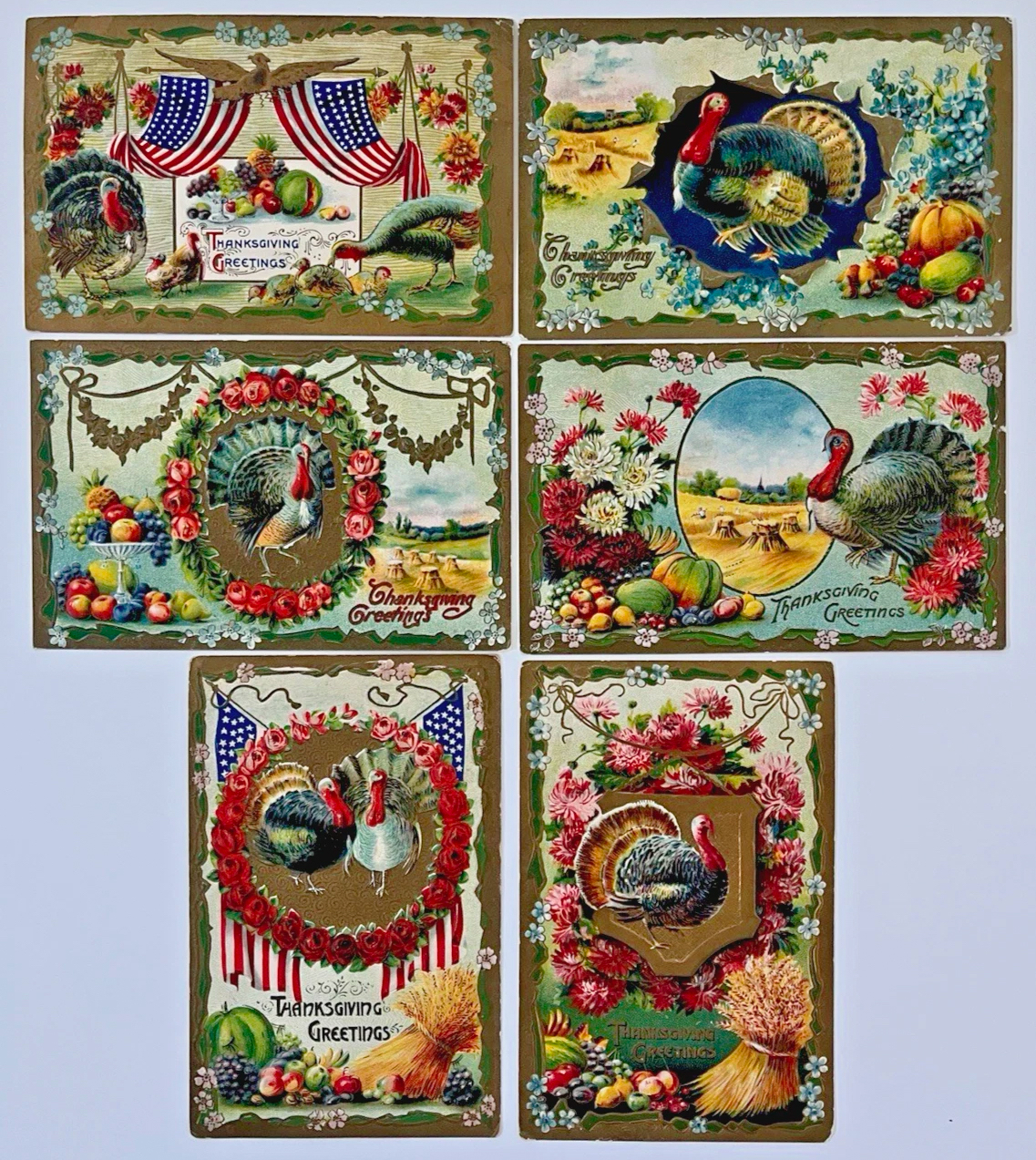
Among the most picturesque, prosperous, and colorful postcards featured a Victorian color scheme collage dominated by turkeys, fruits, flowers, tepees, and rare 47-star American flags and eagles, accompanied by intricate embossed gold leaf frames and calligraphy. These six postcards were printed in Germany and are part of a series published by (Benjamin) Gottschalk, (Julius) Dreyfuss & (Alfred) Davis Co. Ltd. This firm specialized in holiday and greeting postcards, illustrated booklets, calendars, sentiment cards, menu cards, dance programs, toy books, and Christmas cards, and is believed to have been active from 1904 until the early 1920s, with offices at 5 Bunhill Row in London, in Munich, and at 45 East 20th Street and 877 and 879 Broadway in Manhattan. An associate, Julius Dreyfuss, was born in Baden, Germany, and cultivated his talents in London. He founded the Dreyfuss Art Co, and became a greeting card industry pioneer.
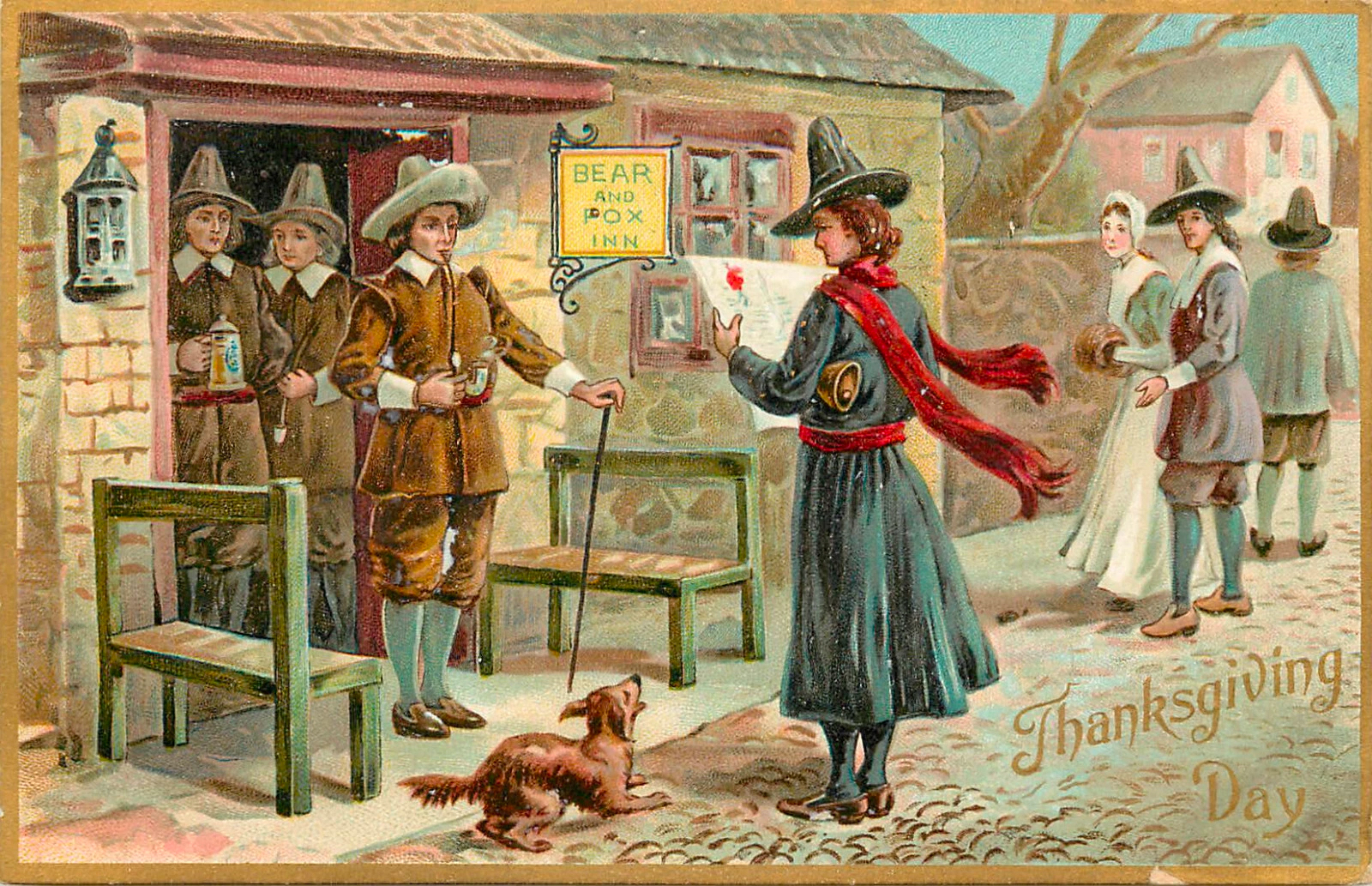
The glory of Thanksgiving Day is beautifully documented on a gold border postcard featuring pilgrims at the Bear and Fox Inn. A woman is reading a proclamation, and a dog expresses much curiosity, as bystanders are in the background. This card was produced by a most famous publisher, Raphael Tuck & Sons as part of the Thanksgiving Day Postcards Series (No. 161).
The firm was founded in London by Raphael Tuck (1821 – 1900) and operated from 1866 to 1959. Other locations included Paris, Berlin, Montreal, and 298 Broadway and 122 – 124 Fifth Avenue. In 1894, his son, Adolph Tuck, created their first picture postcard. This prominent publisher was considered “Art publishers to their majesties the king and queen,” as noted on the reverse of their postcards, since Queen Victoria granted them the Royal Warrant of Appointment in 1883. These postcards are among the most desirable by collectors.
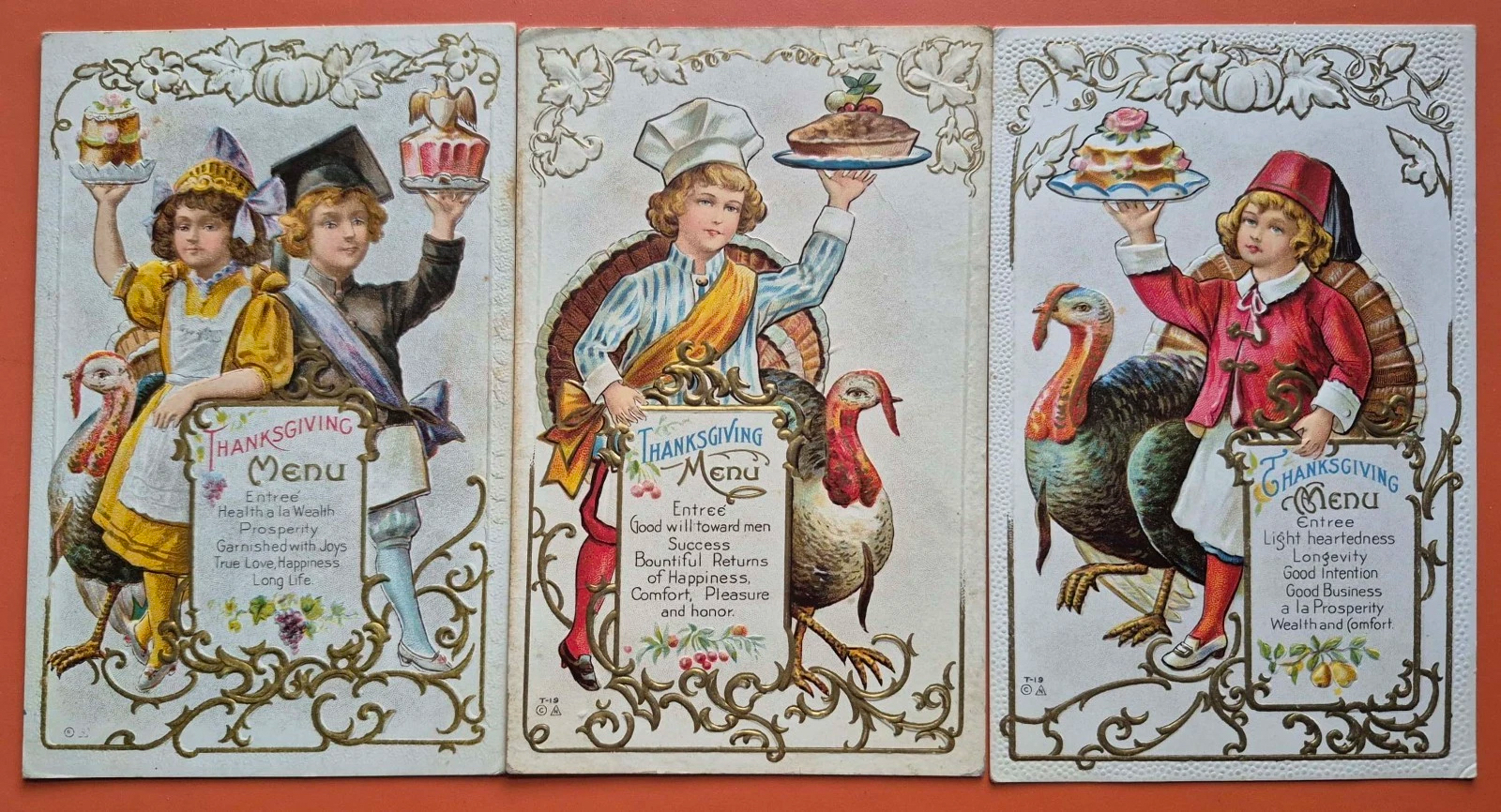
Sometimes a menu was brought to the recipient; not always presenting food, but a selection of blessings. Gilded Age style postcards that are embossed in a menu series feature pilgrim children holding up graceful desserts, while a turkey and vines with leaves and pumpkins offer much character. Each entrée menu features varying inspirational items. Grapes are depicted on a menu as a symbol of abundance and good fortune. This circa 1910 series was produced by New York publisher E. Nash, often prized for their holiday postcards, but much historical background remains a mystery.
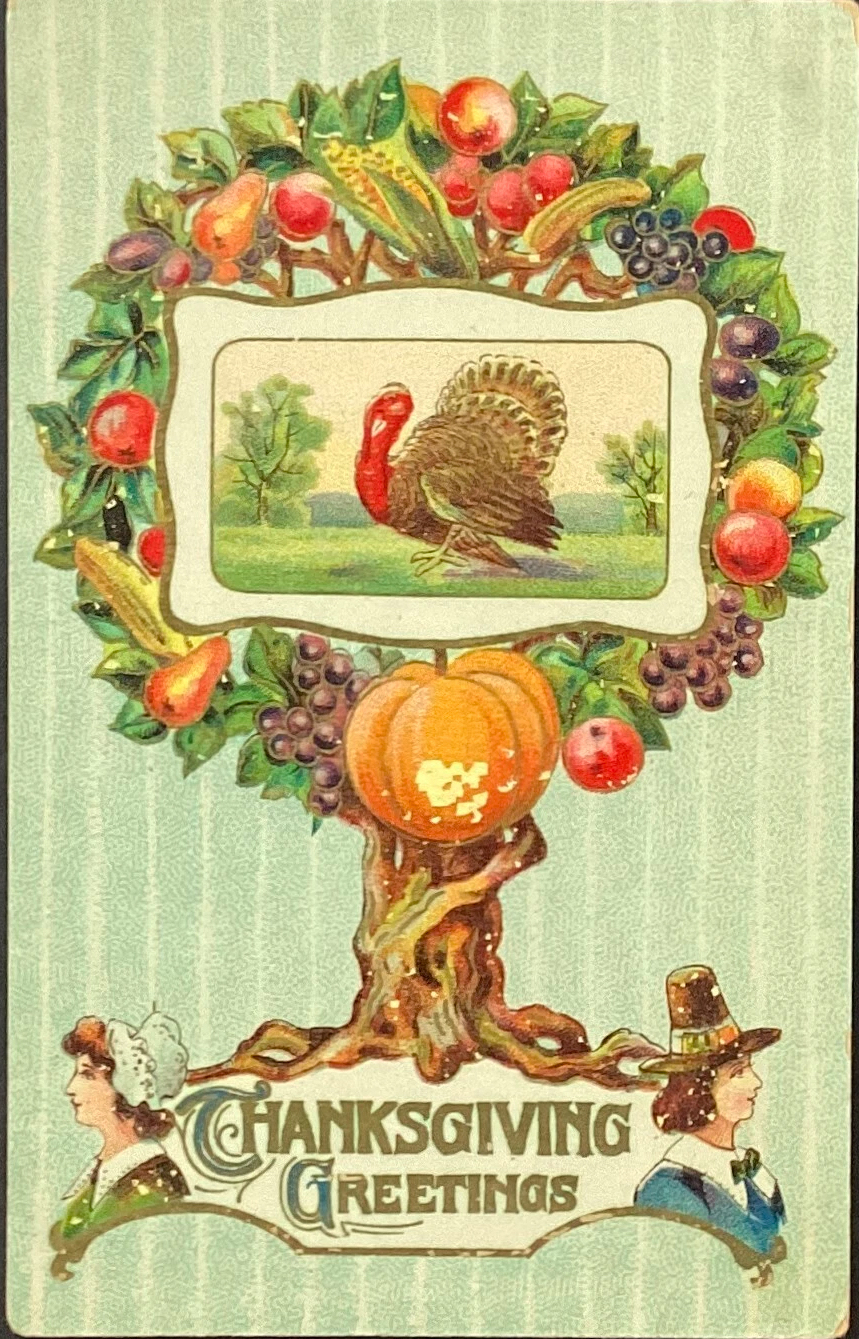
A colorful harvest is depicted in the form of a wreath that meets the trunk of a tree, which is bordered by a pilgrim couple, and a turkey is the centerpiece. Blue and gold Art Nouveau calligraphy adds a regal touch. The reverse notes J.M. New York as the publisher, and indicates that it was printed in Germany.
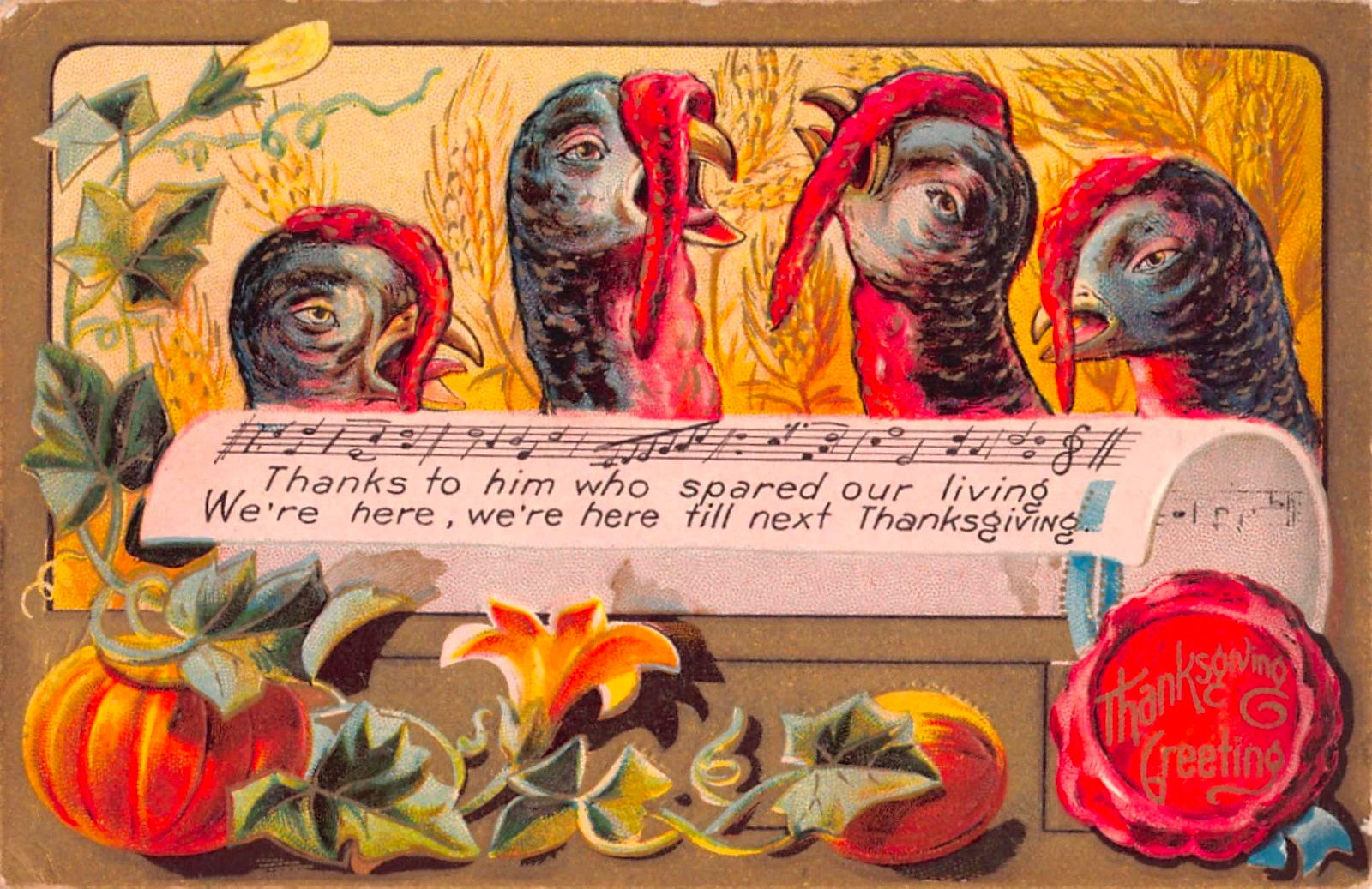
A rich autumn color scheme postcard may even tempt a viewer to play the piano, as in the case of a victorious turkey chorus, peeking from sheet music, and accompanied by wheat, a pumpkin, ivy, and a lily. This is part of Thanksgiving Series No. 3, and was produced in 1908.
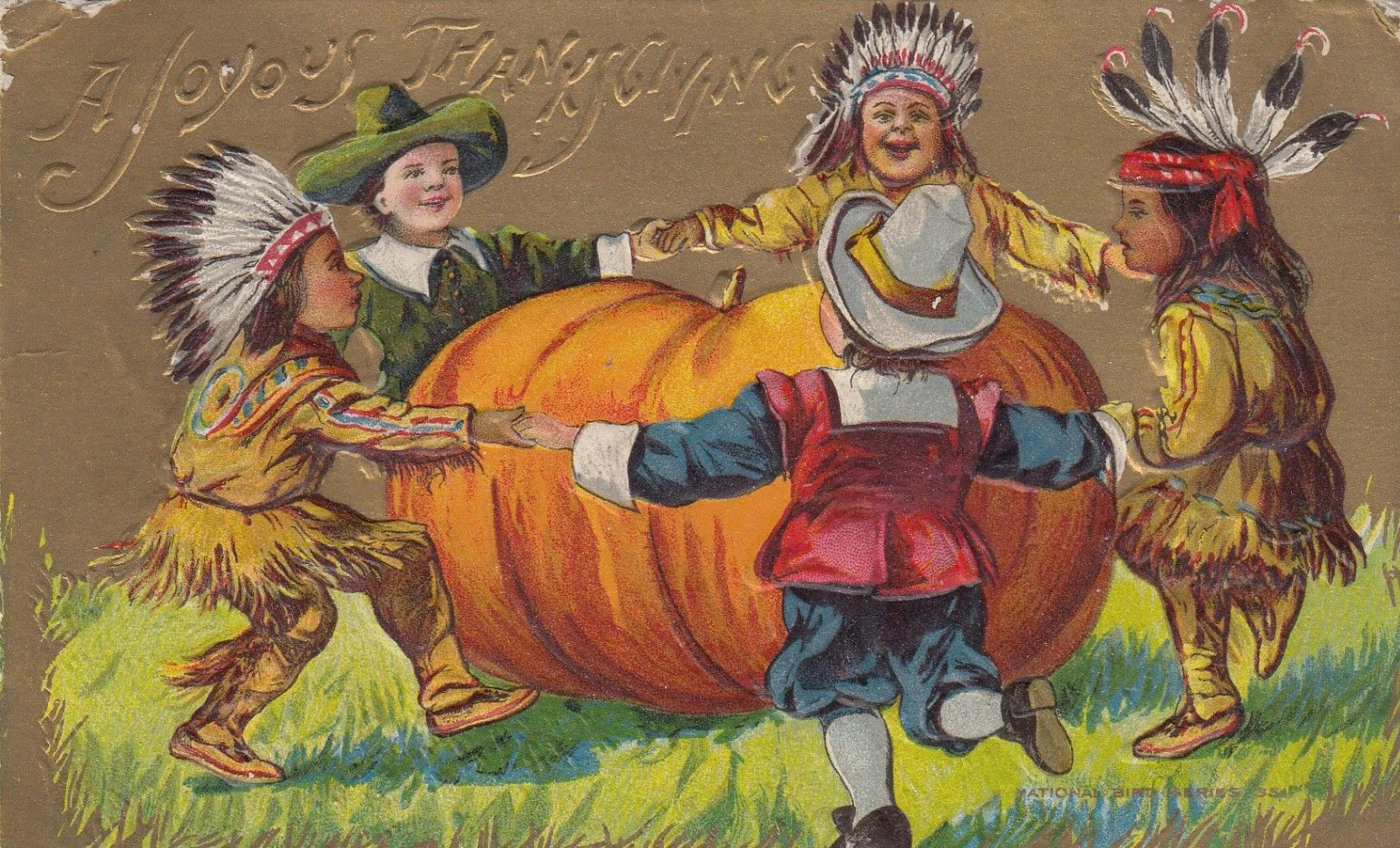
The Alcan Moss Publishing (AMP) Company, an engraver based in Manhattan, produced the National Bird Series. One largely gold and green postcard emphasizes the festivities and unity between pilgrim and Indian children, as they hold hands and dance around a giant pumpkin.
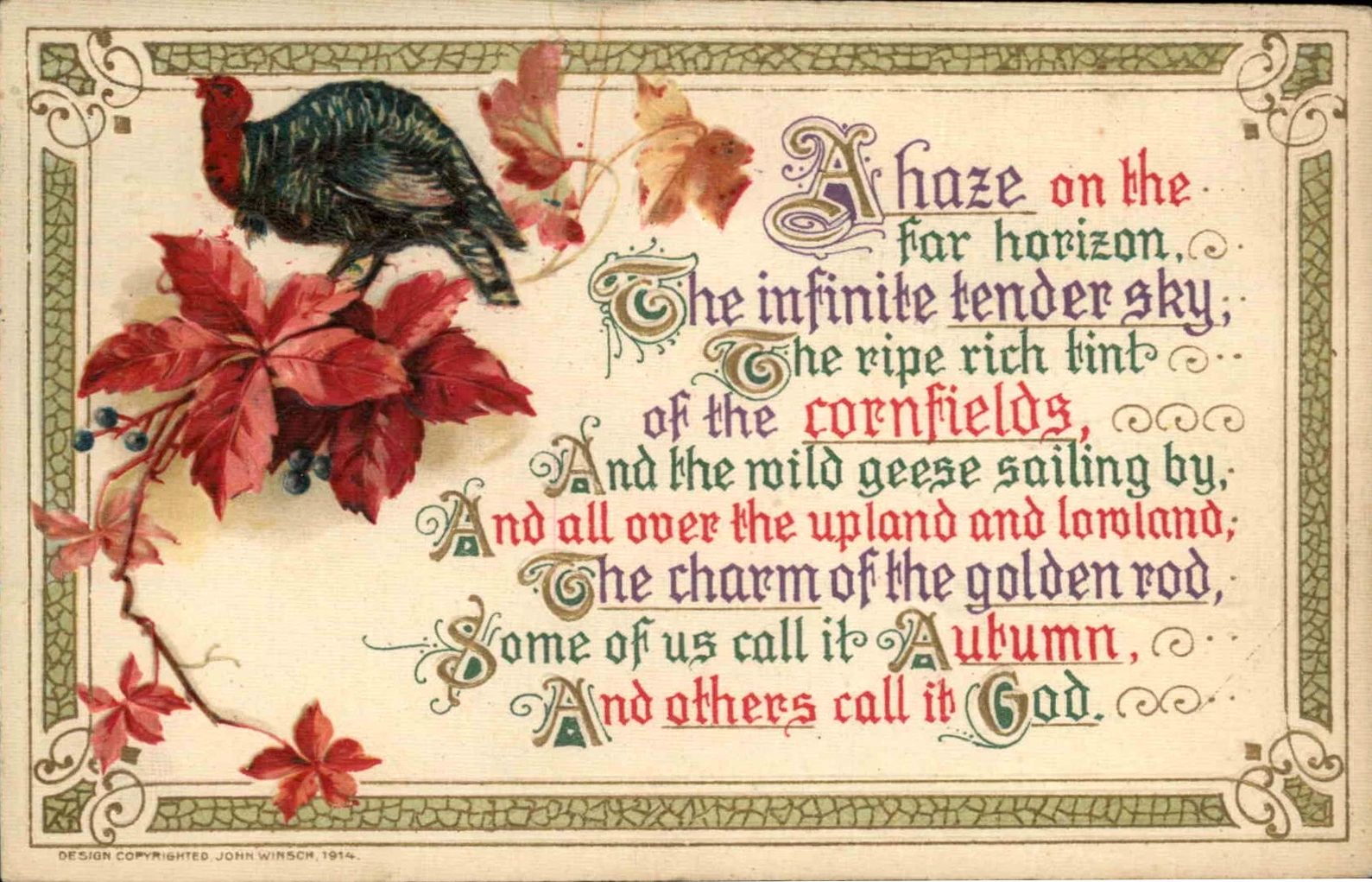
Another postcard featuring a design that was copyrighted by John Winsch in 1914 expressed that G-D is above all. Postcards featured simple to more elaborate poems, also varying in calligraphy. A turkey is perched atop autumn leaves, and an Art Nouveau border frames the composition, while the leaves extend beyond. It was printed in Germany and is number 3942.
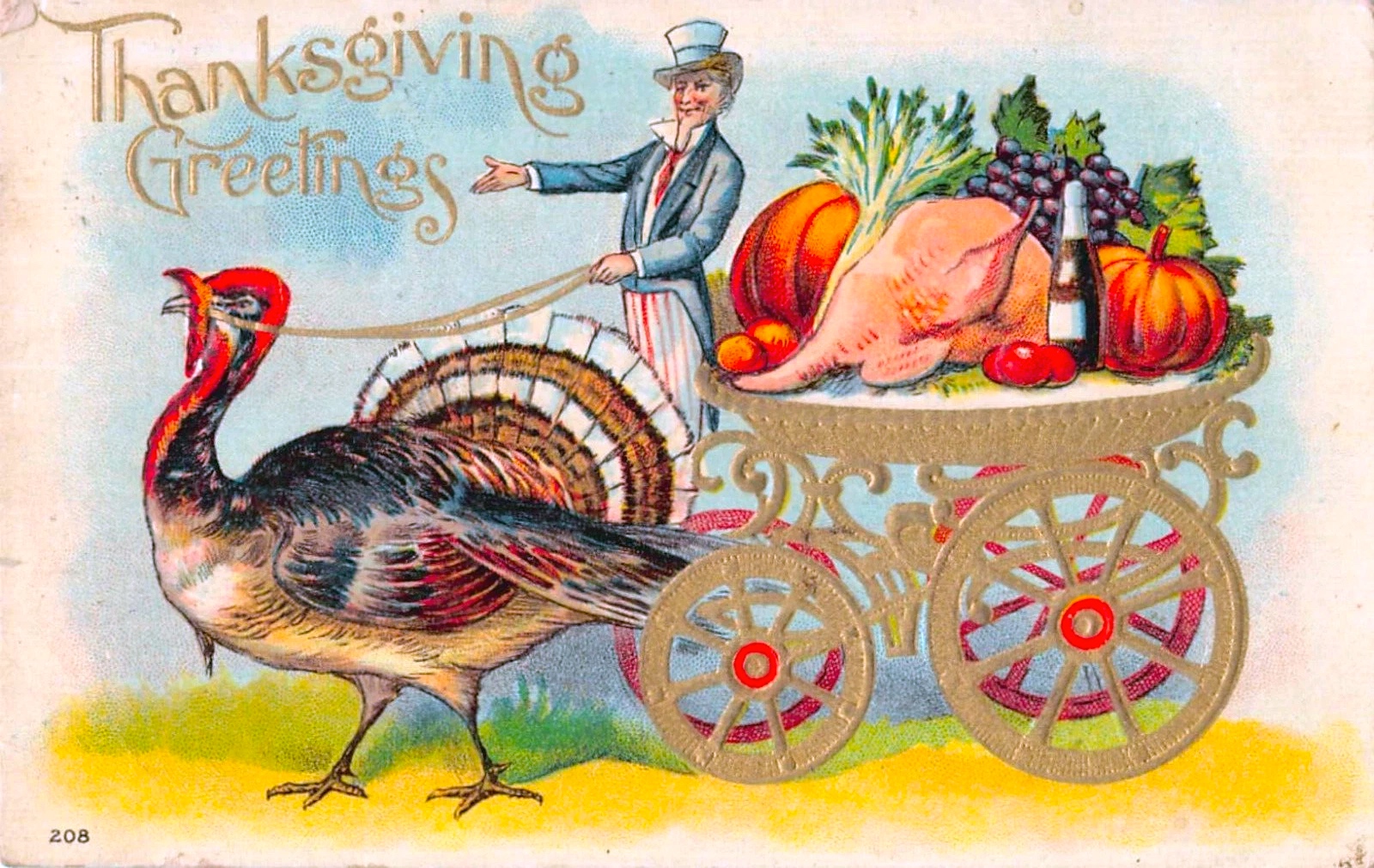
With patriotism and tradition in abundance, Uncle Sam is ready to deliver a delectable feast to your dinner table, and will travel in style on an ornate golden carriage.