A Touch of Medieval Europe at Mayfair House & Windsor House in Forest Hills
Views: 583
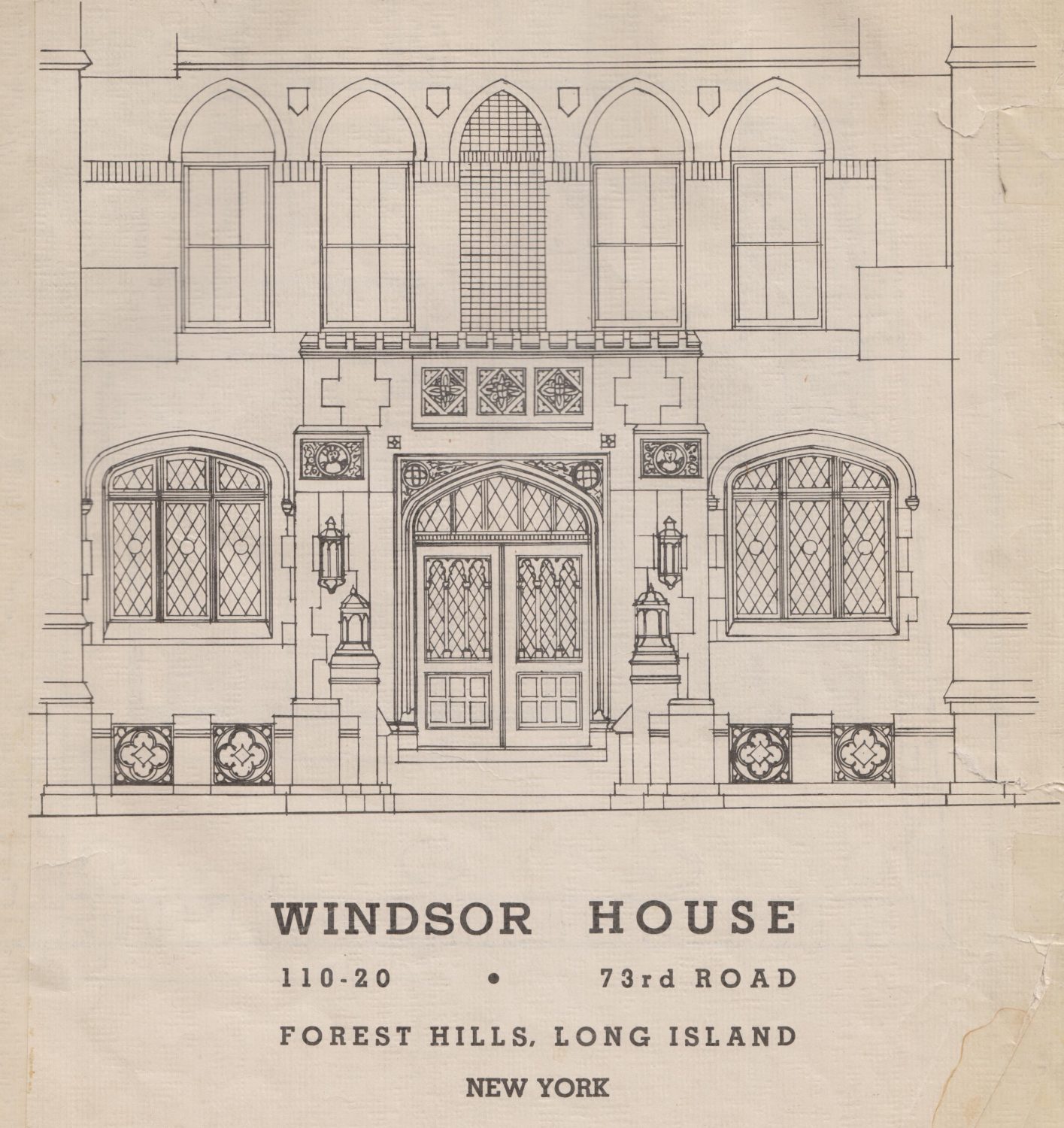
A rendering of the Windsor House rendering.
By Michael Perlman
On opposite sides of one scenic Forest Hills street stand some of the most outstanding examples of Tudor Medieval meets Gothic buildings, with adorned brickwork and stonework and lobbies that continue to showcase the style.
The facades also feature Italian Renaissance elements. Mayfair House at 110-21 73rd Rd was erected and owned by Austin Building Corporation, and designed in 1935 to 1936. Its sister building next-door, Windsor House, was erected and owned by Arende Building Corporation. Today, they are regal co-ops, and are recognized as a superb product of the notable architectural firm, Cohn Brothers. They neighbor other significant buildings, like the Holland House and The Traymore to the East, and The Wakefield and New Hampshire Apartments to the West.
The location was a draw and the rate of stately development was underway, largely due to the proximity to DeLuxe Coaches, which ran 93 trains daily from Manhattan along the LIRR and the 8th Avenue Subway/IND line starting in December 1936. And of course, the anticipated 1939 – 1940 World’s Fair, to which Forest Hills was advertised as the gateway. Another asset is the West Side Tennis Club and the Forest Hills Stadium, a property that boosted Forest Hills as the “Wimbledon of America.” Forest Park was a selling point as a larger park with tennis courts, bridle paths, one of the city’s finest golf courses, playgrounds, and scenic wooded hills.
Gerry Fitch, who wrote for The New York Sun’s real estate section, stated in a January 9, 1937 article, “Residence in Forest Hills always has conferred upon the resident a certain subtle distinction – like the possession of old family silver. The community has had godfathers and godmothers all its life to watch over its development. It has been kept beautiful, efficient, complete, tasteful in architecture and conservative in the admission of both business and populace.” It was referenced as “the most widely known suburb in America.” Mayfair House opened in November 1936, and by the time of the publication, it was already 100 percent rented.
No new developments were out of context in regard to their distinctive architecture and height based on desire. Fitch wrote, “Builders and real estate developers will insist upon architectural supervision, by an appointed commission, of all apartment dwellings to follow the subway, said Fred Hulbert of Cord Meyer Development Company. He foresees a law enacted whereby builders will be required to submit their plans as to height and general design, for approval to the commission. This, he believes, will lead to a change in the method of taxation, so that builders who do not occupy their entire plots, but leave space for gardens and playgrounds, will not continue to be at a disadvantage to the builder who occupies every available inch of plot – an ironic condition existing under the present method of taxing real estate.” Previously, Mayor Fiorello LaGuardia had stated, “Each building shall reflect the beauty of the others,” and the goal of the locality would therefore come to fruition.
Forest Hills was named in 1906 by Cord Meyer Development Company. Quite often, architects, artisans, and builders trained overseas, and immigrated to America to continue their training. North of Forest Hills Gardens is a diverse collection of architecturally and culturally significant buildings designed from the teens to the early 1940s in the Tudor, Georgian Colonial, and Colonial styles.
On December 30, 1935, plans for the six-story Mayfair House was filed for David Isenberg of 451 Albany Avenue by Cohn Brothers. Estimated at $200,000, it was slated to accommodate 72 families on a 140 by 170-foot parcel. Prospective tenants came across an August 28, 1936 ad in The New York Times, which read “New elevator apartments, Forest Hills, 73d Road, bet. Austin & Queens Blvd; Ready for occupancy Sept. 15th, 2-3-4-5 spacious rooms, 1 and 2 baths – Stall shower; Reasonable rentals; 24-hour door service. Large foyers and dinettes, cross-ventilation. Colored tile and fixtures, venetian blinds; Austin Building Corp. Agent on premises, Tel. Boulevard 89589.” An announcement for the opening of Windsor House, which contains 78 suites, was announced in The New York Times on June 13, 1937.
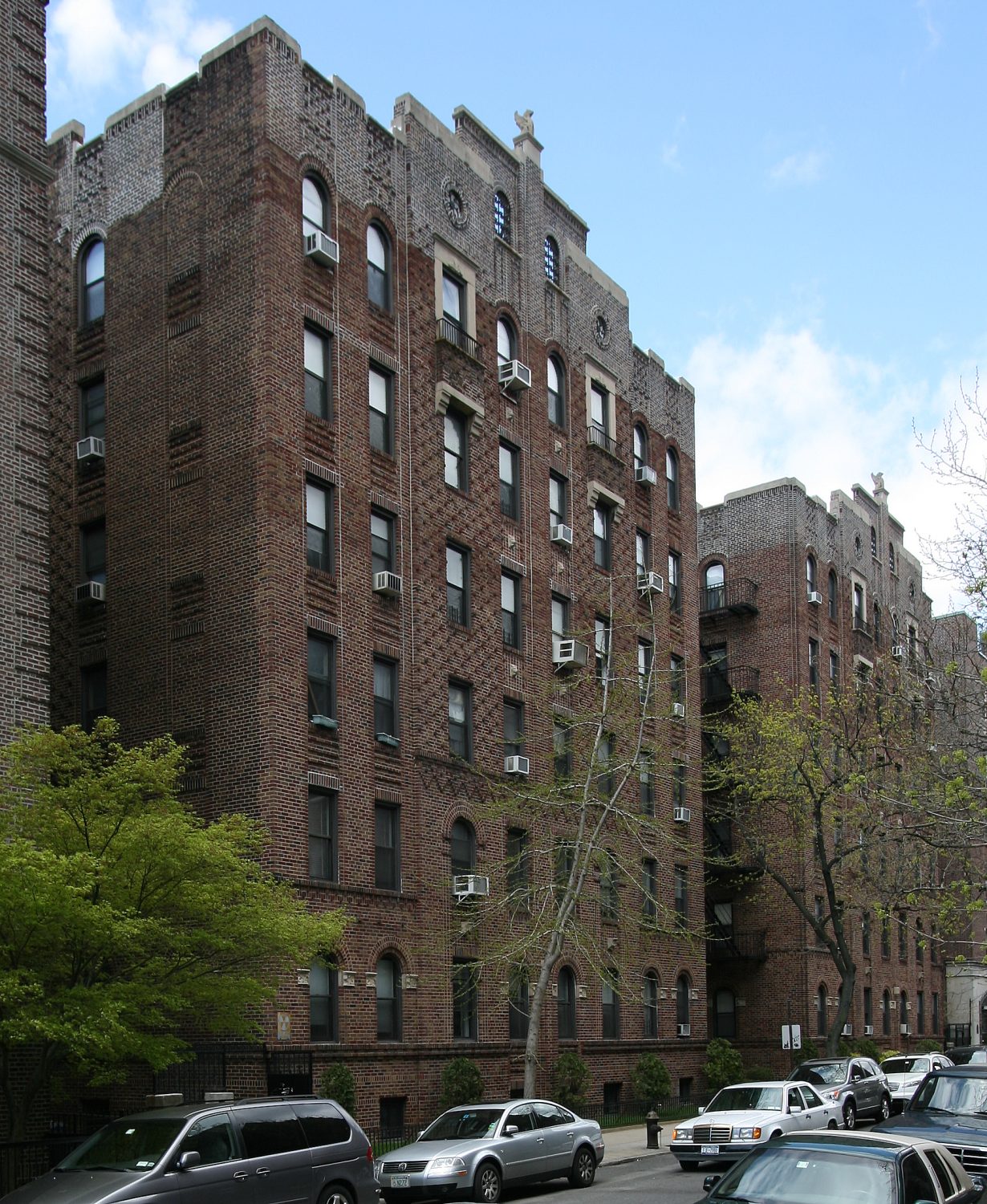
The facade of Mayfair House in 2009.
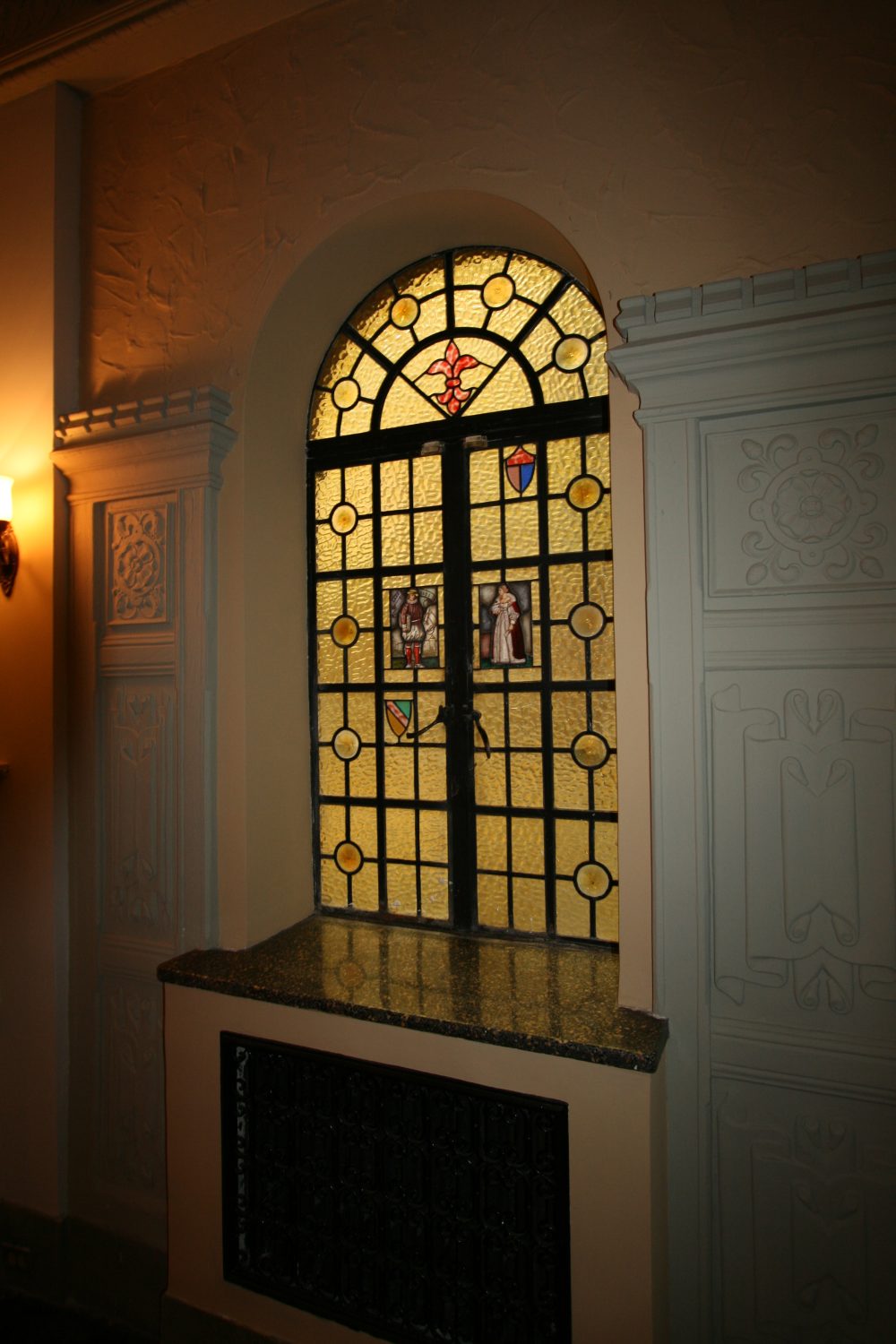
The Mayfair House’s stained-glass in 2010. Photo by Michael Perlman.
In a July 14, 1940 ad that spotlighted both buildings, a 1 ½ room apartment entailed a $45 – $50 rent, 2 ½ rooms at $58, 3 rooms at $62.50 – $75, and 4 to 5 rooms (2 baths) at $95 to $120. The 2025 equivalent for the highest rent would be an estimated $2,776.94. Incoming tenants of Mayfair House understood the meaning of quality. “The builders of Mayfair House had set themselves an exacting task: namely, to offer an individual home with the advantages of the modern apartment house. How well they have succeeded in their efforts is best attested by the fact that Mayfair House was 50 percent rented a month before it was available for occupancy,” read the August 9, 1936 edition of Long Island Sunday Press.
Accommodations in the Windsor and Mayfair House’s original prospectuses are identical. In the 1930s, prospective and new tenants read, “A city apartment to be truly a home must offer some degree of privacy and quiet. Perhaps no building in Long Island offers so much in this respect as the Windsor House. Here on a quiet street, the builder has erected a most beautiful house, with rooms planned to suit the most exacting and discriminating person.”
After many immigrants settled in Manhattan’s Lower East Side and were accustomed to sub-par conditions, buildings such as this duo were a novelty. The Windsor House prospectus focuses on sunlight and cross-ventilation in every apartment, a four-room apartment with two baths having east, south, and western exposures, stall showers with glass doors in the three to five-room apartments, full collective Otis Elevators, outdoor radio aerial for short and long waves, a day and night man at the entrance door assuring 24-hour service, concealed recessed radiators, and colored tiling and fixtures throughout the home.
The duo remains a model of urban planning and superb architecture, although Windsor House had a few unsympathetic upper façade alterations. Mayfair House’s distinctive facade features multi-colored stepped and patterned brick, include arched windows, gargoyles, a crenelated roofline with stone coping and a stone griffin overlooking each wing and the entry façade’s court, elaborate iron grilles, stone lintels with ornamental balconies, and stone griffins that face each other alongside archways that frame the first-story windows. The elaborate stone entranceway that surrounds patterned iron doors features an escutcheon, which is flanked by flowing ribbons. Carved mythological stone reliefs glance at one another alongside an etching that reads, “The Mayfair.”
North Carolina resident Richard Delaney, who was raised in Forest Hills’ Holland House in the 1930s and 1940s, observed Mayfair House’s large arched stained glass lobby windows, and stated in a 2021 interview, “I really thought that I saw glimpses of King Arthur, Lady Guinevere, and Sir Lancelot in some of those portals! The magnificent craftsmanship, design, and detail that went into creating these lobbies is incredible! May their beauty remain steady and be preserved in the years to come!” One of the portals features Jean-Francois Millet’s “The Sower” (1850), a popular figure in stained glass. The lobby features vaulted and coffered ceilings bearing graceful motifs, as well as wood-paneled walls and a huge fireplace that bears heraldic crests and knight-like motifs. The walls also feature griffins flanking a central shield.
Making our way through the Windsor House’s front court, the ornate stone entranceway features stone carvings such as heraldic shields and motifs, and is accompanied by stained glass transom windows. In etched stone, Old English typography reads “Windsor House,” and medallions bearing a four-pointed petal and star motif can be spotted alongside it. Above are stylized foliate motifs within square frames. In the corners near the iron doors, stonework features Celtic knot motifs associated with medieval architecture, and is accompanied by oak leaves and acorns, symbolic of endurance and knowledge. The multi-colored façade features stepped brick accents, arched brickwork and shields, and limestone surrounds.
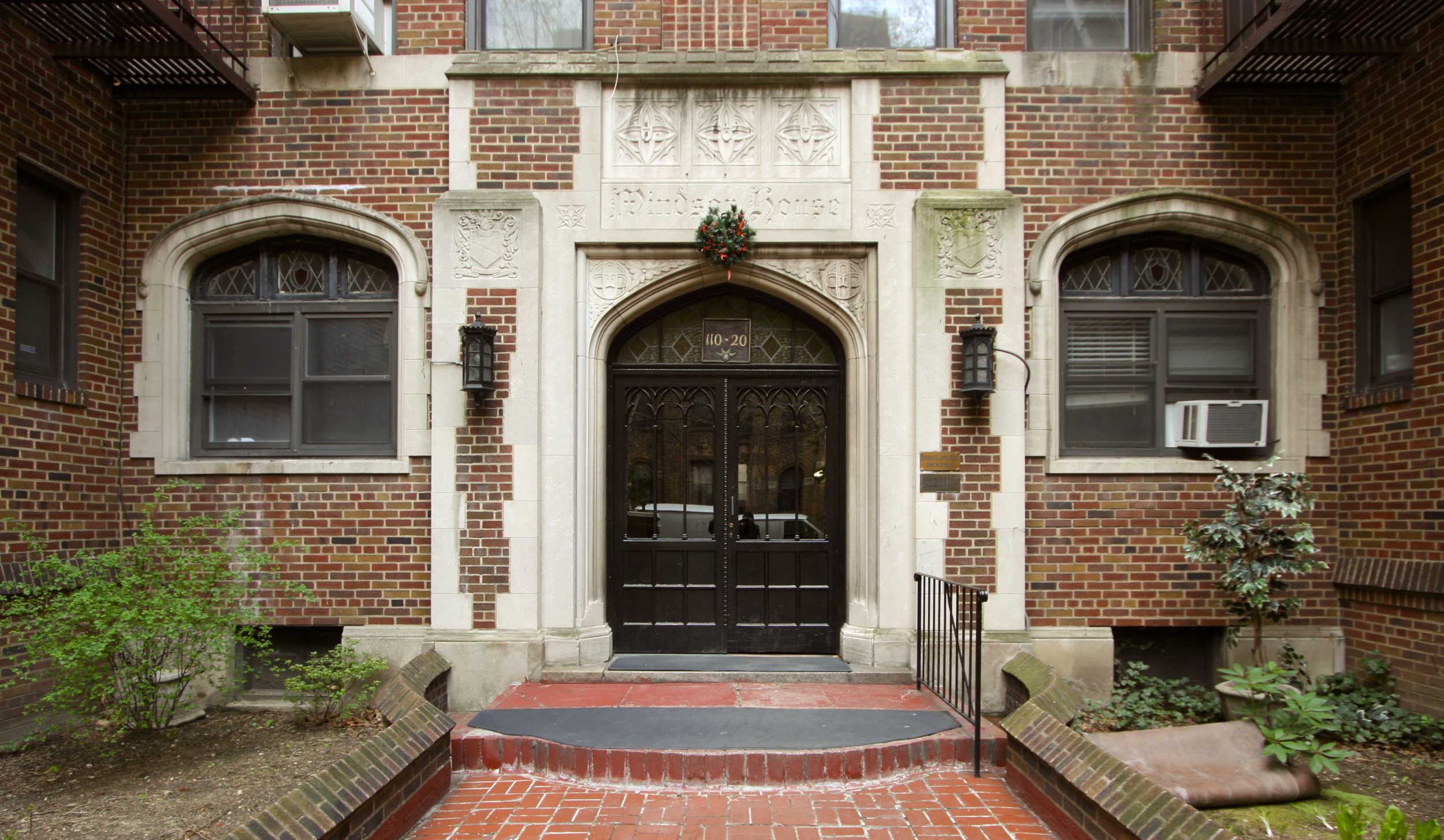
Windsor House’s medieval stonework with stained glass, 2009 photo by Michael Perlman.
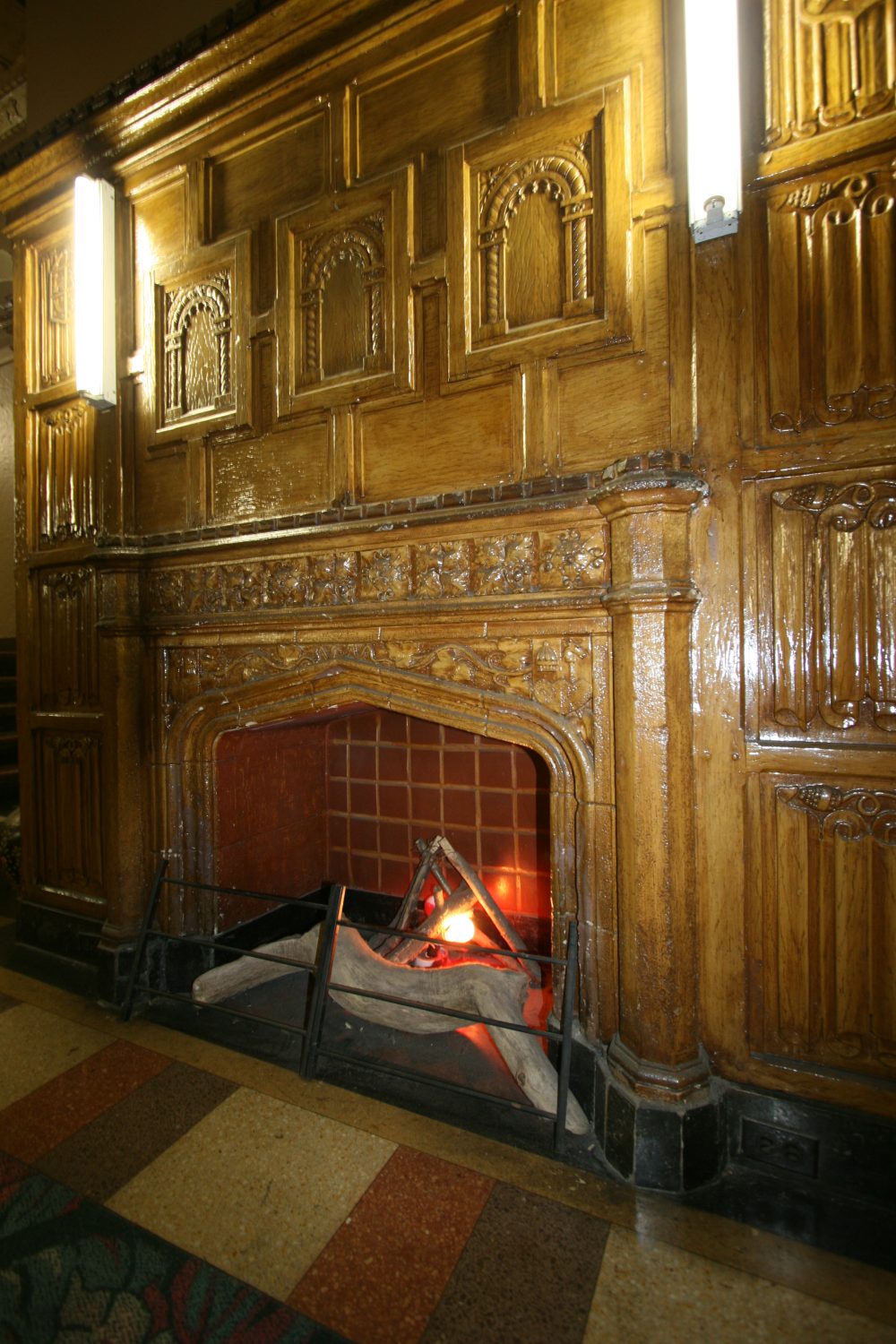
Windsor House’s regal fireplace inspired by a castle in 2010. Photo by Michael Perlman.
The Windsor House lobby also features a coffered ceiling and ornate lintels, in addition to linenfold wood paneling with heraldic shields. This style of warm wood carving was prominent in the 15th and 16th centuries. A colorful geometric terrazzo floor grants distinction. Stained glass windows feature heraldic shields and geometric patterns. An ornate fireplace features scrolls and foliate motifs, as well as a carved crest with a domed structure, a water depiction, and a horse head.
Cohn Brothers consisted of principal architect Benjamin Cohn and his brother, architect Abraham Cohn, who were Latvian Jews who immigrated to America and settled in New York circa 1906. The University of the State of New York Bulletin (Albany) features the brothers as certificate recipients to practice as registered architects as of 1917, and lists the shop that they operated from at 361 – 363 Stone Avenue (renamed Mother Gaston Boulevard) in Brownsville. A 1934 book by the New York State Board of Architectural Examiners featuring registered architects lists them at 191 Joralemon Street in Brooklyn Heights. They often designed exquisitely appointed residential facades, with Tudor and Colonial Revival styles as their preference. Other Jewish architectural firms that spanned the period of the 1920s to the early 1940s, when Jewish architects became more prevalent citywide, included Morris Rothstein & Son, Seelig & Finkelstein, and Shampan & Shampan.
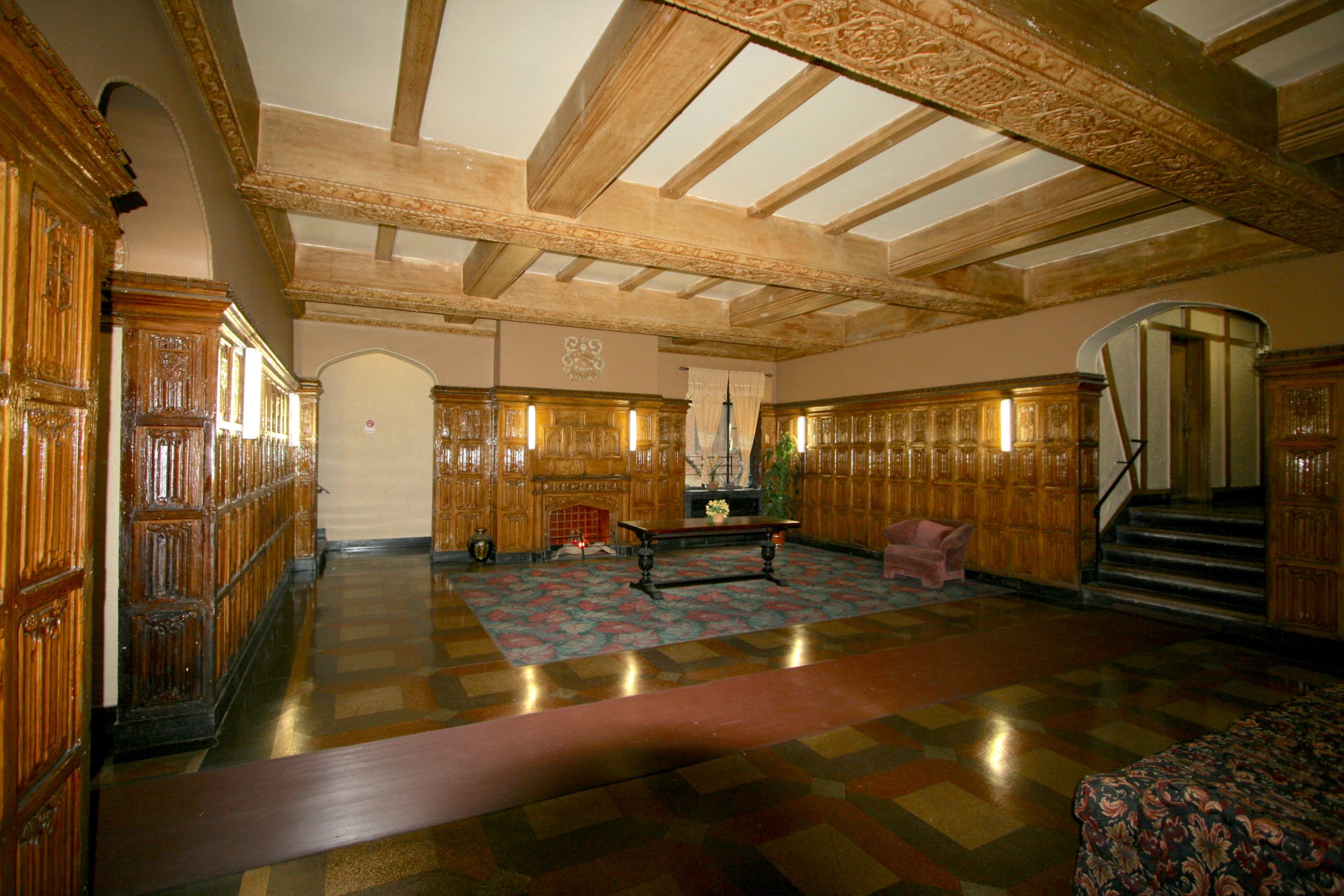
Windsor House’s unique ornate lobby in 2010. Photo by Michael Perlman.
Locally, Cohn Brothers was also responsible for designing Boulevard Apartments at 111-56 76th Drive and The Buckingham at 83-44 Lefferts Boulevard in Kew Gardens. Some other noteworthy examples of their estimated over 100 citywide apartment buildings are Normandie Towers at 43-30 46th Street in Sunnyside, Covington Hall at 43-05 44th Street in Sunnyside, Jacksonian Apartments at 35-05 87th Street in Jackson Heights, The Mount Vernon at 34-31 81st Street in Jackson Heights, Packard Towers at 43-31 45th Street in Sunnyside, The Parkview at 1410 Avenue S. in Brooklyn, The Hampshire at 35-45 79th Street in Jackson Heights, The De Nyse at 601 79th Street in Brooklyn, San Remo Apartments at 535 Parkside Avenue in Brooklyn, Berkley Square at 1701 Albermarle Road in Brooklyn, and The Normandy & The Brittany at 9437 Shore Road and 9425 Shore Road, respectively. A once grand theater-inspired building that varies from their residential designs is The Jerry Building at 1401 Rockaway Parkway in Brooklyn.
If you feel that your building could benefit from a façade and lobby restoration guided by Rego-Forest Preservation Council, as well as a commemorative pictorial and educational bronze plaque through this columnist’s Forest Hills & Rego Park Historic Plaque Initiative, please email mperlman@queensledger.com