Honoring America’s Bravest Through A Forest Hills Monument
Views: 0
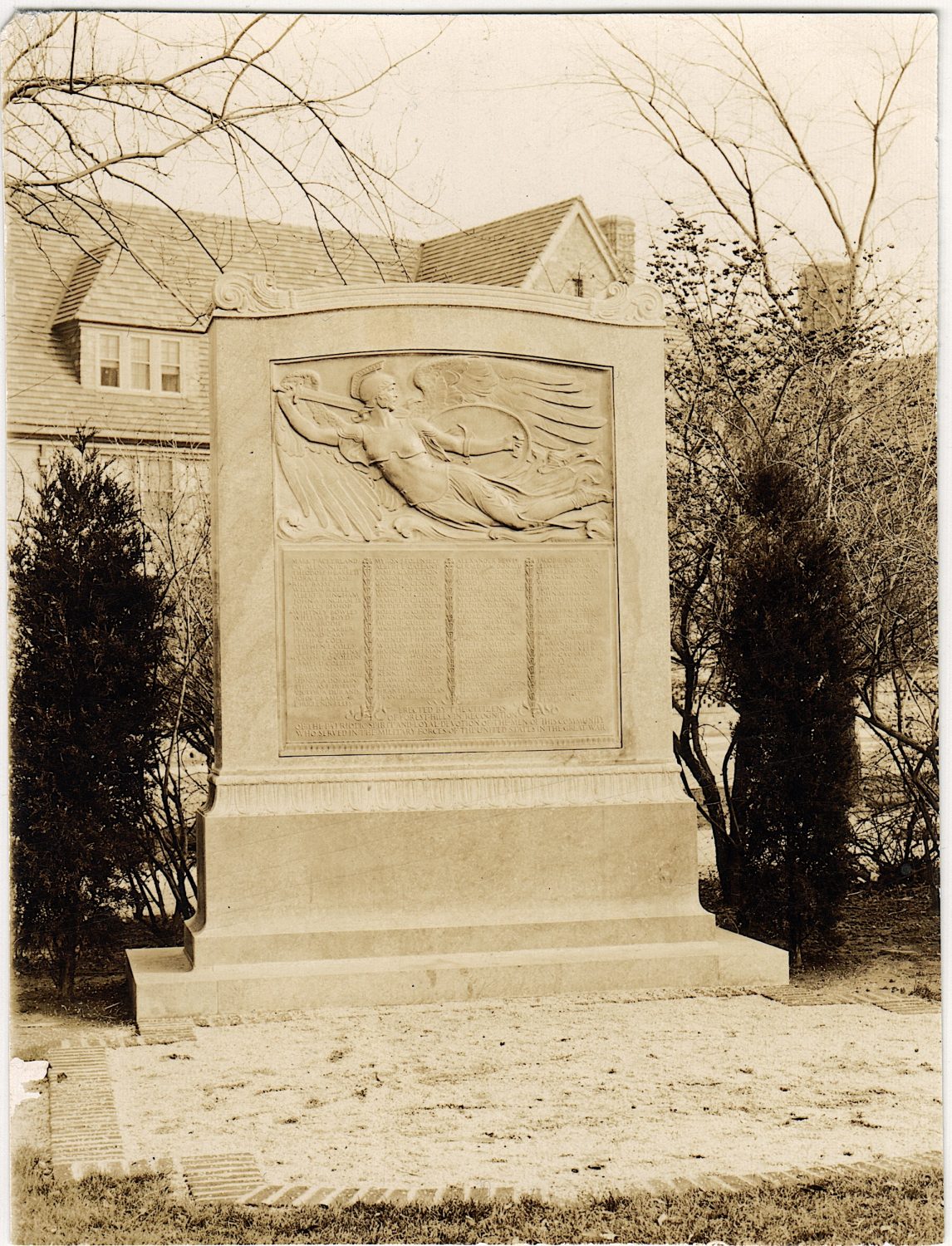
WWI Soldiers & Sailors Memorial circa 1920, Courtesy of Forest Hills Gardens Foundation.
BY MICHAEL PERLMAN
CHAIRMAN, REGO-FOREST PRESERVATION COUNCIL
Architecturally, artistically, and culturally significant monuments and buildings, commemorative parks, and parade routes throughout Forest Hills preserve the memory of America’s bravest on Memorial Day and year-round. The power lies in the hands of residents among preservationists spanning suitable organizations and city, state, or private governing agencies to become community stewards, to most effectively anchor past generations to future generations. Honoring heroes who dedicated their soul to safeguard our country is essential. Behind these monumental properties, a larger than life individual and collective spirit comes alive, offering a voice of heroic achievements at wartime, some accomplishments that followed, and a story about the design and construction of monuments.
Forest Hills was named in 1906 and Forest Hills Gardens was founded in 1909. Public art is a gift to the masses, and among the most historic and diverse monuments in Queens is the WWI Soldiers & Sailors Memorial in Forest Hills Gardens. It is situated on Flagpole Green, formerly Village Green. Dedicated in 1920, this ornate Neo-Classical pink granite and bronze monument commemorates 102 heroic Forest Hills residents. The monument reads: “Erected by the citizens of Forest Hills in recognition of the patriotic spirit and loyal devotion of the men of this community who served in the military forces of the United States in the Great War.”
The monument was designed by the renowned American sculptor, Adolph Alexander Weinman (1870 – 1952), a native of Karlsruhe, Germany who resided nearby at 236 Greenway South and operated a studio at 234 Greenway South. The design symbolizes “The Call To Overseas” above the tablet’s 102 names. In the summer of 2022, residents were privileged to oversee meticulous restoration work, resulting in the polishing of the bronze tablet, which developed a natural green patina or verdigris, as far back as most residents can recall.
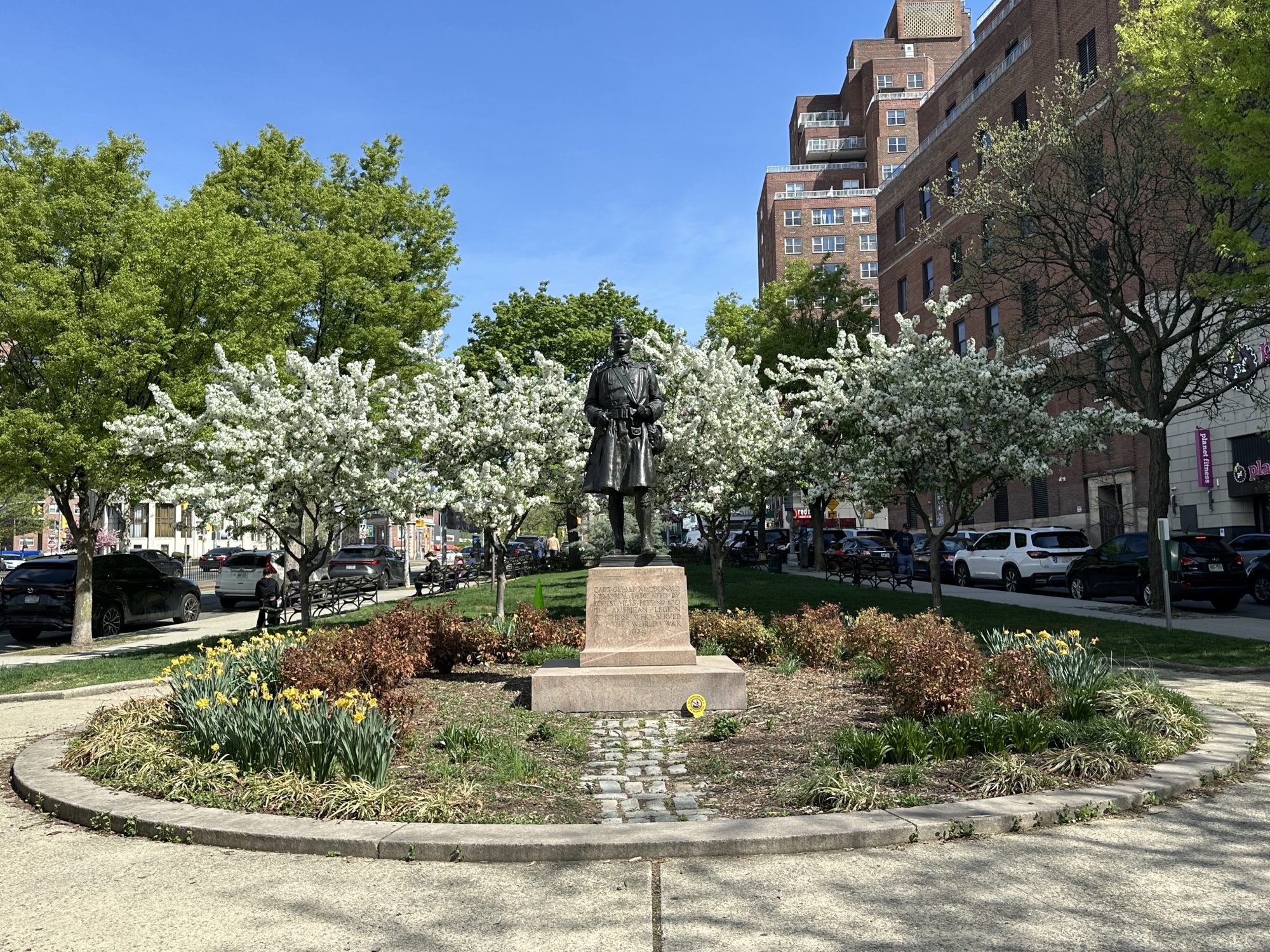
Captain Gerald MacDonald Sculpture, Photo by Michael Perlman
Now it is particularly timely to memorialize and rejoice the spirit of some of the most well-known and long-forgotten names. Artistry runs in the Weinman family. His son, Howard Kenneth Weinman (1901 – 1976), a WWI veteran, is featured on the monument. One of his notable achievements is the Long Island Tercentenary Silver Half Dollar, which commemorates the 300th anniversary of the Dutch settlement of Long Island, and was issued in 1936. Distinctive characteristics are heads of a Dutch settler and an Algonquin Native American, where the heads are alongside one another to represent the harmony among a peaceful settlement. The reverse features a 17th century Dutch ship in full sail. His father is credited with the Walking Liberty Half Dollar and Winged Liberty Dime.
In some instances, families are featured, as in the case of Dr. Joseph MacDonald, Henry MacDonald, and Captain Gerald MacDonald (1882 – 1929), synonymous with MacDonald Park in Forest Hills, named on April 25, 1933. The park’s bronze sculpture bearing homage to G. MacDonald, an officer of engineers at the Battle of Meuse-Argonne, who also erected bridges and dug trenches. The sculpture was dedicated on May 27, 1934 by Mayor Fiorello H. La Guardia, after American Legion Post 630 allocated $1,500 at the request of veteran Henry MacDonald, Gerald’s brother. The granite base inscription reads: “Capt. Gerald MacDonald; Memorial Dedicated By Forest Hills Post No. 630 The American Legion; To Those Who Served In The World War; 1934.” The statue was sculpted by Henry MacDonald’s brother-in-law, Frederic de Henwood (1864 – 1948), a world-renowned sculptor whose works appeared internationally, and was designed by architect William Henry Deacy (1889 – 1967).
Gerald MacDonald Memorial Park was officially named on April 25, 1933, and historically, the brick circle was known as Flagpole Square, where a huge flagpole once existed. On May 28, 1933, the New York Times reported, “The ceremonies included a parade through Forest Hills by American Legion posts, Boy and Girl Scouts, and civic groups. Colonel F.W. Stopford of the U.S. Army, who was the principal speaker at the ceremonies, praised Mr. MacDonald’s war service as an officer of engineers at the battle of the Meuse-Argonne.” It was announced by the Long Island Daily Press that movies of the park’s dedication would be presented at the Post on November 6, 1933.
Five years ago on eBay, this columnist acquired a scarce MacDonald Memorial Games brass medal that represents Forest Hills and WWI history, and depicts Captain Gerald MacDonald. Into the 1940s and potentially later, the Captain Gerald MacDonald Veterans of Foreign Wars Auxiliary existed at 119-09 Sutphin Boulevard. The Veterans of Foreign Wars memorialized the captain by naming their post, The Captain Gerald MacDonald Post, No. 643 of the Veterans of Foreign Wars, according to the 1934 Encyclopedia of American Biography by Winfield Scott Downs.
The WWI Soldiers & Sailors Memorial bears the names of A.M., David and Howard Springsteen, who represent one of the first families of Queens. This family consisted of influential Dutch farmers who owned farmland encompassing what would currently be the south side of Queens Boulevard between Ascan Avenue and 77th Avenue. Their property recalls the days of Forest Hills as Whitepot, prior to 1906. Farmer David Springsteen (1849 – 1911) was also a director of Cord Meyer Development Company and represented the ninth Springsteen generation to settle locally. His six children, included David, who is inscribed on the monument. Through the 1940s, the porch-fronted Springsteen homestead, which was erected in 1898, stood at 112 Queens Boulevard and was later renumbered 108-36 Queens Boulevard.
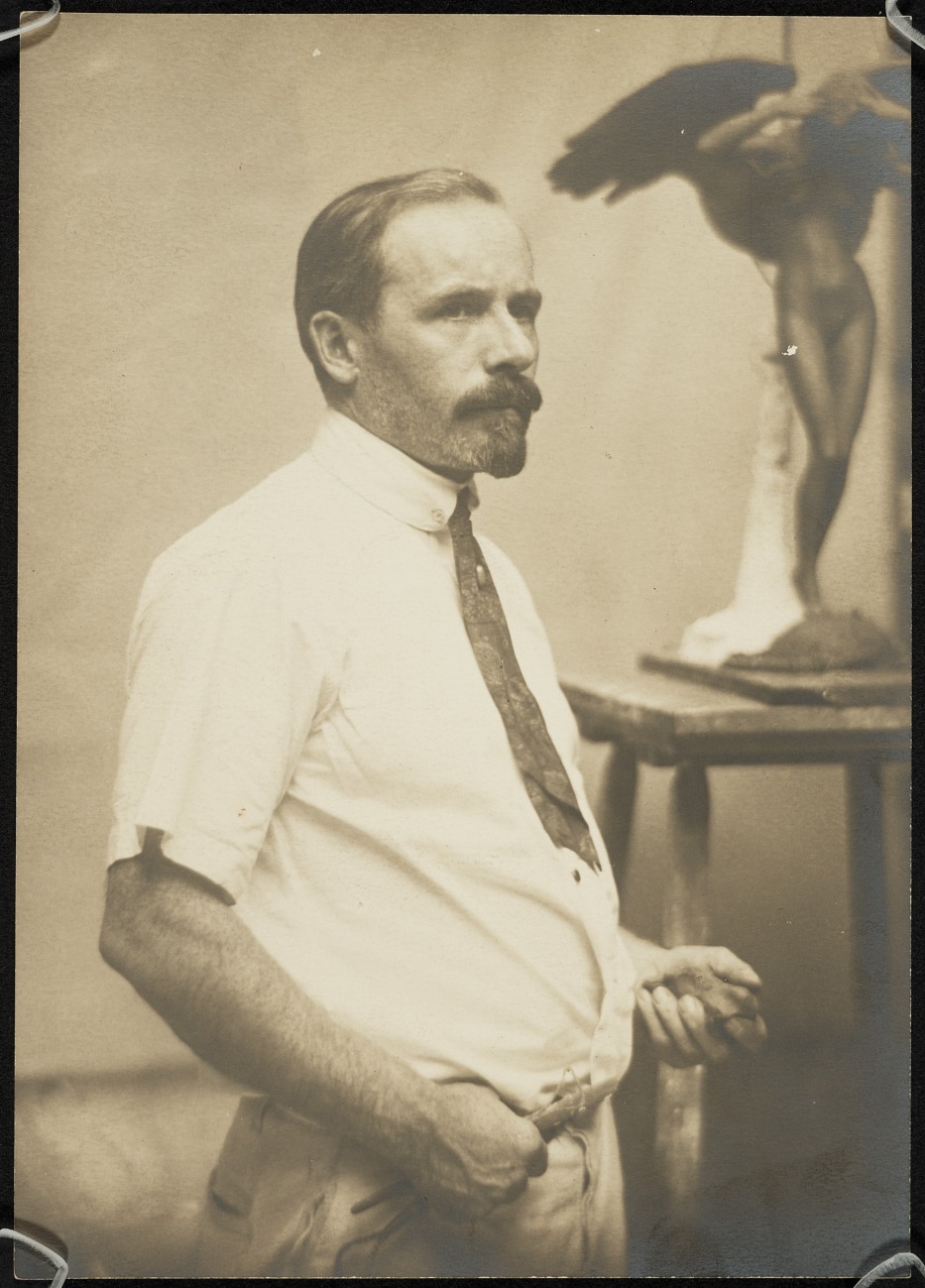
Adolph Weinman in studio circa 1915. Photo via Archives of American Art Smithsonian Institution.
Born in Truxton, N.Y., Cornell graduate and Forest Hills Gardens resident Clarence A. Perry (1872 – 1944) served as a major overseas during WWI and coordinated the post exchange system in training camps. In 1924, he became a lieutenant colonel in the Reserve. He was an employee of the Division of Recreation of the Russell Sage Foundation from 1909 to 1937. As an architect and planner, he originated the “Neighborhood Unit” theory in 1924, where he notably advocated for community development entailing educational, physical, social and recreational components. Perry authored several books, including “Wider Use of the School Plant” (1910), “The Rebuilding of Blighted Areas” (1933), “Planning Improvement of Your Own Neighborhood” (1935) and “Housing for the Machine Age” (1939). Part of his advocacy included promoting community pageants and plays exhibiting patriotic value, in place of risky 4th of July fireworks.
WWI veteran Augustin S. Hardart (1889 – 1969) was the son of Frank Hardart, Sr., who with Joseph V. Horn, founded the Horn & Hardart Company, which launched the Automat, an icon of Americana. Born in New Orleans, A. Hardart, who settled in New York in 1912 with his brother, Frank. A. Hardart, served as secretary of the company through 1946, followed by vice president.
The first Automat opened in 1902 in Philadelphia, and New Yorkers were proud to experience their first branch in Times Square in 1912. In New York and Philadelphia, an estimated 800,000 patrons once frequented 180 self-service cafeterias daily, shaping 20th century dining and culture prior to the rise of the fast food industry. Forest Hills offered smaller Horn & Hardart Retail Shops at 71-63 Austin Street and 116-63 Queens Boulevard. Frank Hardart, Jr (1884 – 1972), the firm’s vice president resided at 188 Ascan Avenue and 64 Dartmouth Street.
Patrons inserted nickels into a slot on a distinctive display of compartments, turned a knob, opened a glass door, and enjoyed fresh sandwiches, entrées, or pies in an Art Nouveau or Art Deco ambiance with a signature massive picture window. Fresh drip-brewed coffee emerged from the mouth of a crafted lion or dolphin. In 1991, the last Automat in New York shuttered, marking the end of a tradition.
The monument takes the viewer into the life of Kenneth G. Judson (1895 – 1970), who resided at 61 Olive Place and whose family was among Forest Hills Gardens’ founders. He served as Navy ensign during WWI and then joined Judson & Co, a cotton brokerage. He was a 65-year Gardens resident, who served as the longtime Forest Hills Gardens Corporation president. Additionally, he was a member of the West Side Tennis Club and Sons of the Colonial Wars.
Also featured is WWI veteran Frederick Truesdale Goudy (1899 – 1962), the son of Frederic William Goudy (1865 – 1947), a prominent American type face designer, who proved that printing is a fine art. In 1943, the Goudy Collection was acquired by the Library of Congress and considered the most comprehensive of its kind. Greater than 100 of his designs were displayed in a 1946 exhibition. The collection consisted of thousands of books, where most featured his typography and design. Signature titles include “Why We Have Chosen Forest Hills Gardens For Our Home” and “The Alphabet and Elements of Lettering.”
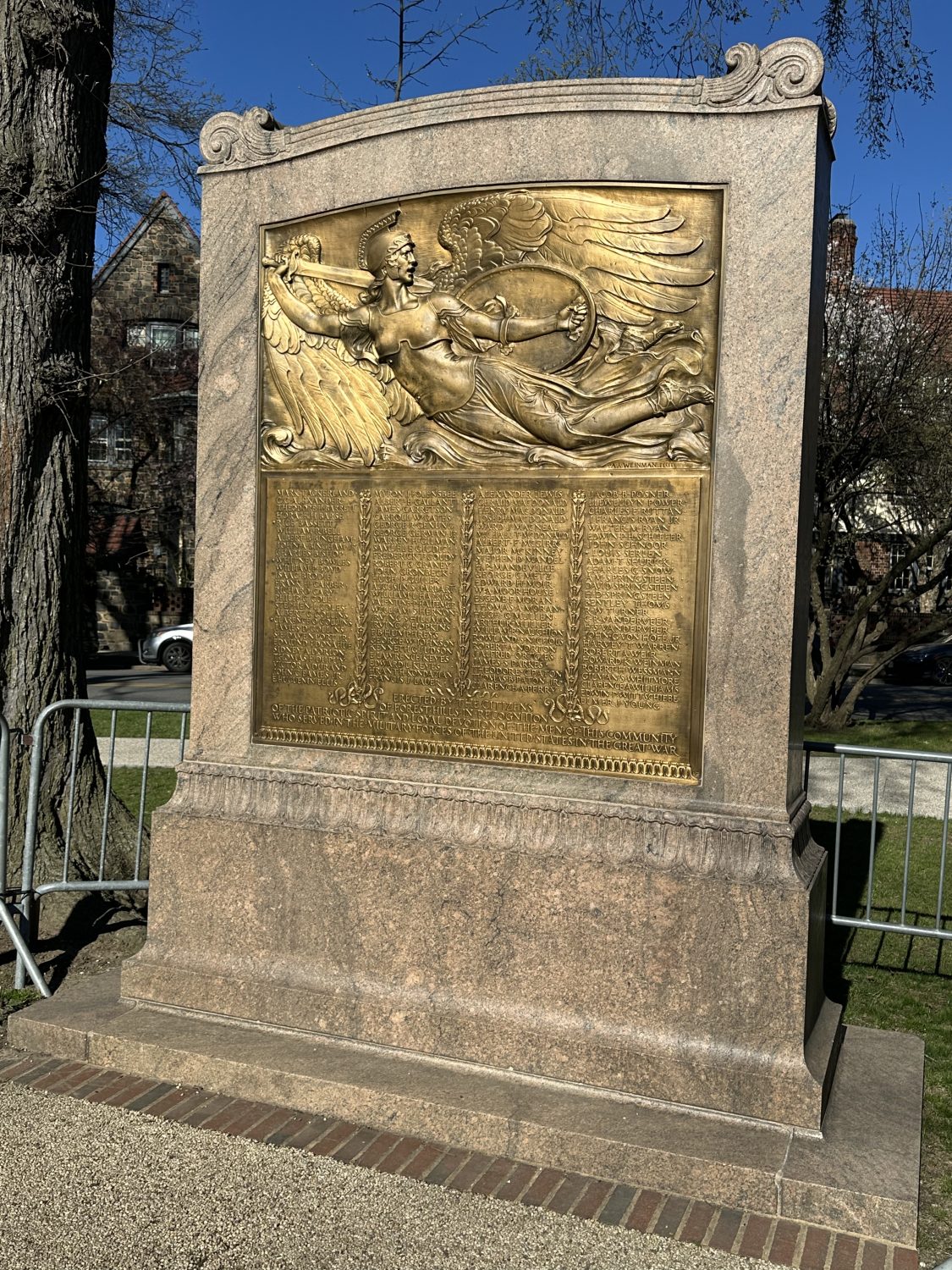
The restored WWI Soldiers Sailors Memorial April 2026 Photo by Michael Perlman.
At Village Press in a pre-Revolutionary farm mill that he named Deepdene in Marlboro, N.Y., it was a family operation, with his wife Bertha working at the case and setting up books, and Frederick T. Goudy operating machines, as his father cut the matrices. The operation was previously located at the family residence on Deepdene Road in Forest Hills Gardens.
Deepdene is a crisp serif type that the elder Goudy designed. Other highlighted typefaces include Goudy Old Style, Goudy Stout and Copperplate Gothic. In his obituary, it said, “Mr. Goudy did more to rescue typography from standardized ugliness than any man since William Morris, whose spiritual descendant he was.” The Goudys worked in the tradition of 16th century artisans.
Adam Thomas Shurick (born 1883) was a significant mining engineer and author whose focus was the operations and economics of the coal industry. His published works include “Coal Mining Costs” in 1922 and “The Coal Industry” in 1924. His books were published by McGraw-Hill and Little, Brown, and Company. He was also a well-respected member of the American Institute of Mining Engineers.
WWI veteran Edwin P. Wittschiebe (circa 1894 – 1985) was born in Brooklyn and relocated to Forest Hills early in his life, prior to residing in Manhasset. It was noted that he was honored on the monument as a citizen who served, rather than being a high-ranking military commander. The Kent Company, associated with his name at 279 Fifth Avenue, was known for manufacturing floor machines.
Valentine Phillip Hattemer (1896 – 1958) was a native of Easton, Pennsylvania who later resided in Forest Hills. After serving the military, he wed Eugenia Weatherly in 1926. He was well-respected as a business owner and partner in the Easton Industrial Dismantling and Salvage Company.
The monument served as a backdrop of numerous events echoing patriotism. On May 31, 1938, The New York Times read, “In Forest Hills, a Memorial Day parade was headed by a detail from the Sixty-second Coast Artillery (Anti-Aircraft). The American Legion and other veteran organizations took part together with youth auxiliary units. The parade started at Austin St. and Ascan Ave. and proceeded to the Flagpole Green and thence to Jerry MacDonald Park, and to the Forest Hills Theatre, where exercises were held.”