Tree Giveaway Marks Success Built on Tradition
Views: 1
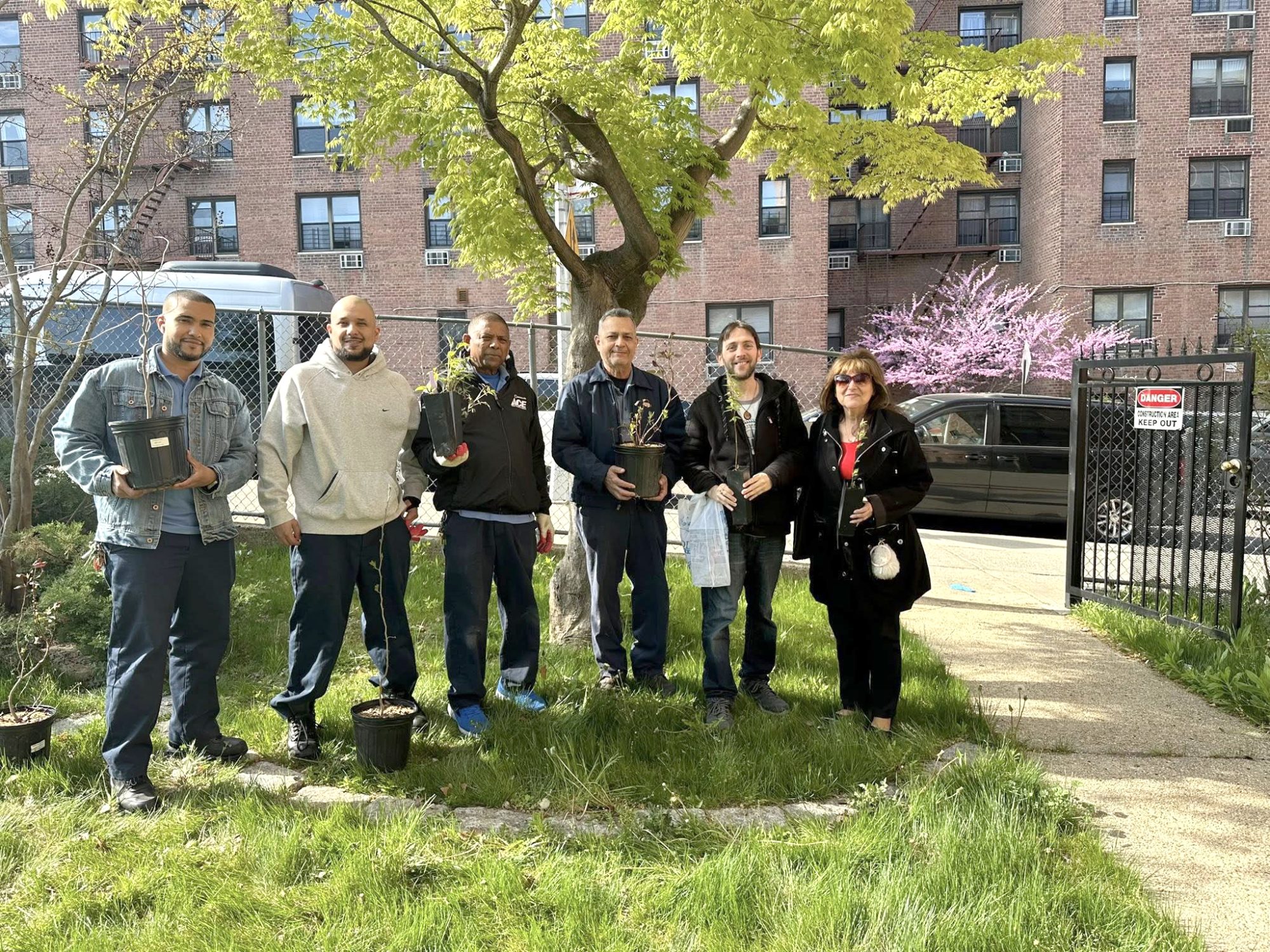
David Minkin supers with event coordinator Michael Perlman & property manager Leslie Hayden.
By Michael Perlman
Chairman, Rego-Forest Preservation Council
Forest Hills among the five boroughs is appearing greener and more colorful, as diverse saplings that are foreshadowed in the path of mature trees were distributed by New York Restoration Project. On a summery afternoon of Friday, April 17, this columnist received a donation of 17 native trees from the passionate and tireless staff of NYRP under the direction of Michael Horwitz, public programming manager, and in turn, donated them to Forest Hills property managers and supers of apartment buildings. This was in response to a much-anticipated beautification and environmentally beneficial initiative. Several were planted on small and larger lawns in front and on the sides of buildings, and now offer a communal feel as they engage a large audience of residents, passersby, and wildlife.
The saplings are diverse, since having a diverse tree canopy can offer immense benefits in the name of beauty, wildlife and pollinators, property values, eliminating pollutants, providing oxygen and shade, addressing runoff, absorbing stormwater, harboring community and meteorological history, and fostering spiritual and creative energy. Planting trees is equally important as maintaining mature trees, which are monumental pillars that unite the generations and offer additional benefits, synonymous with their size.
NYRP, founded in 1995 by Better Midler, is a dynamic citywide nonprofit that is planting roots for future generations. It is recognized for its role in environmental justice and nature conservancy by preserving community gardens among green spaces. The organization is acclaimed for its spring tree giveaway events and MillionTreesNYC partnership.
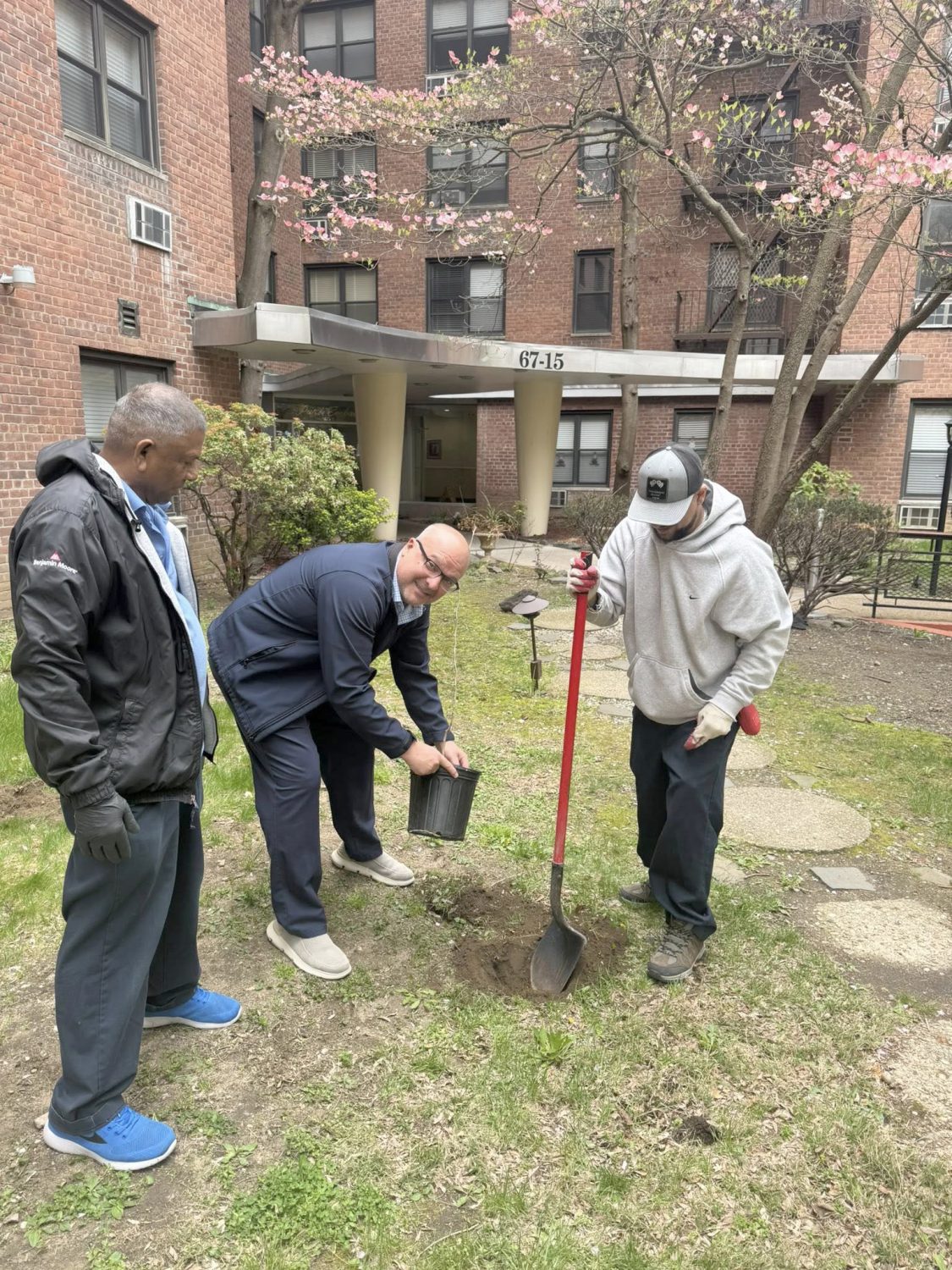
Planting a tree at the Park Embassy with Space Age backdrop.
From 2011 through 2015, this columnist as a member of the Four Borough Neighborhood Preservation Alliance, introduced the multigenerational Forest Hills Tree Giveaway event in MacDonald Park in conjunction with NYRP, and recruited volunteers to donate over 1,200 trees. They were presented with tree certificates, and named after landmarks, notables, and historic street names by Steve Goodman, to encourage greater civic pride and tree stewardship.
Fast-forwarding to 2026, the April 17 tailored tree donation initiative that coincided with NYRP’s tree giveaway season, consisted of Bayberry, 4 Black Gum, 4 Sweet Birch, 2 Beach Plum, and 2 White Flowering Dogwood. Northern Bayberry is regarded as a hardy drought-tolerant 10-foot shrub or a tree with a 15-foot to 20-foot rounded spread. It features numerous branches and glossy dark green, egg-shaped leaves. It bears berries through male and female plants, and is a great supporter of wildlife by attracting birds and butterflies. Showy fall foliage offers hints of red, orange, bronze, and olive.
A Black Gum tree can achieve a height of 30 feet to 50 feet in two decades, and features a pyramidal green canopy and right-angle branches and oval leaves. With its deep red, purple, and orange fall foliage, it is a stunner. Its alligator-hide bark is also a conversation piece. This tree attracts pollinators and wildlife.
Sweet Birch’s highlights include an upright, pyramidal canopy with abundant golden yellow foliage and shimmering red-brown cherry-like bark, and is a magnet for butterflies and a caterpillar/larval host. This shade tree can achieve a height of 40 feet to 60 feet at maturity, attracts pollinators, and supports wildlife.
A Beach Plum tree, with its irregular rounded canopy, matures to be four feet to ten feet with a three-foot to ten-foot spread. It bears fruit in approximately two to three years after being planted, and significant harvests require five to six years. Glossy dark green leaves transform into a vibrant assemblage of orange, red, and yellow come fall.
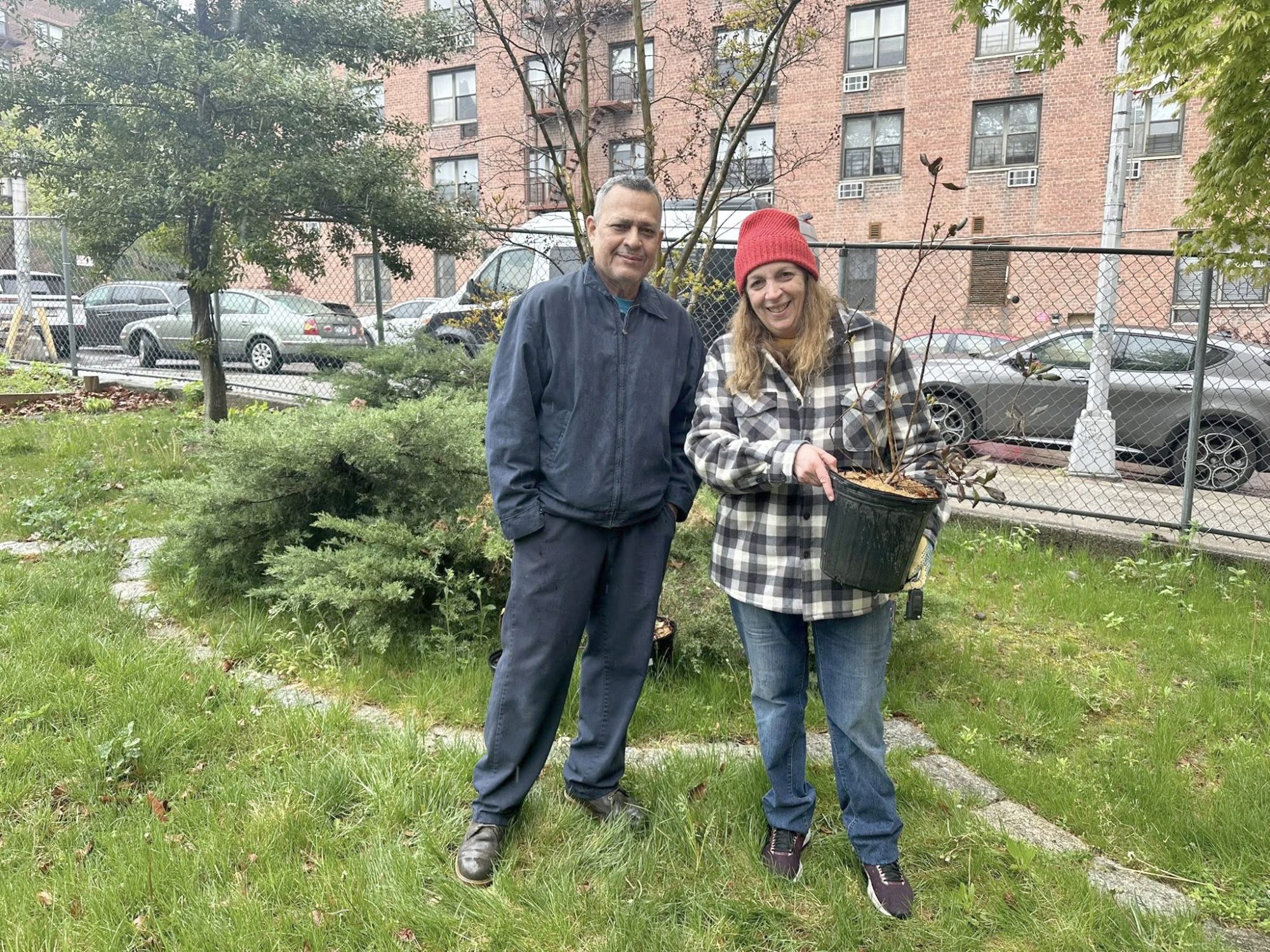
Super for David Minkin with tree adopter Justine Mastanduno.
A (Cornus Florida) Flowering Dogwood greets passersby with abundant white flowers and yellow-green central clusters in the spring, supports wildlife, and attracts pollinators. This slow-growing tree matures to 15 to 20 feet in two decades. In the fall, the light green leaves transition into a reddish-purple. It is recommended to plant it near an Eastern Redbud tree, which coincides in bloom time and also prefers partial shade.
On April 17, quality time was shared with Susan Varo, a superb visual artist from Rego Park, who was proud to lend a helping hand on 67th Road, north of Queens Boulevard, and collaborate on a discussion about nature and community pursuits. As the founder of My Works of Art, LLC, she paints city-inspired and natural scenes, as well as portraits of notables, and produces mixed media for holidays and daily themes. She may even paint the donated trees as a record of their beauty and growth, and as a symbol of branching out as a team.
“My landscape artwork is heavily inspired by many of the beautiful trees I have come to admire in the Forest Hills area,” said Varo. “My impression of seeing this addition of young trees against the long-standing flourishing trees fenced behind them, allowed me to envision what this assortment of saplings may become years from now. From buds to blossoms, I am sure they will be all inspiring for generations to come. I’m very grateful to be able to share in this experience, and acknowledge the diversity of these trees and how very important they are to our environment.”
Park Manor at 100-25 Queens Boulevard, was the recipient of several trees. This clover-shaped residential building, erected in 1958, was designed by award-winning architect Philip Birnbaum, who was a tree lover. “It’s good to have trees around. It makes the place greener,” said super Jimmy Hoti, who adopted five trees. Over the years, its four blocks were Forest Hills Tree Giveaway recipients of diverse species, including White Flowering Dogwood, Eastern Redbud, Red Buckeye, Oak, and River Birch, adding to the mature London Plane and Evergreen trees, among others.
“I like to plant trees and flowers all I can,” said nature enthusiast Roberto Soto, who is the super of the Mid-Century Modern style Park Embassy at 67-15 102nd Street for 10 years, and works in accordance with David Minkin Management for 28 years. He was among the firm’s supers who lined up with much passion at the nearby Monaco-Monte Carlo’s private garden, where each posed with a tree in their hands.
Erected in 1961, Park Embassy features a huge lawn and side gardens, and a unique pre-1964 World’s Fair and Asian-inspired bridge that leads to a rare Space Age style sweeping columned entry marquee. This distinctive address is also where prominent builder David Minkin once resided. The super planted six saplings, inclusive of the front lawn and the east garden. The species, excluding Beach Plum and Northern Bayberry, adds to the diversity of Autumn Flowering Cherry, Purple-Leaf Plum trees, and mature Honey Locust and Pink Dogwood, among others.
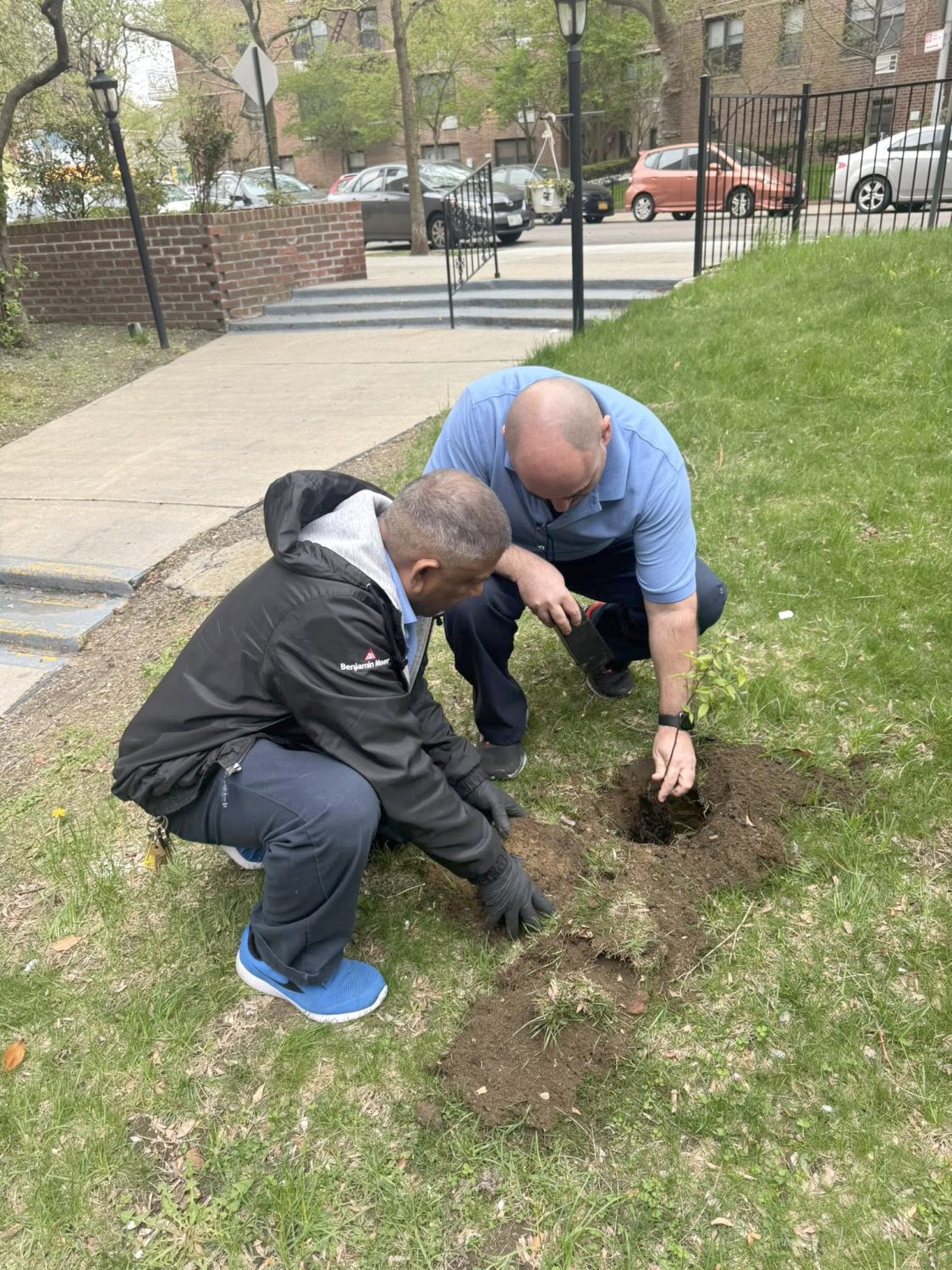
Planting a tree near the Park Embassy’s path.
David Minkin Management property manager Leslie Hayden takes pride in being born and raised in Forest Hills. “As a property manager, it has been especially meaningful to manage properties in Forest Hills and Rego Park—communities that feel like home,” she said.
She reminisced 2011 as if it was yesterday. “I first met Michael Perlman when he was coordinating his first Forest Hills Tree Giveaway (June 2011), in response to the September 2010 macroburst. In the aftermath of the storm, Michael reached out about adopting trees to help replace ones we lost. It was an incredible opportunity to restore what had been damaged and begin anew. Our superintendents have lovingly cared for those trees ever since, and together we’ve watched a beautiful diversity of species take root and flourish throughout Forest Hills and Rego Park. I’ve told Michael that if the opportunity arises, I would love to volunteer locally.” One of Hayden’s favorite poems is Joyce Kilmer’s “Trees,” written in 1913. “It is a reminder of the beauty, majesty, and quiet strength that trees bring to our lives. All of us continue to celebrate not only their grace, but the health and well‑being they bring to our neighborhoods,” she said.
.
The poem reads:
“I think that I shall never see
A poem lovely as a tree.
A tree whose hungry mouth is prest
Against the earth’s sweet flowing breast;
A tree that looks at God all day,
And lifts her leafy arms to pray;
A tree that may in Summer wear
A nest of robins in her hair;
Upon whose bosom snow has lain;
Who intimately lives with rain.
Poems are made by fools like me,
But only God can make a tree.”
On a cold and rainy weekend that followed, Justine Mastanduno, the longtime Kew Gardens Cinemas manager, adopted a Northern Bayberry tree. It will be planted over the weekend at The Compost Collective’s apiary on Yellowstone Boulevard and Kessel Street in Forest Hills. She proudly volunteers with originators Carlos Pesantes and his wife Renee Rivera. “Receiving the tree as a gift from Michael was an honor. It is the gift of life, not only because it is a living entity, but because it will support life,” said Mastanduno. “I love knowing the birds will enjoy the cover of its leaves, which native bees also use for their nests. The berries should last well into winter, offering sustenance for wildlife. It is so important to plant native flora. Our ecological health depends on us to help maintain it by planting natives.”