Being A Tree Hugger on Earth Day & Year-Round
Views: 14
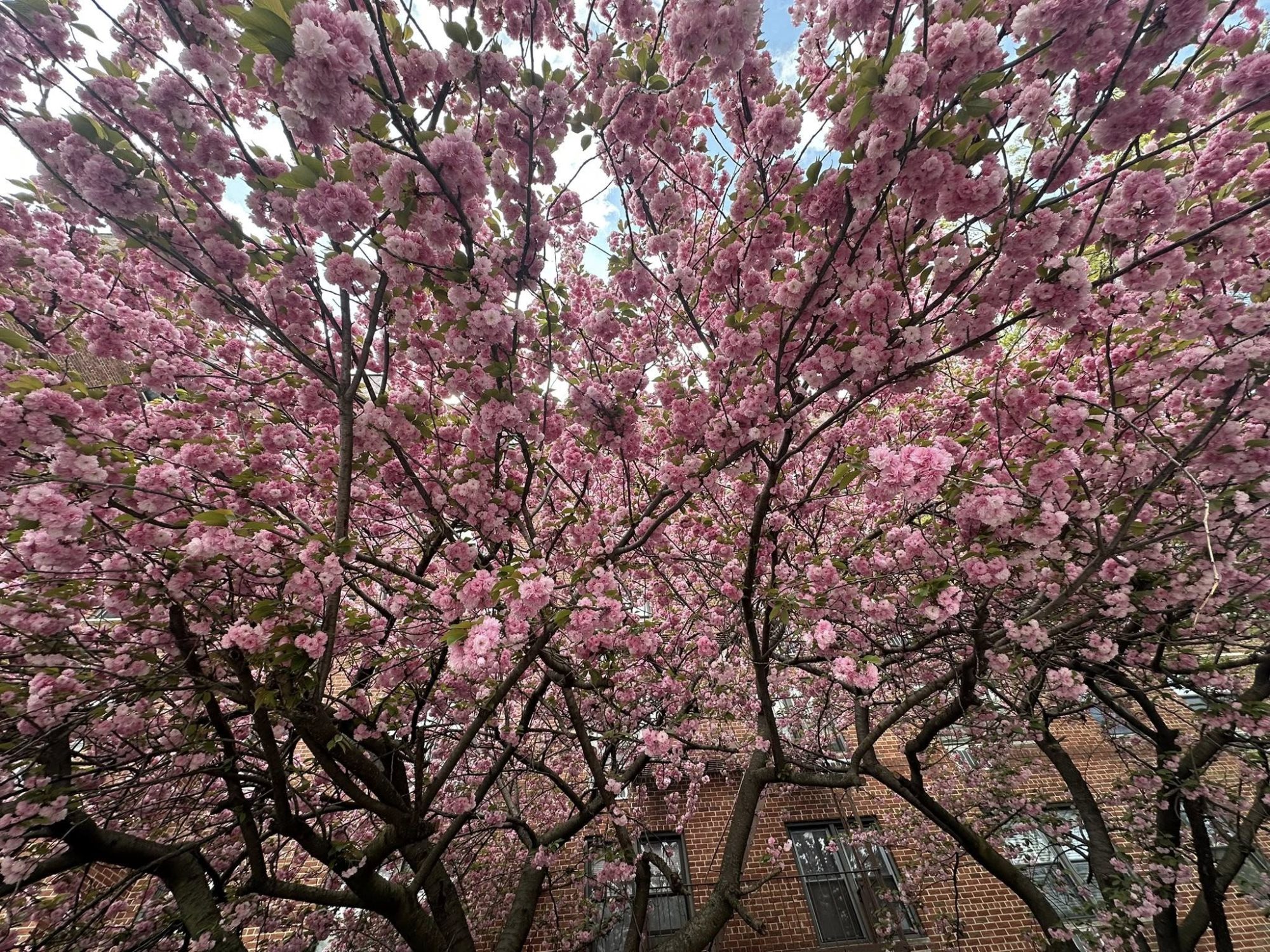
Looking up at a Cherry tree, Haddon Hall, Photo by Michael Perlman.
By Michael Perlman
Chairman, Rego-Forest Preservation Council
The five boroughs are home to over 7,000,000 trees and counting, representing greater than 200 species. Under a beaming sun on a mild spring day, blooming opportunities are underway as residents embark upon a leisurely stroll throughout their neighborhoods. Buds and blossoms emerge among a diverse extended family of trees, a sea breeze sensation may become apparent, birds harmoniously chirp and warble, and squirrels forage. Distinctive architectural details become an idyllic complement of a colorful canvas of revitalizing trees, ranging from weeping to columnar to rounded crown varieties.
A closer eye can be taken as one glances upward or pans in an omnidirectional manner alongside an allée or encounters a majestic solitary tree, and fulfills their additional pair of lenses as a photographer, painter, illustrator, writer, poet, storyteller. The gifts of nature continue to unfold as an individual or team helps preserve trees or plants the bearings of a monumental pillar. Under routine maintenance, trees can communicate most effectively with people, wildlife, and each other year-round, such as through their underground mycorrhizal network, linking their roots. Trees can also tell stories that are realized with one’s eyes and shaped by meteorological history. Trees are quite a performer and an audience.
Earth Day can be felt throughout the year, and the holiday accentuates the need to commit good deeds for an environmental chorus of showstopper trees, as well as engage in alternate clean air initiatives among others. The inaugural Earth Day on April 22, 1970 was conceived by Senator Gaylord Nelson of Wisconsin, and coordinated by Denis Hayes, a 25-year-old environmental advocate who spread the concept nationally. He is also responsible for playing a role in shifting environmentalism from specified causes such as wildlife conservation to an extensive movement that continues to be unified. At the time, an estimated 20,000,000 nationwide residents attended events in community gathering spots and schools. It became a catalyst for the Environmental Protection Agency, established by President Richard Nixon, and the Clean Water and Endangered Species Act. According to the Library of Congress, on Earth Day’s 20th anniversary, over 200 million residents spanning 141 countries participated in festivities, which was also under the leadership of Hayes.
According to the Parks Department, Union Square Park was an ecological carnival, which became the focus of numerous Earth Day observances and teach-ins throughout the metropolitan region. “Some 100,000 people were estimated to have thronged to the square in one of the largest demonstrations since the socialist rallies of the 1930s. The empty streets resulted in at least one picnic spread at the intersection of 57th Street and Fifth Avenue, and Mayor John V. Lindsay repeated the idea during the summer of 1970 when he closed Fifth Avenue to traffic for four successive weekends. The City also banned cars for the day in Central Park in Manhattan, Brooklyn’s Prospect Park, Forest Park in Queens, and Silver Lake Park in Staten Island.”
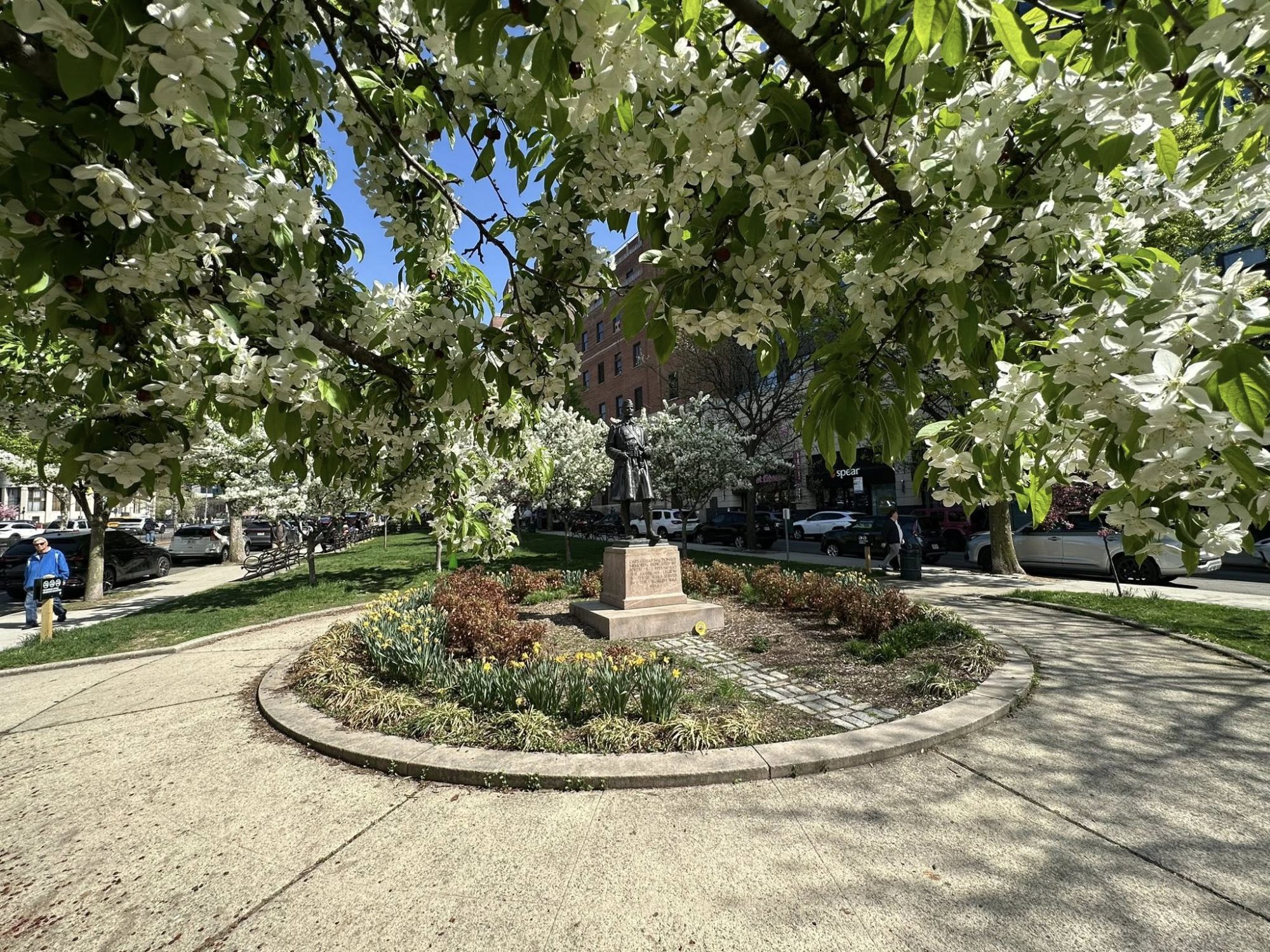
Spring blooms frame the Captain Gerald MacDonald Statue, Photo by Michael Perlman.
Preserving and expanding upon a diverse tree canopy can offer immense benefits in the name of beauty, wildlife, property values, curbing air pollution, providing shade, absorbing stormwater, harboring history, boosting well-being, and fostering spiritual and creative energy. Planting trees is equally as important as maintaining mature trees that unite generations and offer additional environmental, economic, and scenic benefits, which often come with size and age.
On Earth Day and year-round, one can be a tree hugger to reduce stress hormones and boost immune function. “Our city’s trees have supported us through thick and thin; keeping our city cool and our lungs healthy. To show your appreciation for our trees, why not give them a hug? It’s okay!” stated the Parks Department.
Throughout Forest Hills and Rego Park, as well as citywide, and alongside graceful and colorful Daffodils, Hyacinths, Tulips, and Forsythias, stand a number of picturesque fragrant trees, especially after the arrival of spring. On Earth Day and thereafter, it is beneficial to understand a selection’s distinguishing characteristics, and then expand one’s discoveries.
The striking yet graceful Eastern Redbud is noted for its rosy pink clusters and heart-shaped leaves, which appear on branches and trunks. They are drought tolerant, a supporter of wildlife, have a round vase-shaped canopy, and at a medium growth rate, achieve 20 to 30 feet in two decades, which is considered small.
Pagoda Dogwood offers creamy white flowers and horizontally tiered branches that resemble an oriental style pagoda. It ranges from 15 feet to 30 feet in height at maturity, with a 15-foot to 30-foot spread. Its canopy is rounded and irregularly shaped. In the fall, the leaves turn burgundy. Another popular variety is a Pink Dogwood, which produces soft pink blossoms with white accents each spring, and matures up to 25 feet. It offers a rounded canopy with low branches.
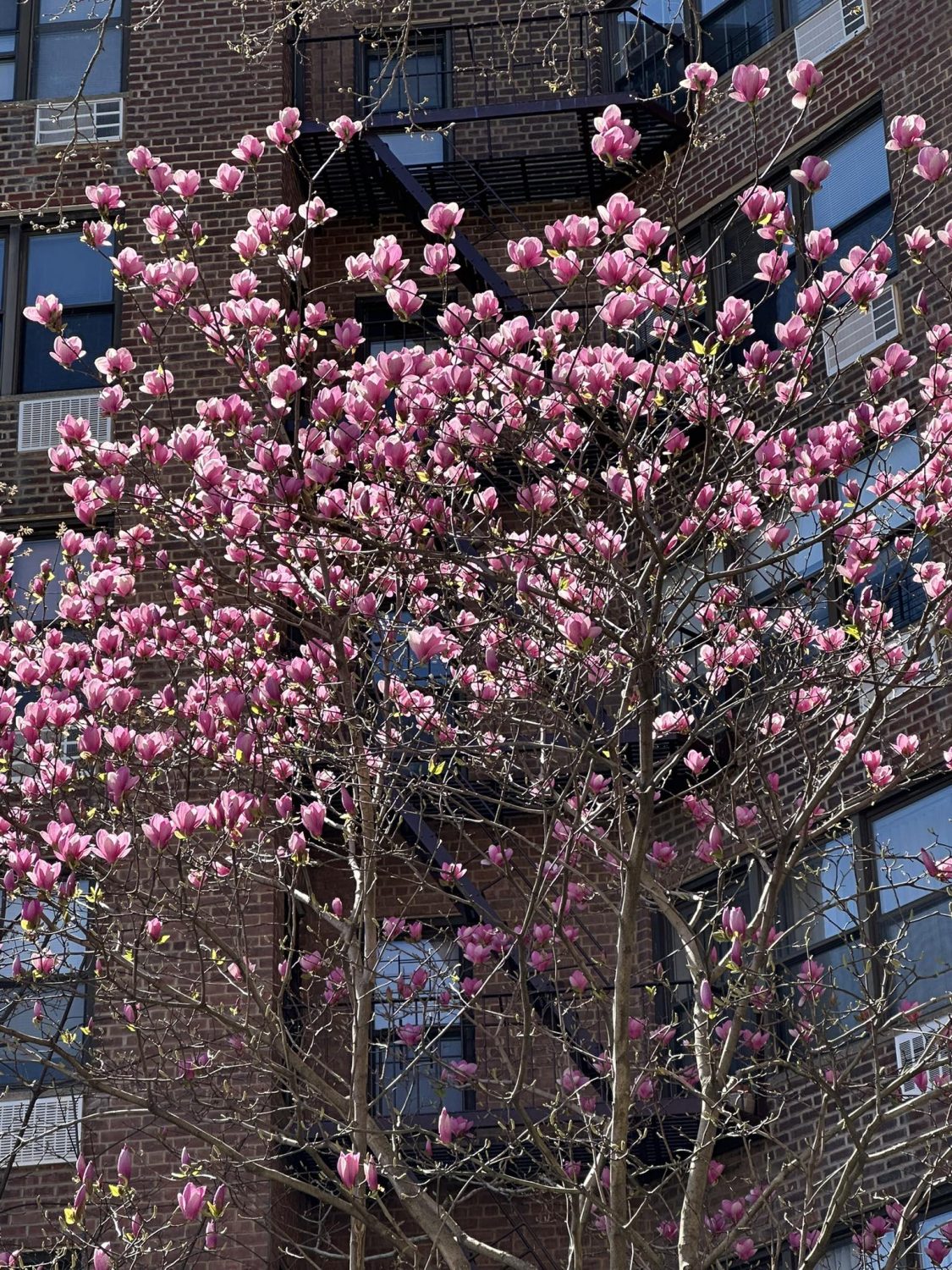
Magnolia, Park Manor, Photo by Michael Perlman.
Sweetbay Magnolia features cup-like creamy white flowers atop semi-evergreen leaves that are glossy green on top and silvery-white beneath. This columnar vase-shaped tree reaches up to 50 feet at maturity, with a 25-foot spread, and supports wildlife. Jane Magnolia is praised for its large tulip-shaped flowers that are pinkish purple on the outside and white within. It blooms in early spring, prior to the appearance of glossy green leaves. Granting distinction from others Magnolias, the Jane variety, which reaches a height of 15 feet with a maximum 12-foot width, is an ideal candidate for small gardens, and it maintains resilience towards colder temperatures. MacDonald Park and the Park Manor apartment building in Forest Hills are home to outstanding examples.
Allegheny Serviceberry produces white flowers and bears fruit every two to three years. Narrow petals and heart-shaped to elliptical leaves are distinguishable. Its edible juneberries, which attract pollinators, are beneficial for over 40 bird species and bees. It is also praised for its orange-red fall foliage. In 20 years, it can reach 20 feet, and in 40 years, up to 25 feet.
The fragrant Kwanzan or Kanzan Cherry trees are among the favorites of all New Yorkers, with their distinctive deep pink double blossoms. “These trees were part of a 1912 gift to the people of the United States made by the Mayor of Tokyo. The famous cherry trees around the Tidal Basin in Washington, D.C. also came from this gift on behalf of the people of Japan. While you can spot Kanzan cherries in full bloom in many places around Central Park, the most spectacular display can be found on the west side of the Reservoir, near 90th Street on the Upper West Side,” states The Central Park Conservancy. They achieve a height of 25 to 40 feet at maturity.
An alternate favorite is the fragrant Yoshino Cherry tree, distinguished by white to pale pink blossoms. This species also signifies a gift of friendship by the Japanese government. The oval leaves feature a narrow base. Okame cherry trees are often the earliest variety to blossom, and are notably found near the Unisphere and New York State Pavilion. According to the Parks Department, the flowers are light pink, but with a long deep red calyx, which is the cup-like component that holds the petals together. From a distance, the calyx and reddish-brown flower stalks grant its showy deep pink appearance.
A Callery Pear tree was nursed back to health after surviving September 11th, and would become known as “The Survivor Tree.” It is popular throughout New York, especially as a street tree, and is a native of China and Vietnam. Its canopy is upright conical and may feature a rounded crown. It is distinguished by clusters of small snow-white flowers, where each flower has five petals. The glossy green leaves on top to a pale green on the bottom modifies its colors in the fall, ranging from yellow and orange to red, pink, purple, and bronze.
Fast-growing Red Maple trees, which can reach 60 feet at maturity, produce early spring flowers that are small and unique, and offer a distinctive canopy from a distance and a pyramidal or rounded crown. Red Maples provide various ecological benefits. In the fall, its scarlet foliage is stunning.
A low-branch Sargent Crabapple often achieves growth of up to 10 feet, and extends up to 15 feet in width. In the spring, deep pink buds bear five-petaled white flower clusters, and in the fall, the show continues as dark green foliage turns bright yellow. Small bright red fruits attract birds.
To maintain and expand upon a diverse urban tree canopy, consult with the Parks Department, Partnerships For Parks, Tree Time, New York Restoration Project, and the Arbor Day Foundation, while being a daily tourist in your own neighborhood.
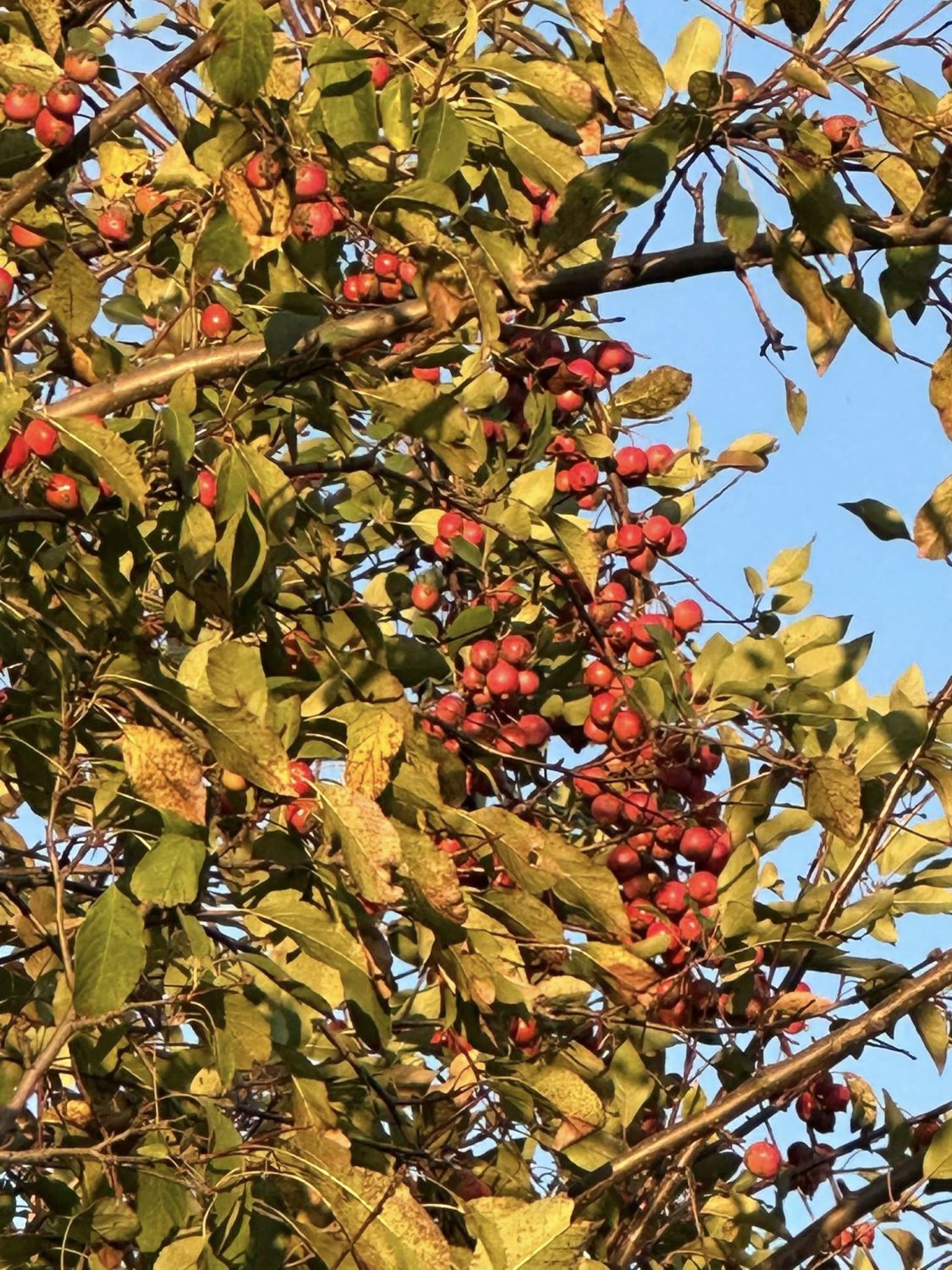
Crabapple tree, Park Manor, Photo by Michael Perlman