Architectural Street Co-Naming Initiative Underway
Views: 215
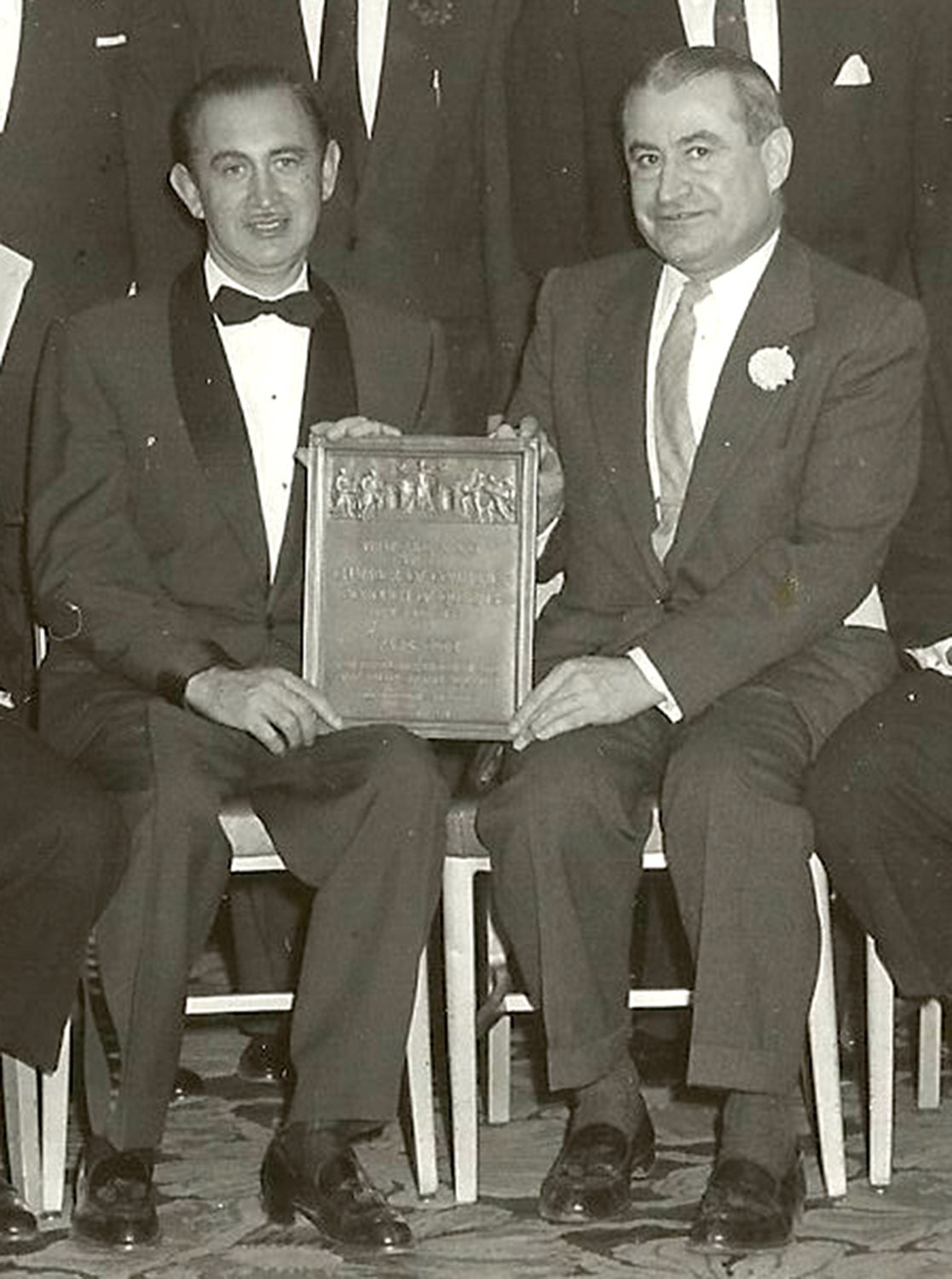
Alfred Kaskel & Philip Birnbaum, 1st prize plaque by Queens Chamber of Commerce for the Metropolitan Industrial Bank Building, Dec 1952 awards dinner
Honoring Prolific Architects in Forest Hills & Rego Park
By Michael Perlman
Throughout New York City, passionate residents, community organizations, and elected officials become community stewards and preservationists after advocating for the co-naming of a street intersection in commemoration of an influential figure posthumously or a historical event. As Chairman of Rego-Forest Preservation Council, this columnist launched an initiative to co-name streets after significant architects of Forest Hills and Rego Park, who also influenced other sections of the city and beyond. Aspirations include “Philip Birnbaum-Alfred Kaskel Way,” “Manoug Exerjian Way,” and “Benjamin Braunstein Way,” and the potential for opportunities is bound to rise. To date, descendants of architect Philip Birnbaum and partner builder Alfred Kaskel, as well as a descendant of architect Manoug Exerjian, granted their support. The intersections will be announced after drumming up community supporters.
Achieving diverse street co-namings is significant, analogous to Queens being the most culturally diverse borough countrywide, and being a mecca for personal achievements spanning every industry and talent. In Queens, some of the numerous street co-namings are Rabbi Dr. Asher Murciano Way, Geraldine Ferraro Way, Harry Van Arsdale, Jr. Avenue (69th Road), Abe Miller Way, Walter Becker Way, The Ramones Way, Rue Barry Lewis Way, Detective Jeffrey A. Lee Way, Ilyau Aronov Corner, and Alex Braginsky Drive.
Forest Hills (named 1906) and Rego Park (1923) were recognized by the prestigious Historic Districts Council as “Six To Celebrate” communities in 2014 and 2020, respectively, as a result of their architectural distinction alongside cultural and historical significance. It would be inspirational for recent residents and longtimers to learn about the achievements of award-winning architects and builders. They designed early sections of each neighborhood, in addition to individual buildings nearby, and therefore shaped the community.
Dr. Robert J. Birnbaum and his sister, the late internationally recognized artist and producer Dara Birnbaum, support establishing “Philip Birnbaum-Alfred Kaskel Way” in Forest Hills. He explained, “My father Philip Birnbaum and Alfred Kaskel were bonded in their love for the borough of Queens. Their aspirations as an architect and developer was to enrich and enliven the post-World War II lives of the diverse populations that were making Queens their home, and to ensure the fulfillment of their ‘American Dream,’ as depicted in my late sister Dara Birnbaum’s art piece, ‘Journey: In the Shadow of the American Dream,’ commissioned by the Miller ICA at Carnegie Mellon. These pioneer developers and architects laid the foundation for the vibrant borough we know today.” He continued, “It is important to memorialize their achievements. To date, that recognition has been sparse, if acknowledged publicly at all. It is a blessing that preservationist Michael Perlman and fellow preservation colleague Evan Boccardi of Forest Hills have undertaken doing so through their street naming initiative for each architect.”
Philip Birnbaum and Alfred Kaskel epitomize teamwork in the name of architecture and development, especially throughout Forest Hills, and the duo was among the most significant community visionaries. The majority of their buildings foster neighborliness, exhibit unique architectural and landscape features, and were recipients of 1st prize bronze plaques at the Queens Chamber of Commerce’s annual building awards competition. It is rare for a duo to design and develop a generous section of a neighborhood. Their numerous apartment houses within the confines of Yellowstone Boulevard and 108th Street uniquely merge Colonial and Art Moderne styles, and are attributed as presidential buildings. From 1939 through 1942, they completed the Thomas Jefferson, James Madison, Andrew Jackson, and the Benjamin Franklin. Then in 1949, they continued their presidential/dignitary trend with the George Washington and Grover Cleveland. As innovators, they welcomed Forest Hills residents with detailed large lobbies with picture windows overlooking a central courtyard with a sunken fountain and cherubs, and accompanied by gardens accessible from the lobbies and the street. They are also noted for curved brick corner terraces, soundproofing, and exposures which maximize sunlight and fresh air. Some lobbies were furnished with antiques collected in Europe.
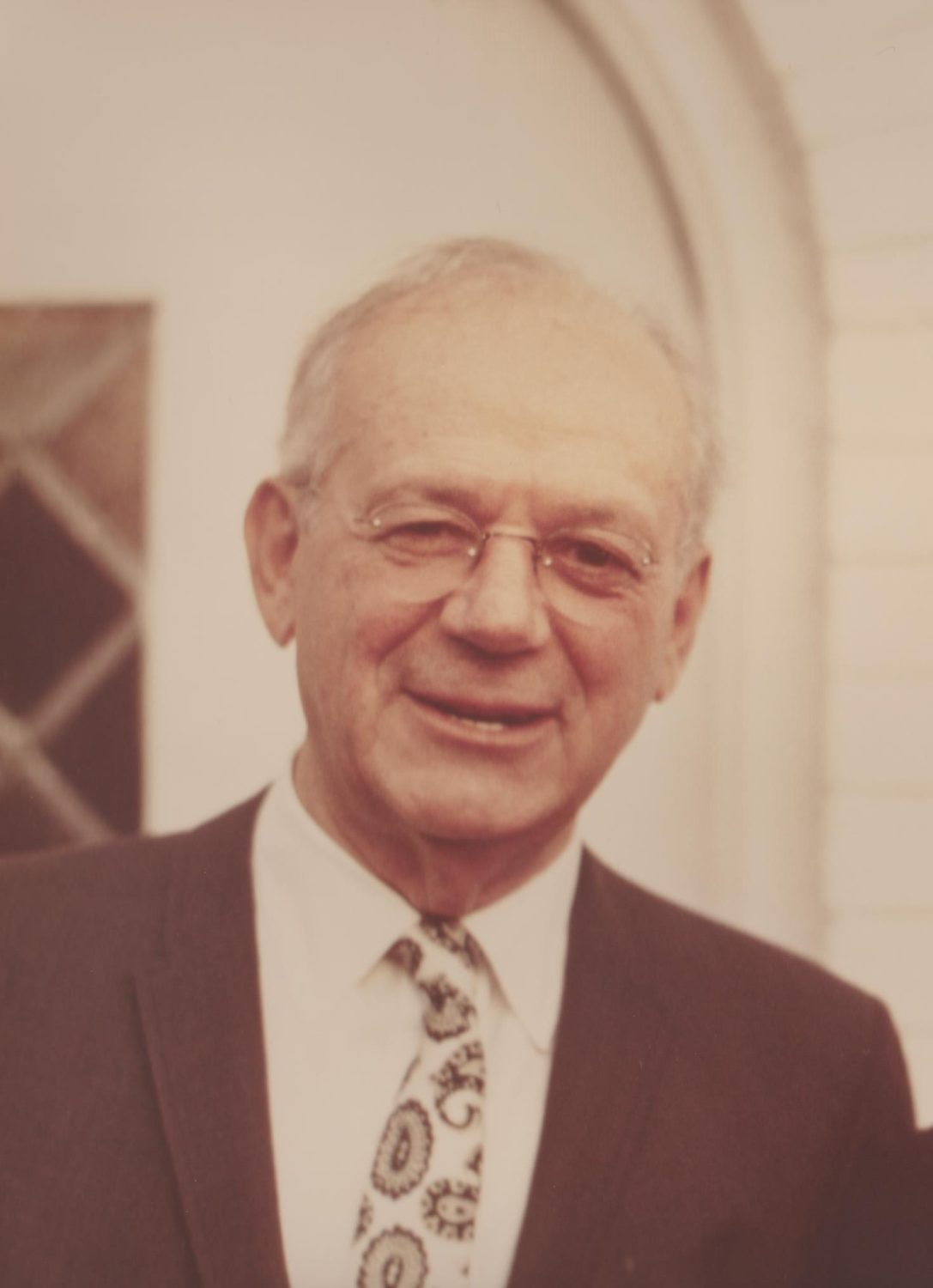
Benjamin Braunstein, Courtesy of his late daughter, Edith Magaziner
Between 1953 and 1955, they introduced the Woodrow Wilson and James Monroe in Forest Hills, and the Martin Van Buren in Rego Park. West of the presidential developments, they introduced the 13-story Howard Apartments in 1952 at 99-32, 52, and 72 66th Road, which was named after Kaskel’s son, Howard, and were the first fireproof buildings of steel and concrete without fire escapes. The Birnbaum family lived in the 99-72 66th Road penthouse. The Anita and Carol apartments in Rego Park were named after Kaskel’s daughters. Dara Gardens, completed in Kew Gardens Hills in 1952 was named after Birnbaum’s daughter.
That year, the award-winning Mid-Century Modern Metropolitan Industrial Bank at 99-01 Queens Boulevard was completed. It was the first regional bank to utilize all industrial materials, distinguished by its colonnade corner with curved glass, stainless steel and Swedish granite fins, triple-height windows, a streamlined teakwood balcony, an Art Deco terrazzo floor, and an interior mural commemorating Colonial scenes in Queens. “I am enamored by the Metropolitan Industrial Bank, which has a very positive and progressive design, especially for that period,” said his daughter, the late Dara Birnbaum in 2015.
For the Pickman family, Birnbaum designed Forest Hills South, a complex of seven Georgian Colonial buildings which face a park-like campus with fountains, north of Queens Boulevard between 76th Drive and 78th Avenue.
They varied from the neighborhood’s typical six-story apartment house with the towering Mid-Century Modern Kennedy House at 110-11 Queens Boulevard, which features a large crystal chandelier in the lobby, bands of terraces, and achieved a record in Queens for a roof deck with a swimming pool. Completed in 1965, it memorialized President Kennedy. “He wanted lobbies of buildings to feel somewhat grandiose, to give a type of prestige to the then rising middle-class,” said Ms. Birnbaum.
As an architect of over 300 buildings throughout New York City, Birnbaum was highly praised for his efficient apartment layouts, where he aimed to eliminate interior hallways, enabling builders to fit additional apartments per floor. He would say that he designed for the residents, in contrast to the elite. In 2018, Ms. Birnbaum explained, “My father’s vision yielded a truly exemplary design that would yield elegance to posterity. He was proud of his achievements, as he came from a very impoverished situation in a Lower East Side tenement, but he really raised himself by his bootstraps and got through Columbia University’s College of Architecture.”
Kaskel, who immigrated from Poland at 21, is remembered as a major post-war period builder. His July 11, 1968 obituary in The Riverdale Press referenced some of his Riverdale buildings, and stated, “His high-rises stand throughout the New York area and in Miami and Miami Beach. At his death, Carol Management owned and managed more than 20,000 apartments, including hotels and office buildings.” It also referenced his (former) $250,000 dancing fountain with programmed music and lighting at Park City and Park City Estates. It continued, “A connoisseur of art, Mr. Kaskel adorned the lobbies of his apartment houses with rare lamps, modern sculptures of metal, and antique statues.”
Architect Manoug Exerjian’s accomplishments signify training by old-world European scholars. Believed to have been born in 1888 in Constantinople, he was a graduate of the Royal School of Architecture in Istanbul, and immigrated to America in 1914, prior to The Armenian Genocide. In 1923, he established an architectural practice in Great Neck. It is believed that he resided at 119-51 Metropolitan Avenue in Kew Gardens with his wife, Arax, and in a Mediterranean Revival style rowhouse at 68-48 Fleet Street in Forest Hills. At the time of his passing in 1974, he resided at 18 Bonnie Heights Road in Manhasset. Locally, he operated branch offices at One Continental Avenue and to the west of The Virginia apartments.
He was the owner of 67th Avenue Realty Corporation, and architect of the award-winning twin apartment buildings, The Virginia at 98-120 Queens Boulevard and The Carolina at 98-76 Queens Boulevard, designed in the Art Moderne style in 1938. The location was highly desirable, since the IND subway line opened on December 31, 1936, and was steps away from the 67th Avenue station. Another incentive was a brief commute to the 1939 – 1940 World’s Fair. The facades evoke the spirit of the Grand Concourse and South Beach, and architecture, art, and landscaping consolidate harmoniously at the duo. A Queensborough publication ad, which spotlighted The Carolina with Manoug Exerjian and Dick Realty Corporation as the owner (and builder), stated “Winner of an award for excellence in design and construction, Chamber of Commerce of the Borough of Queens, 1939 Building Awards.”
As residents take a stroll along the serene section of Austin Street, west of Yellowstone Boulevard, they encounter Colonial rowhouses resembling a touch of the south. Among them are 67-50 to 67-76 Austin Street, which was considered a fine achievement. In a circa 1941 letter from the architect, who also served as the president of the owners as “Houses For Modern Living, Inc,” a description of the two-story award-winning attached residences was included.
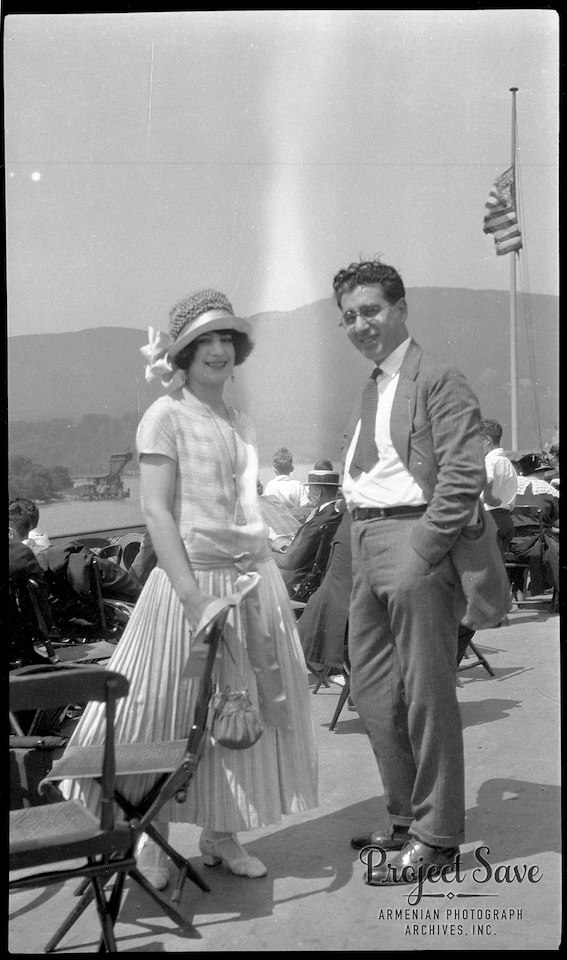
Suzanne Algen Exerjian & her husband Manoug Exerjian, NY, circa 1920 – 1925, Courtesy of the family of Zevart & Cesar Algen
Another significant project is Italian Charities of America at 83-20 Queens Boulevard in Elmhurst, which he designed in a traditionally-inspired Modernist style and completed in 1951. A distinctive characteristic is a unique porch-like curved corner, accentuated bricks, and roundels. It was also awarded for its architectural and civic value by the Queens Chamber of Commerce.
Hastings-on-Hudson resident Ted Andreasian, a well-respected photographer, is the grandson of Exerjian. His artistic eye can stem from his grandpa. “I have always enjoyed and appreciated his work. I am most familiar with his projects in Manhasset and Great Neck (numerous mid-century apartment buildings and shops), as well as the Armenian Church of the Holy Martyrs in Queens, where I attended Sunday School.” When asked if he would support having a street co-naming along with a commemorative exhibit and/or mural, he said, “That would be a very nice gesture.”
Constantinople native Benjamin Braunstein (1892 – 1972) was an award-winning architect, who graduated from the Hebrew Technical Institute in 1908, and continued studying at the Beaux Arts Society, where he won medals. He served in the Army in WWI and launched an independent practice in 1921. In 1934, he served as Queens reconditioning supervisor of the Home Owners Loan Corporation, a government agency that refinanced home mortgages. He was a Flushing Savings Bank VP. His last residence was at 43-69 170th Street.
When Queens’ population doubled in the 1920s and further progressed due to the 1936 IND subway line and the 1939 World’s Fair, he along with his builder colleagues embraced the opportunity. He was acclaimed for his cost-effective large garden apartments, which maximized open space, light, and air, and were a draw for middle-class families. Many of his career’s achievements earned awards at the Queens Chamber of Commerce’s annual building competitions.
Braunstein designed the earliest apartment buildings of Rego Park, which are Remo Hall (Tudor) in 1927 (6 years into his practice), Jupiter Court (Spanish Mission, 1927), and Marion Court (Spanish Mission, 1929), in addition to Our Saviour Lutheran Church (Colonial, 1931) as a client of REal GOod Construction Company, which named the community. He continued with The Sterling (Georgian Colonial, 1939) and the Oxford-Cambridge apartment group (Colonial meets Art Moderne, 1939). All represent his shift in architectural styles.
In Forest Hills, he designed several buildings, including Valeria Arms (Neo-Tudor), Sutton Hall (Tudor; recipient of Rego-Forest Preservation Council’s bronze Forest Hills Historic Site plaque, 2023), the Holland House (Tudor & Art Deco), The Wakefield (Colonial), Tilden Arms (Georgia Colonial), The New Hampshire (Georgian Colonial meets Art Moderne), The Chatham (Georgian Colonial), The Concord (Colonial), and The Bradlee (Colonial). The Greenway (Tudor) is a Forest Hills Gardens standout.
Navigating to Kew Gardens, his projects include The Mowbray (Spanish Mission) and Kent Manor/Hampton Court (Georgian Revival), which is on the National Register of Historic Places. In Bayside, Hawthorne Court Apartments (Tudor) was landmarked in 2014. He also designed Glen Oaks Village in Bellerose, Concord Village in Brooklyn, Beech Hill Gardens in Douglaston, and Mitchell Gardens and Linden Hill cooperatives in Flushing.
“Co-naming after architects of merit is important, and should be done more often,” said Jason D. Antos, a historian and author who serves as Queens Historical Society executive director and Queens Borough Historian. As an experienced street co-naming achiever, he recalled, “In 2015, I worked with Bayside Historical Society to co-name the intersection of Northern Boulevard and Marathon Parkway as Matinecock Way, honoring the history of the Native Americans of Queens. This tribe once resided in villages spanning Little Neck, Flushing, Pomonok, Bayside, College Point, Douglaston, and Whitestone.” “Jackson Heights,” a book by Jason D. Antos and Constantine E. Theodosiou, inspired Council Member Daniel Dromm to support the street co-naming “Manny ‘The Wrong Man’ Balestrero Way” at 73rd Street and 41st Avenue in Jackson Heights.
Antos explained his road to success. “With those street co-namings, we obtained a letter from the family, a letter from elected officials, and then most importantly a vote from the community boards.” Additionally, it can prove helpful to circulate an offline petition to enroll the support of residents along the proposed co-naming location and nearby, consisting of a couple hundred signatures. He is also open to street co-naming collaborations with residents and community organizations.
“I think that street co-naming after architects is very important,” said historian and author Kevin J. Walsh, who is the well-respected face behind the Forgotten New York website. Since 1999, he and guest colleagues have been on a mission to chronicle the unnoticed aspects of the city, which tourists never see, including painted building ads, abandoned subway stations, and out-of-the-way neighborhoods. “I can name one architectural critic, who has a subname street sign on Skillman Avenue in Sunnyside Gardens, which is named for Lewis Mumford,” he continued. Mumford also resided in the Sunnyside Gardens Historic District, where he resided with his wife Sophia and their two children at 40-02 44th Street from 1927 to 1936. Besides being a literary critic, he is remembered as a city planner, historian, and philosopher of technology. He is deemed a most influential urbanist of the mid-twentieth century.
When asked why architecturally-oriented street co-namings are few and far between citywide, Walsh responded, “My thinking is that streets are not often named for architects because appreciating architecture is so subjective. Frank Gehry’s buildings look like crumpled paper to me, but he was renowned.” Nevertheless, one may be hard-pressed to deny the history and significance associated with a majority of classical, Art Deco, and Mid-Century Modern architects, who are recognized by their academic credentials, independent or competition-based accolades, and most notably the architectural beauty and originality of their career’s buildings.
The spirit of architects continues to come alive through facades and interiors that are experienced daily. Their buildings, and especially those that offer charming, distinctive, and perhaps unique facades and/or interiors, become a communal experience and landmark in the eyes of the majority, if not already designated as a NYC Individual Landmark or Interior Landmark, or safeguarded as part of a Historic District. Buildings serve as educational tools, and street co-namings can encompass that, while generating civic pride.
The Queens Name Explorer project features honorable street names and co-names, and parks, monuments, markers, and schools among buildings that are named in tribute to influential figures: https://nameexplorer.urbanarchive.org/pr/nameexplorer. As for architects among other borough-wide position titles, co-namings consist of Lewis Mumford Way, Ivan Mrakovcic Way at 84th Avenue and 114th Street, Peter Magnani Way at 81st Street and 34th Avenue, and Lawrence Murphy Street at 88th Street and 34th Avenue.
To volunteer for the local street co-naming initiative, email mperlman@queensledger.com