Rediscovering Master Architect John Almy Tompkins II: Preserving Tompkins’ Spirit in Forest Hills Gardens & Beyond
Views: 233
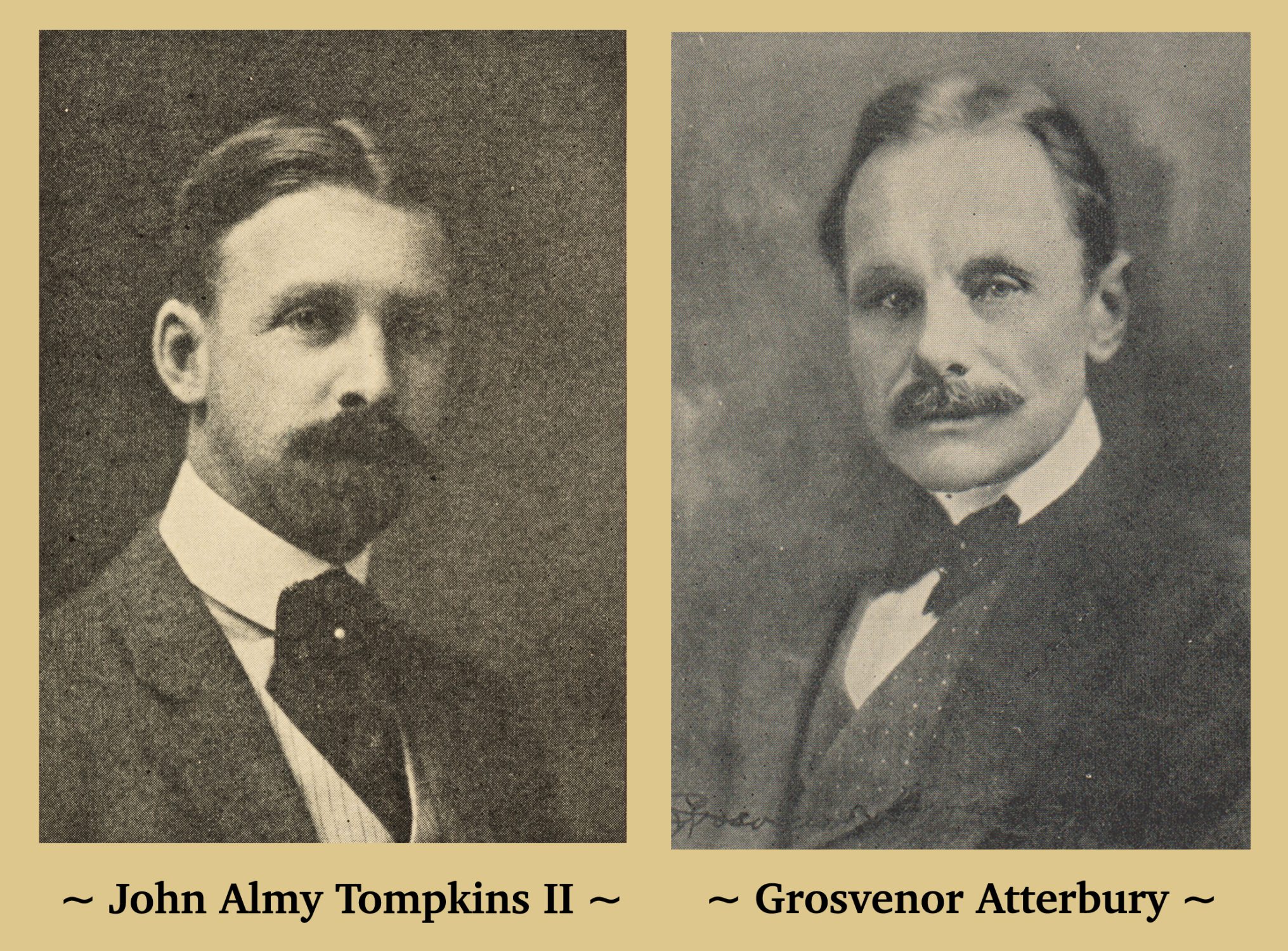
Legendary associated architects.
By Michael Perlman
Historic Forest Hills Gardens, one of the earliest planned garden community in America, is additionally scenic and culturally significant as a result of Architect John Almy Tompkins II (1871 – 1941). But today he is largely forgotten. With his prolific accomplishments, including the Clubhouse of the West Side Tennis Club, and Church-in-the-Gardens and the Community House, evoking the Tudor-style of Sir Ebenezer Howard’s “Garden City” movement, his spirit continues to enrich generations that experience these treasures. The power lies in the hands of current and future New Yorkers to become community stewards alongside the Forest Hills Gardens Corporation and Forest Hills Gardens Foundation by preserving these buildings among others citywide, which ties into his vision and memory being preserved for posterity.
Over a week ago, this columnist acquired a rare piece of history on eBay, and a journey through Tompkins II’s life began to unfold. A 19 by 14-inch two-page spread in the December 1922 edition of “Country Life” was titled “A Cottage Designed to Become a Garage,” and features first and second-floor blueprints, as well as captioned images of his native stone English residence’s façade and interior at 41 Deepdene Road, which he also designed. The cottage was praised for its solid construction, which enabled the potential for its studio to be converted into a garage in support of the rising automobile, and adjoin a larger house. Prior to its development, he resided in Manhattan.
A photo highlights the entrance detail, stating “The door is painted peacock blue, and glows softly like a jewel set in the gray stone wall.” It also highlights a small dining alcove adjoining the studio, where doors open upon a pergola featuring a tranquil wall fountain. Additional charm is initiated by English leaded glass casement windows. A caption reads, “In the studio, the soft gray cement and stone walls throw into effective relief the furnishings and the brick of the fireplace. A wrought-iron grille (above the Dutch chest) contributes a note of beauty, and at the same time gives better ventilation to the kitchenette on the other side of the wall.” The feature continues, “The narrow stairs leading to the balcony and upper rooms are screened with an iron grille reaching to the ceiling. A plush red rope supported by iron rings in the wall serves as a handrail.”
“No house of the village attracts more attention than does the one which is the home of John Almay Tompkins and his friend (editor and writer) Samuel A. Chapin, on Deepdene Road, just east of Olivia Park. Not only does the house charm, because of its individuality and simplicity, but also the attractive garden with its colorful flower beds and the shaded lawn in the rear, where bird bath and fountain attract the featured friends,” read “The Forest Hills Bulletin,” published on October 13, 1923. It was mentioned that “Country Life” readers asked Tompkins to devise plans of that nature for their homes countrywide.
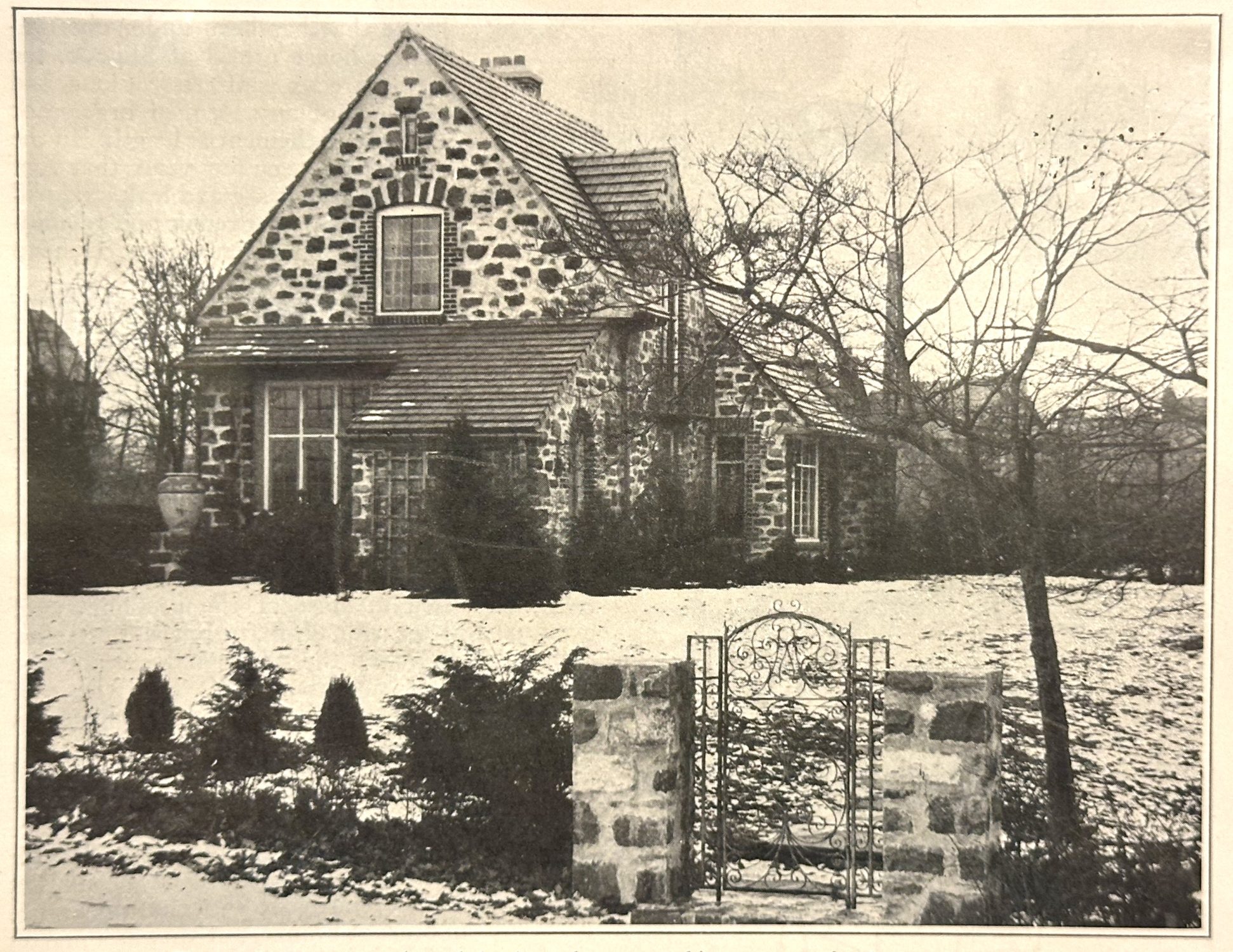
John Almy Tompkins II’s cottage, 44 Deepdene Rd, circa 1922.
John Almy Tompkins II, a native of Baltimore, Maryland, was the son of Jane Carr Tompkins (circa 1835 – 1910s) and Brevet Brigadier General Charles Henry Tompkins Sr. (1830 – 1916) of the Union Army during the Civil War. They had five children, which also included Anna Tompkins of Cambridge, Massachusetts, Eliza Rodman Tompkins of Forest Hills, Vincent, and Charles Henry Tompkins Jr. After the war, his family prospered, which can be attributed to their status in Baltimore’s social circles. Nevertheless, their family did not abandon their solid roots associated with their Almy lineage in Portsmouth, Rhode Island, consisting of early Colonial settlers.
Tompkins pursued his studies at St. Paul’s School, an Episcopal boarding school in Concord, New Hampshire from 1883 to 1889, and was a Class of 1894 graduate of Columbia School of Architecture, where he earned a Ph.B. After the Civil War, Baltimore was a hub for Victorian architecture and urban projects, which conditioned him to design principles and his path ahead. That consisted of a mix of Gothic and Romanesque, Italian Renaissance, and French Second Empire.
Shortly after graduation, Tompkins established a practice in 1895 and partnered with Gardner Abbott as Abbott & Tompkins from 1897 to 1899. He became an associate architect with Grosvenor Atterbury (1869; Detroit, MI – 1956; Southampton, NY) and was listed in directories circa 1900. Around 1909, he collaborated with Atterbury, Forest Hills Gardens’ principal architect, and was well-regarded as a Russell Sage Foundation aide. Atterbury also collaborated with Frederick Law Olmsted, Jr. of Olmsted Brothers, the prominent urban planner and landscape architect associated with the Gardens. Tompkins and Atterbury operated from 20 West 43rd Street and 139 East 53rd Street.
Tompkins would travel to Great Britain and throughout Europe. He exhibited his work as a member of the Architectural League of New York, located at 215 West 57th Street. As of 1930, he was an elected American Institute of Architects Fellow. He was also a member of the Municipal Art Society, the Alpha Delta Phi fraternity, the University and National Arts clubs, and his pastimes included tennis, football, and golf. In 1918, he was featured in “Who’s Who in New York.” He retired from his career in 1937 as a result of an illness, and resided four more years in Forest Hills Gardens. He was not married and had no children, and neither was his sister, who lived with him at 41 Deepdene Road.
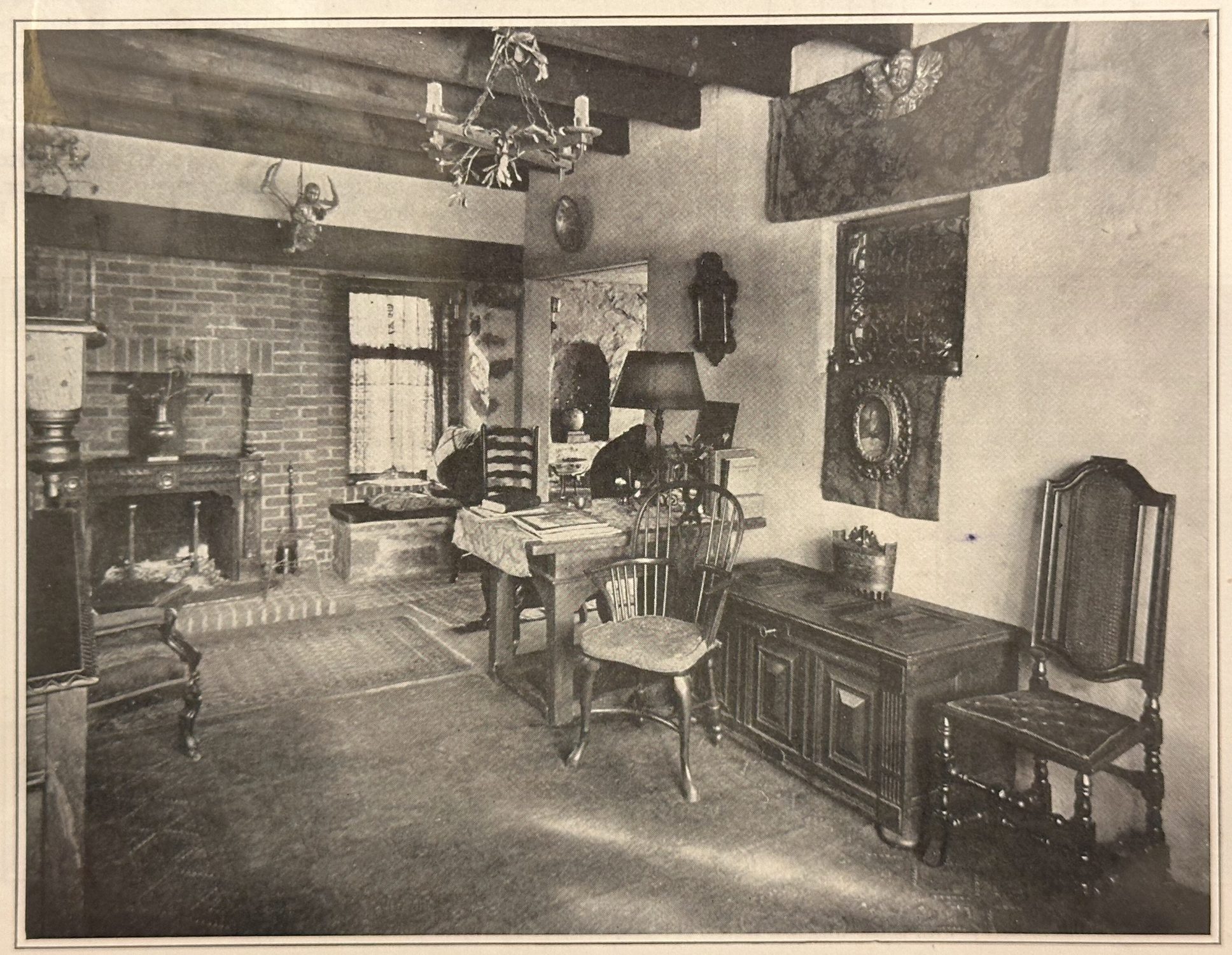
John Almy Tompkins II’s cottage, 44 Deepdene Rd, Studio with a fireplace, circa 1922.
Backtracking, Tompkins supervised the restoration of the landmarked New York City Hall, where he collaborated with Atterbury. Much success was met at the restored Governor’s Room, which philanthropist Margaret Olivia Slocum Sage facilitated. In August 1909, The New York Architect stated, “And now that it has been restored to its original condition together with its decorations and furniture, it becomes one of the real architectural heritages of our municipality that every citizen ought to feel justly proud of and satisfied with. It is a noble and worthy apartment, and the visitor to our city will learn an important lesson of the dignity and beauty of our earlier civilization as recalled by the quiet harmony, exquisite taste, and fitness of this most acceptable room.”
Another landmark is The Russell Sage Foundation Building and Annex at 122 – 130 East 22nd Street, which was initially erected from 1912 to 1913. It served as the headquarters for the Foundation that became known as a foremost social reform organization of the Progressive era and meant to improve living conditions. The NYC Landmarks Preservation Commission stated in their designation report, “Architect Grosvenor Atterbury’s elegant design was inspired by the sixteenth-century Florentine palazzo, but adapted to a twentieth-century office building.” It later reads, “A complementary Annex was built in 1930-31, also designed by Atterbury with associate John A. Tompkins II, for the New York School of Social Research and other agencies.”
Beyond New York City, Atterbury and Tompkins designed the Misquamicut Golf Club in Watch Hill, Rhode Island, and Tompkins designed the Gate Lodge at Dobbs Ferry, New York. In Ridgefield, Connecticut, they collaborated on the stone manor at 24 Old Wagon Road, erected in 1911, and reminiscent of Atterbury’s famed Tudor mansion at 8 Markwood Road in Forest Hills Gardens. They also designed the unique 1904 Sydonie Mansion in Zellwood, Florida, modeled after Alhambra, a palace and fortress in Spain. Tompkins served as a draughtsman for St. Andrew’s Memorial P.E. Church in Yonkers, New York.
A century ago, no expense was spared for the approximate 15-hour Fourth of July Festivals, originating in 1914. The 1924 festival marked the 148th anniversary of America’s independence, and the Celebrations Association of Forest Hills Gardens Inc. held multi-generational patriotic, recreational, and artistic festivities throughout the community, complete with resident celebrities, such as vaudevillian singer, actor, and dancer Fred Stone who performed with his family, Dorothy and Paula Stone on that day. Station Square’s exquisite decorations, designed by Tompkins, made the Gardens’ gateway bloom. Atterbury, Tompkins, and Stowe Phelps (1869 – 1952) designed Fred Stone’s Forest Hills Gardens house at 150 Greenway North, which included a basement where he and his family rehearsed.
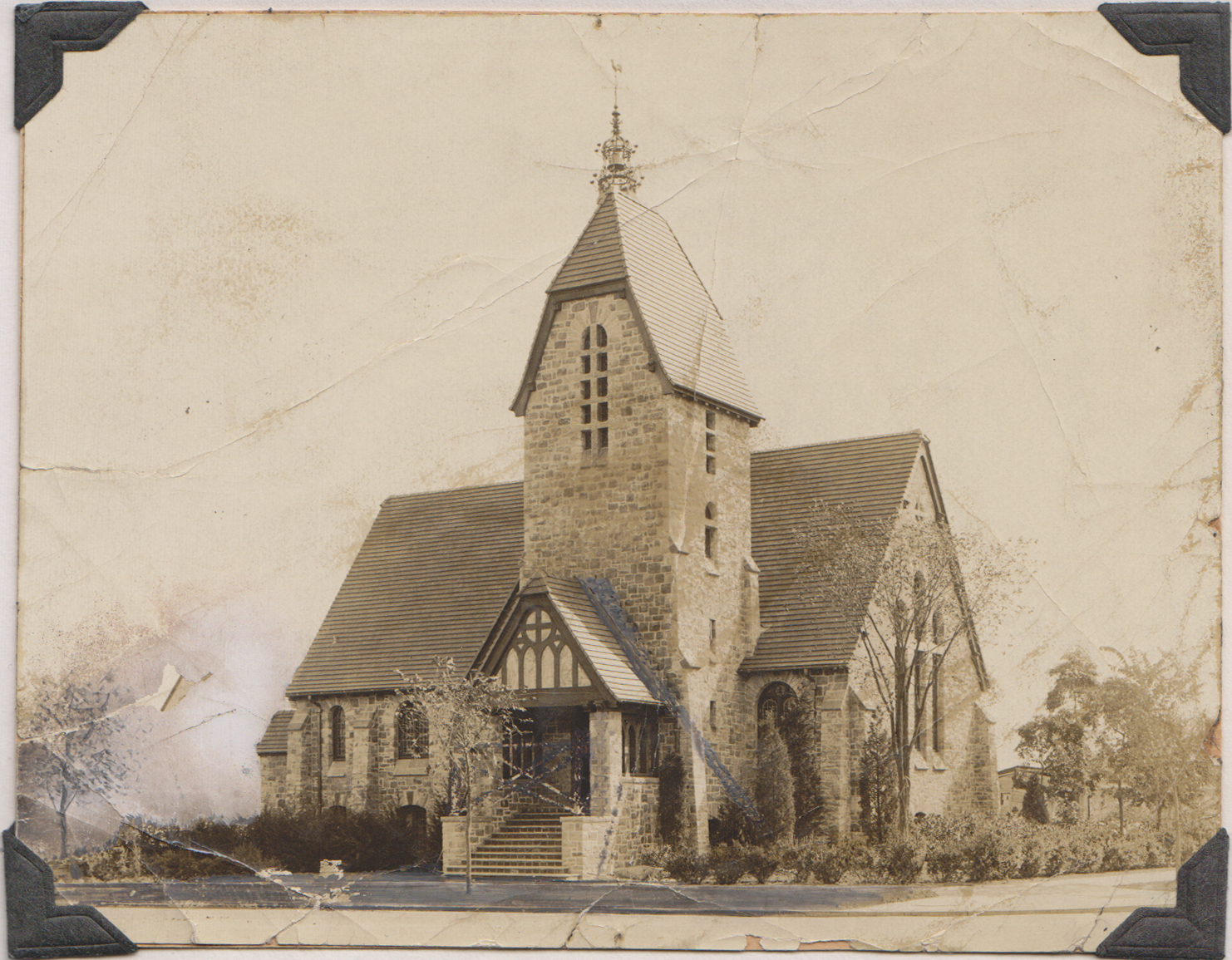
Church in the Gardens shortly after completion. Courtesy of CITG Archives.
In the souvenir program of the opening of the Tudor-style stone and stucco Community House on August 12 to 14, 1926, Tompkins was featured as the associate architect alongside Atterbury and Phelps, and commended for being untiring in his efforts and cheerfully providing advice at all times. William T. Anderson was the builder. Naturally, Tompkins served as Chairman of the Decorating Committee, and collaborated with George H. Merrill and Henry Hof, who also fulfilled his role as Building Committee Chairman, in addition to Mrs. Hof, who generously offered her decorating services. “We have had our Fourth of July Celebrations, our picturesque Christmas entertainments, our Women’s Club, our Men’s Club, the Gardens Players, the Choral Club, the Mothers’ Club and many other organizations. We have needed a center for these activities, and now after such a long wait, we have been rewarded. The Community House is finished!” stated writer Letitia Preston Randall in an excerpt of “An Appreciation.” This general indoor-outdoor meeting destination complemented outdoor assembly spots, including Station Square, Flagpole Green, the Tea Garden, Olivia Park, and Hawthorne Park. A community house was a staple of traditional garden communities.
Nearby is another significant achievement by the Atterbury – Tompkins duo. The West Side Tennis Club was founded in 1892 on Manhattan’s West Side. After outgrowing its third home at Broadway and 238th Street, land was secured at 1 Tennis Place in Forest Hills Gardens for a stately Neo-Tudor Clubhouse, which would overlook tennis courts and portable temporary grandstands. On August 2, 1913, The American Contractor reported a general contract awarded to The Sage Foundation Homes Company at 47 West 34th Street and Forest Hills at an estimated $50,000 for the “Tennis Club House,” but it is believed to have cost $30,000.
“When the new grounds of the West Side Club are completed, there will be nearly sixty courts, which will make this the largest lawn tennis plant in the world,” read the May 4, 1914 edition of the Daily Star. Praise was relayed for their novelty layout. “The courts have been ‘oriented,’ that is, they have been laid out in such a manner that instead of running from north to south, as nearly all courts do, they are disposed so as to catch the sun’s rays in a manner favorable for play at different seasons of the year,” an excerpt continued.
Tompkins was a West Side Tennis Club member and captain, who helped devise arrangements for the grandstands to courts configuration to accommodate an estimated 7,400 spectators in preparation for the National Lawn Tennis Championship in the summer of 1915. He served on a committee alongside J.S. Myrick, Raymond D. Little, Harry Parker, H.C. Martin, Karl H. Behr, Moses Ely, and Lyle E. Mahan.
Not long after, the Club and the U.S. Lawn Tennis Association partnered to finance the 14,000-seat Forest Hills Tennis Stadium, America’s first tennis stadium, designed by foremost public buildings architect Kenneth Murchison (fellow Columbia University Class of 1894 graduate) and engineer Charles Landers in 1923. Today, the Club offers 38 courts featuring five professional-grade surfaces, a pool, dining room, meeting rooms, and social activities.
Making our way to Church-in-the-Gardens at 50 Ascan Avenue, this prized collaboration between Atterbury and Tompkins, secured National Register of Historic Places status in 2009. Ground was broken on August 23, 1914 and the church was dedicated on October 10, 1915. The earliest worship service dates to October 1912 in a Station Square storefront, and it continues to operate as a Congregational church, embracing all denominations. As a philanthropist, Mrs. Sage generously devised arrangements in 1914 to fund the church, which is reminiscent of an English country Tudor Revival church with a stone façade bearing half-timbering and stained glass, and a Norman style roof with steep gables and a bell tower. Stonework and elaborate woodwork is a treat within. The church also accommodates world-class performances by Musica Reginae and the Forest Hills Choir.
Readers picked up the “Reflections of Yesteryear” column in the March 27, 1938 edition of Long Island Sunday Press, which explained that the church features no single architectural style. “Details were taken from various schools. The tower at the entrance is the sort you frequently see in the south of France. All arches are found (Roman) except at the back of the chancel where there are pointed arches. The stone used in the building of the church was mostly taken from nearby fields and hills. The wood in the interior is largely cypress.” The pipe organ and chimes were donated by Mrs. Sage in 1916, and the pulpit and reading desk were gifted by Mr. and Mrs. Robert Weeks de Forest, who were essential figures behind the Russell Sage Foundation’s development of Forest Hills Gardens.
Extending much gratitude to the Forest Hills Gardens Foundation for their dedication as stewards of a valuable expanding resource of historic Forest Hills Gardens photos, bulletins, and documents, as well as collaborating on research to help shape this commemorative column. “The Foundation’s mission entails the preservation of the rich cultural and architectural history of Forest Hills Gardens, one of the first planned communities in the US,” explained Archives Committee co-chair Ann F. Chamberlain. Visit www.foresthillsgardensfoundation.org to explore a searchable resource. To donate vintage photos or reproductions to the archives, or if you are a relative of John Almy Tompkins II, please email foresthillsgardensfoundation@gmail.com and mperlman@queensledger.com.