Helen Keller Comes Home Through U.S. History Teacher David Edelman: Preserving Helen Keller’s Legacy & Embracing “Civics for All”
Views: 228
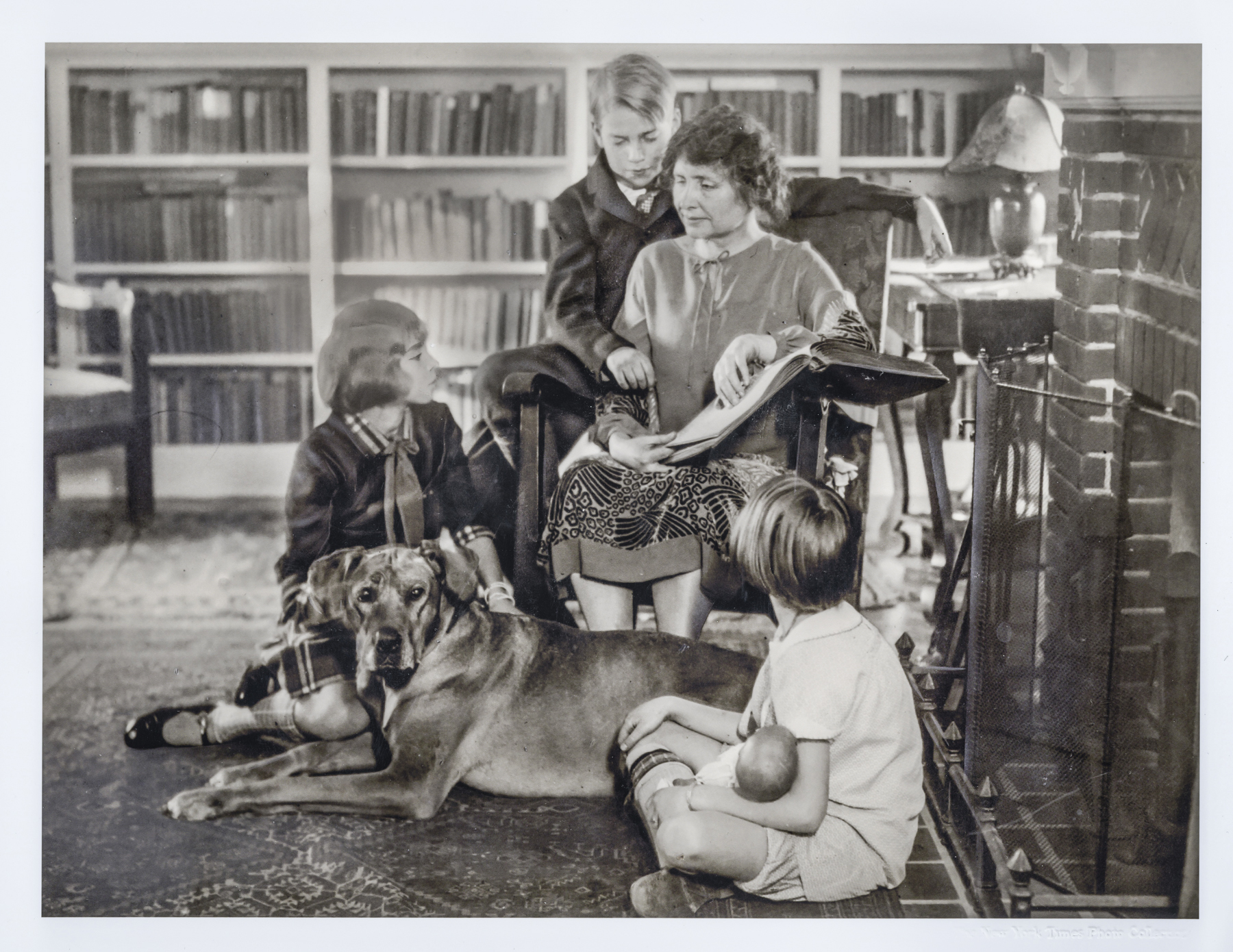
Helen Keller inside her home. Courtesy of Susanna & Robert Hof.
By Michael Perlman
A historic and diverse New York City is largely at the fingertips of 11th grade students at Washington Irving Campus High School, thanks to the civic-minded ingenuity and longtime dedication of David Edelman, a U.S. History teacher from Forest Hills, where he resides with his family for the past eight years.
While walking under the Ascan Avenue LIRR trestle in Forest Hills, residents and visitors encounter the 48-foot by 4-foot “Helen Keller Forest Hills Tribute” mural and plaque, which was developed by this columnist, painted by international muralists Crisp and Praxis, and installed in June 2019. Temporarily, the mural has a protective covering for the duration of adjacent construction pertaining to the LIRR’s accessibility expansion project.
As an advocate, author, and lecturer, Helen Keller (1880, Alabama – 1968, Connecticut) is remembered as a most courageous 20th century figure. From 1917 to 1938, she resided in a brick-gabled and limestone seven-room house at 93 Seminole Avenue, later renumbered 71-11 112th Street, which she nicknamed “our castle on the marsh.” Today, the site accommodates The Reform Temple of Forest Hills, which annually hosts the “Helen Keller Shabbat of Inclusion” featuring a guest speaker, who despite facing a challenge, embraces life to the fullest.
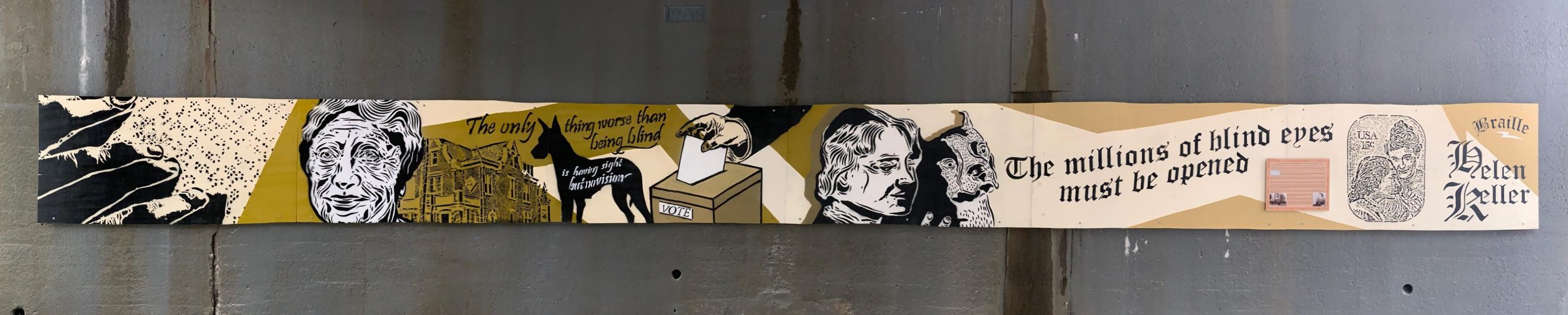
Helen Keller Forest Hills Tribute Mural & Plaque, Ascan Ave.
Enter the world of David Edelman, who prioritizes project-based experiential learning, as he keeps in mind that local history is often overlooked by most schools and their districts. “I am glad that NYC Public Schools and their ‘Civics for All’ initiative supports teachers like myself in teacher leadership endeavors, to develop instructional tasks that help students uncover the often-hidden history that is all around us,” said Edelman.
A few weeks ago, the mural was projected onto a screen in his classroom as part of his civic-minded lesson plans, and it reflected Keller’s challenges and success stories that shaped American history and took her worldwide. “My students consistently point to this and similar projects that extend learning beyond the classroom, as a highlight from their high school experience,” said Edelman.
Students’ impressions about Keller, stemming from the mural and plaque, were in abundance. Edelman explained, “Although I teach in Manhattan, I always have a handful of students from Forest Hills who know the mural and have to do a double-take when they see it on the screen in a moment of ‘Wait, I know that… I’ve seen that before!’ That is a great feeling as a teacher, to help prompt student learning centered on their neighborhoods, and the items they have encountered without much thought previously. Students appreciate the mural’s street art style, and the striking black and white images. Students often make connections between the ballot box and the quotes I share on Keller’s thoughts of American democracy and elections.”

History teacher David Edelman.
It is vital for citywide residents to become aware of our history, and murals such as the Helen Keller project play a superb role in memorializing and teaching the city’s history, according to Edelman. “I appreciate how the mural’s language and illustrations draw connections to the importance she placed on voting. I also use it as a conversation starter in my class to discuss how residents can take action and work together to memorialize the past in creative and meaningful ways.” He inspires his students by saying that an original copy of her autobiography exists in the school library, and if they find it, he will grant participation credit for their course.
Edelman’s students had many questions to ask, and this year it included many misconceptions of Keller, which he explained as new and very surprising. “TikTok and viral videos that often circulate about historical figures spread misinformation. It appears this extends to Helen Keller, since several students said they saw videos that attempt to dispel her vision and hearing limitations through conspiracy theories.” One of his students mentioned that Keller flew a plane, which Edelman was skeptical of, but after conducting research, he learned that she flew a plane for approximately 20 minutes in 1946. “She piloted a Douglas C-54 from Rome to Paris with her companion Polly Thompson relaying instructions via tactile sign language on her hand, demonstrating incredible control and proving the capability of deafblind individuals to operate aircraft with assistance. She described feeling the plane’s delicate movements, and found the experience wonderfully liberating. I love learning new things from my students,” he continued.
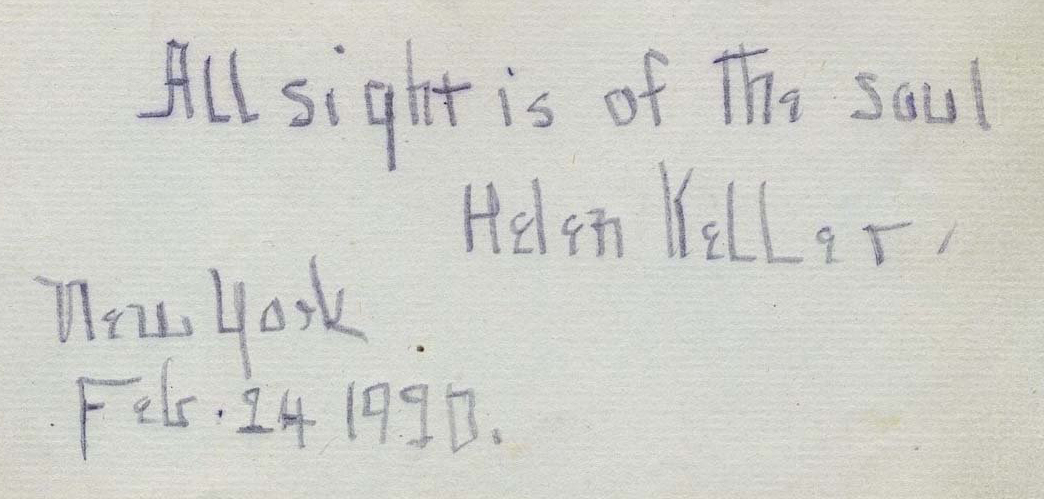
Helen Keller quote and signature, February 24, 1920.
Edelman explained the goal of his Helen Keller lesson plan among the larger picture of the course. “My students who complete the project by developing screencasts and leading walking tours about NYC-centric activists will receive credit towards earning a New York State Seal of Civic Readiness on their High School Diploma, a commendation offered as part of the state’s new initiative to update and modernize graduation requirements. During the fall semester, my U.S. History students read and analyze quotes from different activists from American Reconstruction to the present day. Students select one activist of their choosing with connections to NYC, and develop a presentation that speaks to their life, beliefs, actions, impact, and NYC site connections and memorialization. During the spring semester, students will create virtual screencasts on their activists, and lead walking tours for community members to teach others about the history of our city.” He launched this project and obtained accreditation from NYC public school’s “Civics for All” to enable students to earn credit towards a “Seal of Civic Readiness” in 2024. He previously had students create and lead walking tours about NYC and slavery, both on the side of supporting its institution and fighting for its abolition, to acquire a well-rounded experience in the city as their campus.
Reminiscing about Edelman’s childhood, he learned about Keller as an elementary school student. “Like many students educated in the 1980s, I remember watching ‘The Miracle Worker’ in class. This was perhaps my first introduction to people with sight and hearing disabilities.” Fast-forwarding, he achieved a BA in Economics from The University of Michigan and a Masters in Education from Hofstra University in 2007. Ever since then, it feels as if he is making history as an influential civic-minded teacher. His mother was a NYC teacher and worked at PS 108 in Queens. “My mother and my experience serving in AmeriCorps NCCC inspired me to become a NYC teacher. I am also motivated daily by teaching in a historical school building, which my grandmother graduated from in 1932,” said Edelman. He is also proud that his grandfather, who was a NYC taxi driver, resided in Forest Hills, a neighborhood that he would also enjoy during his childhood.
Much history is to be desired upon encountering the subject of Helen Keller. After she contracted Scarlet Fever, she became blind and deaf at 19 months. She was examined by Alexander Graham Bell, telephone inventor and pioneer speech teacher for the deaf, who referred her to Perkins School for the Blind. At 7, she met Anne Sullivan Macy (1866 – 1936), who was partially blind. “Miracle Worker” Macy lived with her in Forest Hills, becoming her teacher and closest companion, and she later lived with secretary Polly Thomson (1885 – 1960). She had eight dogs, mostly Great Danes, including Sieglinde and Hans. Keller and Macy would attend Sunday services at First Presbyterian Church of Forest Hills.
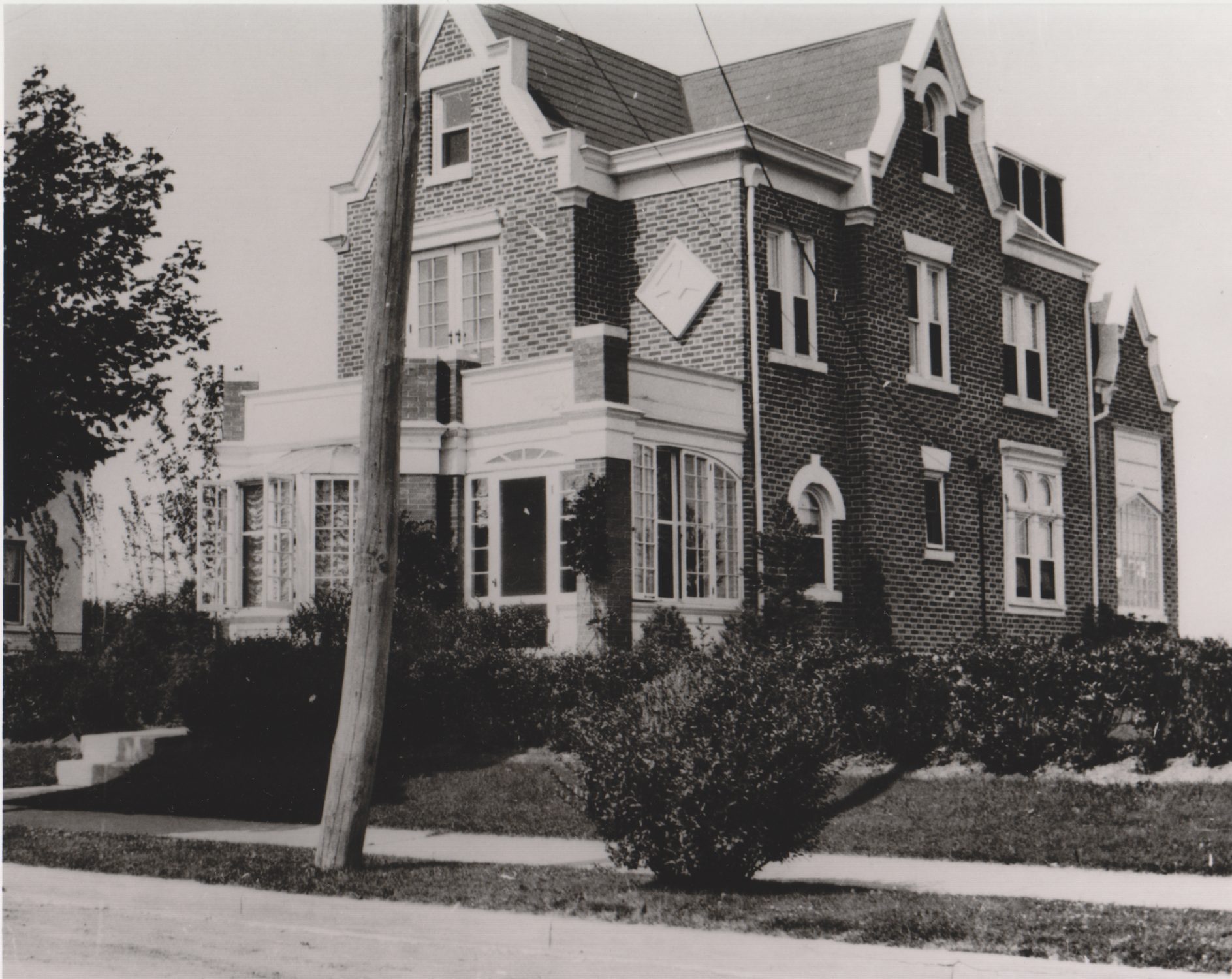
Helen Keller Anne-Sullivan Macy Polly Thomsons house 93 Seminole Ave Later 71 11-112th St. Courtesy of Michael Perlman scaled.
Keller mastered the manual alphabet and learned to read Braille and print block letters. At 9, she began to read lips and communicate. As a graduate of Radcliffe College in 1904 at age 24, she became the first deaf and blind individual to earn a Bachelor of Arts. In 1913, she began lecturing on behalf of the American Foundation for the Blind, and her objective of removing stigmas associated with sight and hearing disorders took her worldwide. Traditionally, such conditions resulted in placing the blind and deaf in asylums. Braille became the international standard in 1932. She also advocated for labor rights and women’s suffrage.
Keller’s published works include “The Story of My Life” (1902), “The World I Live In” (1908), “Out of the Dark” (1913), “Midstream” (1929), and “Helen Keller’s Journal” (1938). She wrote “Into The Light,” a popular column for The Daily Star, a Queens newspaper. On her home’s lawn, she celebrated birthdays by coordinating large parties for the blind, and held fundraising tours to benefit the American Foundation for the Blind. Her guests ranged from journalists to scientists to social workers.
In 1917, Keller welcomed members of the Rainbow Division of Camp Mills, which consisted of 1,200 soldiers from 27 states, who came in through Station Square. She explained, “The Star-Spangled Banner was more than 100 years ago dedicated as a symbol of freedom. We have since that time lived for that flag and for freedom, and I am proud to meet you, who are now ready to die, if need be, for it, that there might be equal rights for all men and women alike. That flag stands for a nation that obeys laws that honor women and protects virtue, and may you soldiers teach that lesson, so that it will be observed in every nation.”
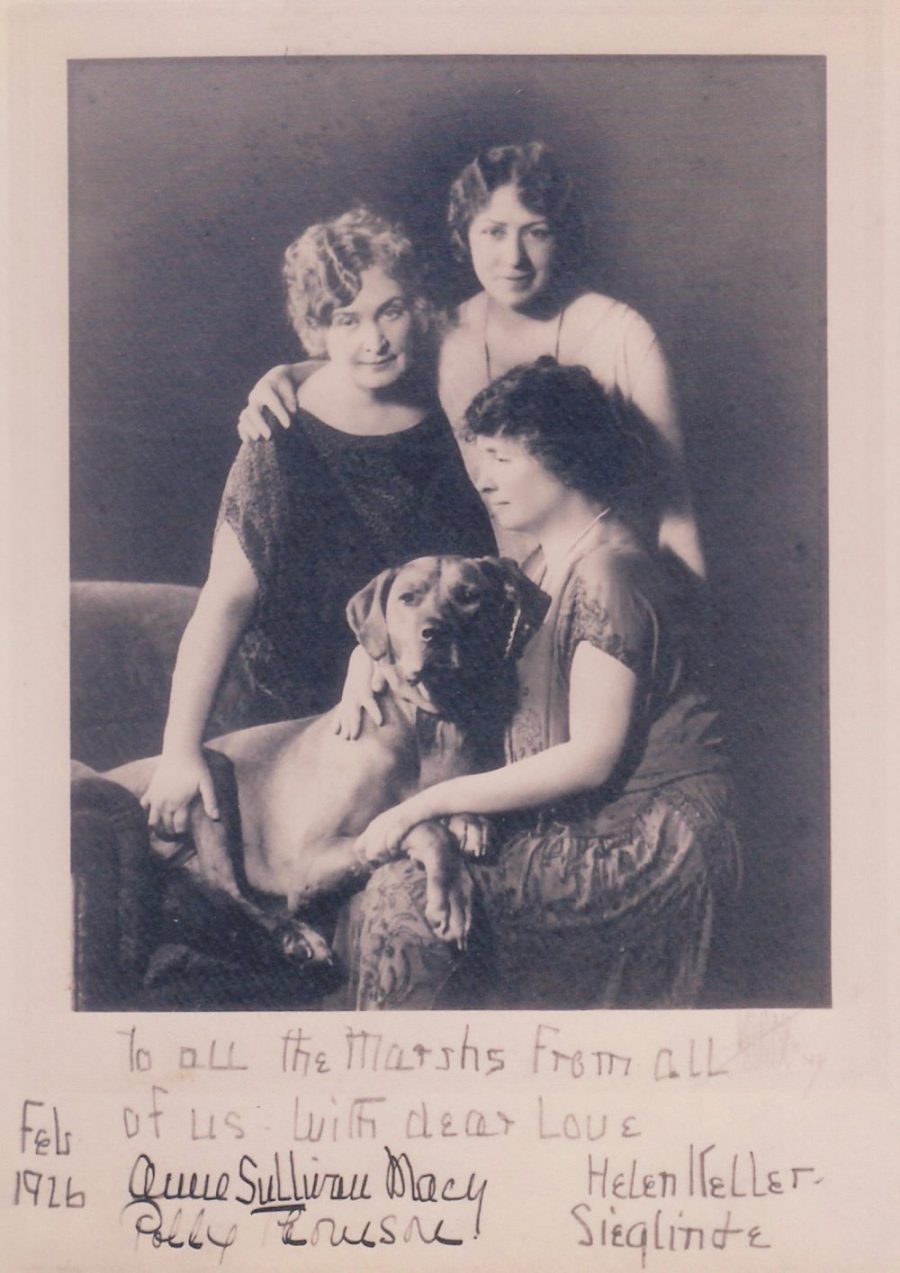
Helen Keller & dog Sieglinde in bottom row, Anne Sullivan Macy & Polly Thomson in top row. Courtesy of the Hof family.
From 1920 to 1924, Keller and Macy partnered for an educational vaudeville act. At the 1925 Lions Club International Convention, Keller stated, “Alone we can do so little, together we can do so much” and challenged Lions to become “knights of the blind in the crusade against darkness.” In 1926, Keller and Macy lectured at the Forest Hills Theatre to over 1,000 guests, to aid in the relief and education of the blind through the American Foundation for the Blind, as part of a national campaign. Edwin Grasse, a blind organist, violinist, and composer accompanied Keller, as organist Samuel Pearce of The Church-in-the-Gardens played.
In 1924, Keller delivered a Thanksgiving address to children of The Church-in-the-Gardens. An excerpt read, “What we think in our hearts, and do, first for the other fellow, and then for ourselves, is the thing that makes us happy, and life worth living. Because people care, the blind receive their sight, and the dumb find their tongue.” She also spoke at The Community House, becoming the first woman to address the Forest Hills Men’s Club in 1928, after being encouraged by its president, Homer Croy, a local notable author, screenwriter, and humorist.
In 1931, with her Great Dane by her side, she presented “How Parents Can Help Their Children” at a Public School 3 Mothers Club meeting, and advised parents to encourage their child to discuss their studies, problems, and interests, but not to criticize and pretend an interest, since insincerity will refuse their confidence. Rather, sympathy will gain their confidence. Today, Edelman’s two daughters walk in the footsteps of Keller, as students of the renamed PS 303.
After the Continental Avenue subway opened in 1936, she wrote with excitement, “Polly and I went to town by the new subway just opened from New York to Forest Hills – that brings me into closer contact with people.”
Edelman finds it “humbling and inspiring” that Keller resided in his neighborhood for 21 years, and was deeply engaged in local civic life. “It transforms her from a distant historical figure into a neighbor whose daily life intersected with the same streets, schools, and public spaces we use today. Her presence makes history feel immediate and personal, reminding me that global impact can grow out of local commitment,” he said.
Edelman feels inspired by her life and teachings, which he is proud to preserve as a teacher. “Helen Keller, despite being blind and deaf, was someone who was able to communicate very clearly and bluntly on issues she felt very passionate about. She was able to establish connections between her life and others, even when their circumstances and backgrounds were very different from her own. Although many people know Helen Keller’s name, her story as a young girl, or a bit about her advocacy for those with vision and hearing impairment, they do not know she co-founded the American Civil Liberties Union in 1920. Her full story often remains hidden.”
Keller delivered empowering statements, such as “The best and most beautiful things in the world cannot be seen or even touched – they must be felt with the heart” and “The only thing worse than being blind is having sight but no vision.” She also said, “The millions of blind eyes must be opened. Society is always creating too much trouble for philanthropy to patch. One must attack social problems at their roots.” Edelman explained, “One of my favorite Helen Keller quotes that I share with my students as part of our ‘Activist NYC Project: Hidden Voices, Hidden Sites’ is ‘We vote. What does that mean? It means that we choose between two bodies of real though not avowed autocrats. We choose between Tweedledum and Tweedledummer.’ She made this statement in a letter written in 1911 to an English suffragist. Women in New York did not have the right to vote until a statewide constitutional amendment measure was approved by male voters in 1917. This victory occurred after it failed two years prior. It would take nearly three more years before the 19th Amendment granted women’s suffrage nationwide in August 1920.”
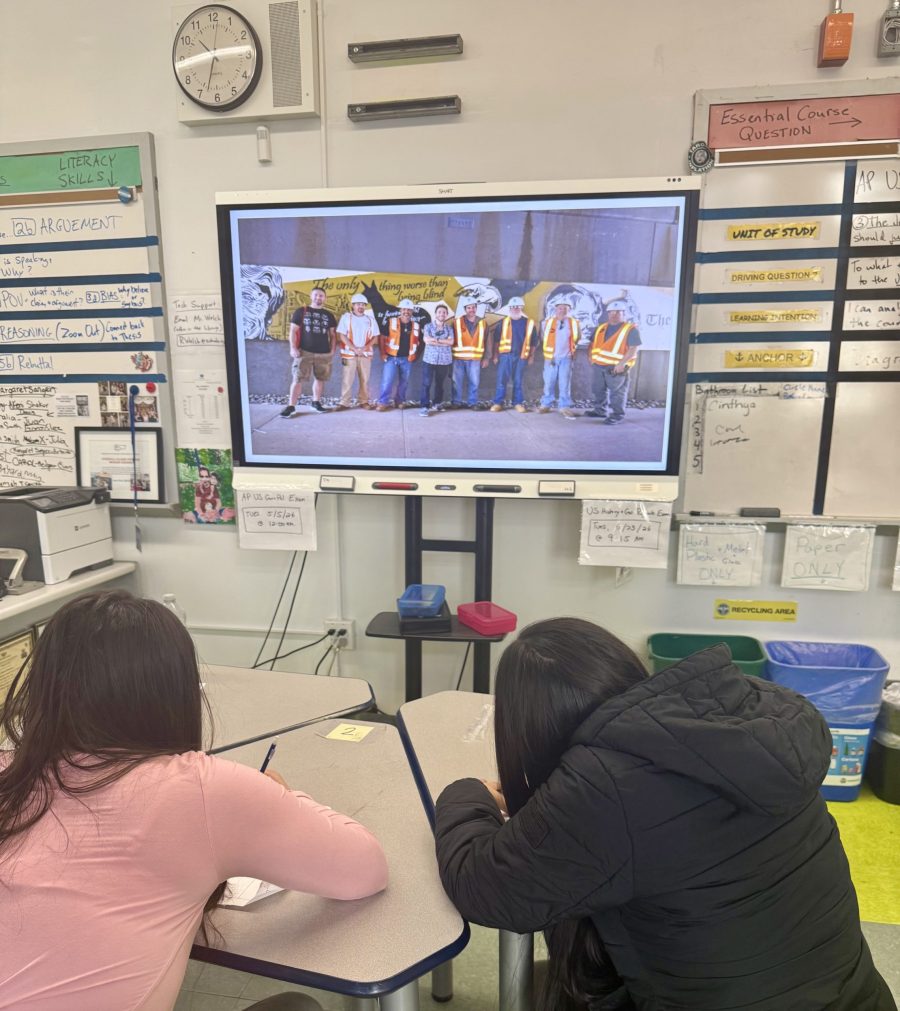
Helen Keller lesson plan featuring Helen Keller Forest Hills Tribute mural & plaque, December 2025 photo by David Edelman.
Edelman is most proud of his projects that memorialize NYC school history, such as their Washington Irving Campus school history exhibition, and his students’ involvement in city participatory budgeting and their action civics projects to improve various problems that they view as most pressing in the community.
When asked, “How may Helen Keller feel that a wise and dedicated teacher is preserving her legacy in a beneficial manner?” he replied, “Helen Keller would likely strongly support projects that require students to study activists and design student-led historical walking tours for community members, since they align closely with her beliefs about education, democracy, and social responsibility.” He pointed out her belief in education moving beyond memorization and rather cultivating moral purpose and civic action, as well as emphasizing that students must learn not only about injustice, but how to pinpoint it in the world.
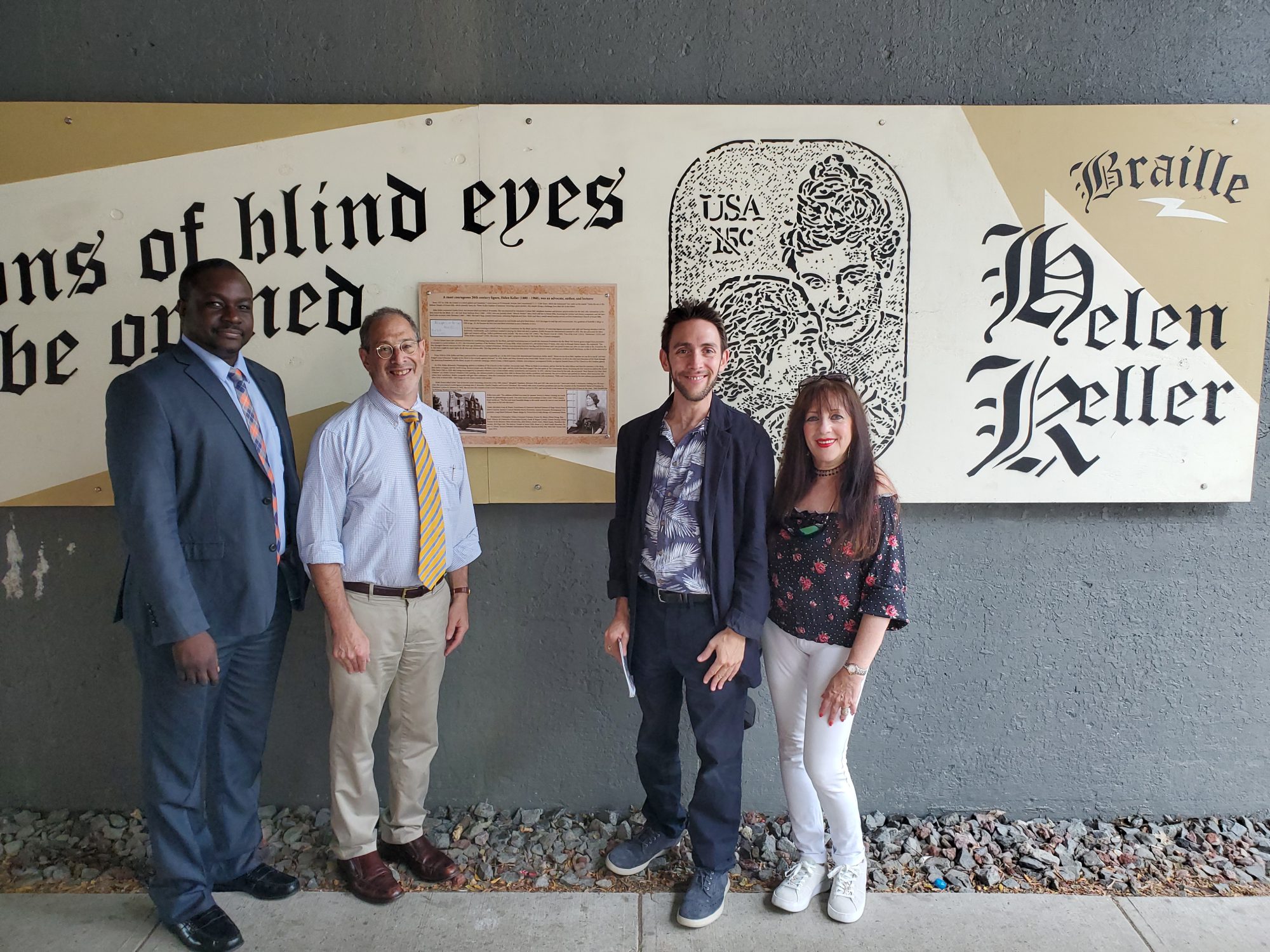
Helen Keller mural with Richard Calixte, Seth Bornstein, Michael Perlman, Linda Perlman, Photo by Rob MacKay, 2019.
Edelman explained, “Researching activists would appeal to her, since she admired individuals who challenged entrenched power and expanded democracy, whether labor organizers, civil rights leaders, disability rights advocates, or women’s rights activists. She believed young people should encounter history through human struggle and courage, but not abstract facts. Student-led walking tours would particularly resonate with her emphasis on experiential and accessible learning. She believed knowledge was most powerful when it was lived, shared, and connected to a place. By guiding community members through local history, students become learners and teachers, an idea Keller championed as essential to democratic education. She would value how such tours make history public, participatory, and rooted in everyday spaces, rather than confined to textbooks or elite institutions.”
Keller insisted that education carried a social obligation. “Having students engage the community transforms learning into civic contribution, fostering empathy, communication skills, and a sense of responsibility to others. Importantly, she would likely push educators to ensure these projects include voices of often excluded people with disabilities, immigrants, workers, and marginalized communities, and to design tours that are physically and intellectually accessible to all participants,” said Edelman.
Great achievements are built on challenges, as Edelman has proven. “Teachers are faced with the challenge of juggling many ever-evolving initiatives and curriculum demands. This means preparing students for standardized exams, while providing meaningful opportunities to engage in project work and be eligible to earn such credentials as a ‘State Seal of Civic Readiness.’ I look forward to collaborating with teachers and district leaders to create and facilitate projects, enabling students to uncover the often-hidden history of their city, and make school relevant again,” he said.