An Intriguing Restoration of Century-Old Metropolitan Avenue Facades
Views: 395
By Michael Perlman
It is not every day that we witness façade restoration work upon Forest Hills’ architecturally distinctive buildings outside Forest Hills Gardens. With a passion for a community’s timeless design, a long-term creative civic spirit, dedication, and teamwork, Queens’-own Fazio Construction is a dynamo that once again proves how it can come to fruition, and how craftsmanship and elegant style must not be a lost art. If Fazio Construction can apply their touch to more properties throughout Forest Hills, Rego Park, and nearby, classic facades and communities can be further beautified.
Fazio Construction at 58-41 63rd Street in Maspeth consists of owners Gino and John Fazio, and Gaetano as a PM (Property Manager). They are three brothers with a shared vision for restoration, renovation, construction, and preservation. Fazio Tile & Design at 105-23 Metropolitan Avenue is owned by their sister, Joanne, and was established in 1991. A few generations can sometimes be spotted working side by side.
“We filed with the Department of Buildings in June 2024, and found it crucial to get working soon thereafter,” said Gaetano Fazio. “Early stages of deterioration were noticed in 2010, when there were no threats of imminent danger. Our first impression was what could have allowed this wall to fail in the manner it was doing, and that this would be a big undertaking to repair the right way,” explained Gaetano and Gino. An average day consisted of five to ten workers, where Gaetano served as project manager and Connor McGee served as masonry foreman.
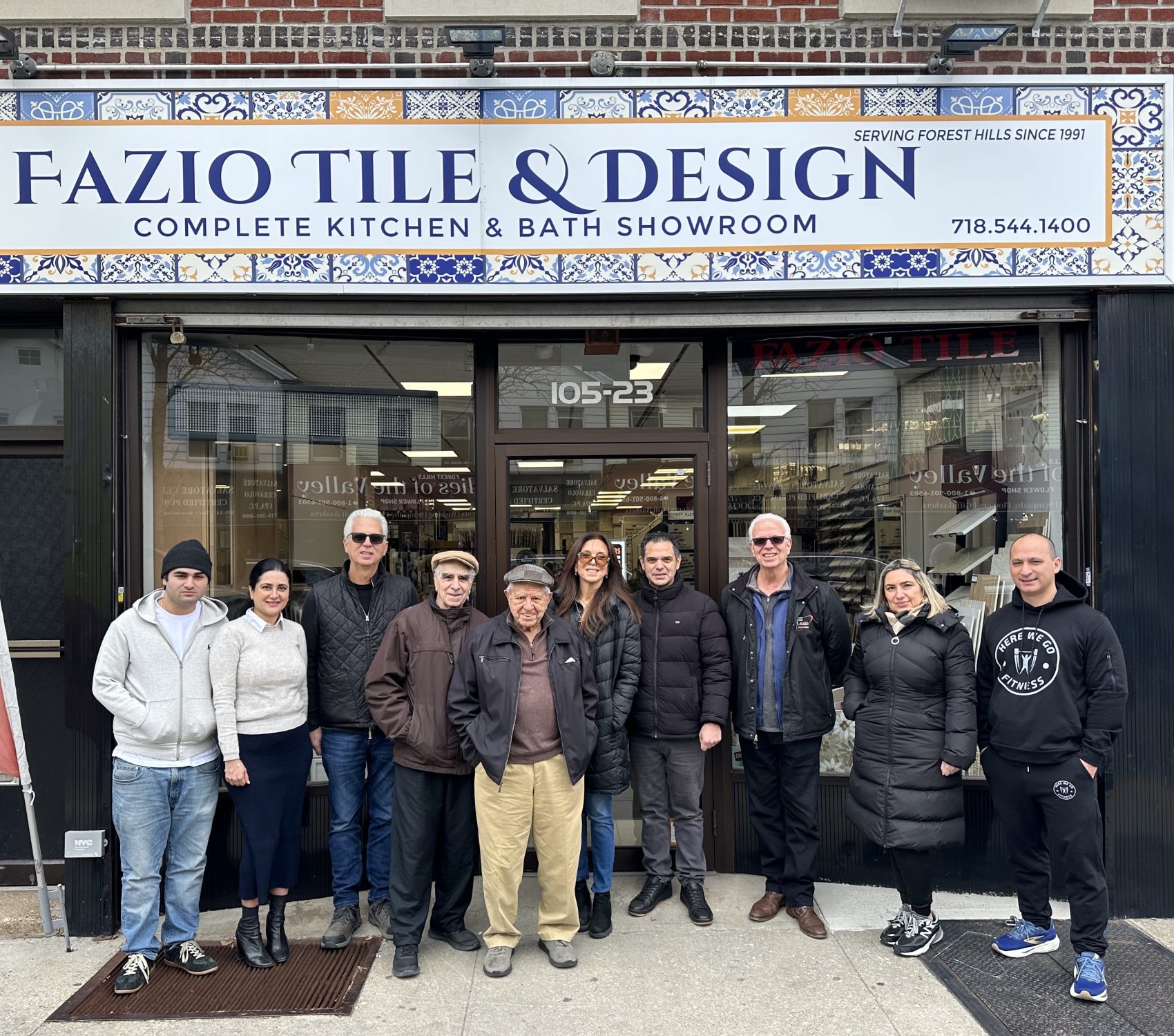
Teamwork of Fazio Construction & tenants in front of Fazio Tile & Design, Photo by Michael Perlman. Photo by Michael Perlman.
In mid-July 2024, scaffolding was erected along seven harmonious commercial and residential buildings spanning 105-15 Metropolitan Avenue to 105-29 Metropolitan Avenue, as construction professionals collaborated diligently. The property is believed to have been erected in 1925 and designed by the notable architectural firm, Seelig & Finkelstein. In early December 2024, the restored and replicated facades saw the light of day, further enhancing the historic landscape of a village-inspired Metropolitan Avenue.
The three landlords consist of the Fazio and Citrano families, and John Gemelli. The Fazio family owns four of the seven restored buildings, where each consists of one commercial tenant and one residential unit above. Alongside, Fazio Tile & Design, LZ Salon & Spa, Here We Go Fitness, Brilianna Photography, and Law Offices of Juliet Cohen are their commercial tenants. The corner is occupied by the historic Eddie’s Sweet Shop, which has been owned by three generations of the Citrano family since 1968, and was formerly Witt’s Ice Cream. The opposite corner is home to Attorneys At Law. Each tenant is a small business that offers a classic personalized mom and pop ambiance, synonymous with Forest Hills.
Great projects are built upon challenges that are bound to surface, and rewarding results follow. Gaetano and Gino pointed out the need to get all owners onboard, and assess the façade’s composition. They explained, “Structural shoring was necessary in some parts. Temp walls were built in each apartment, and we coordinated work scope diligently with tenants. We made sure that the length of the wall was watertight and sealed after our workdays, with a rollover tarp system that we implemented. We had material delivered with a boom lift once or twice per week, and arranged accordingly to close off traffic. We also had to remove all demolition debris off-site daily, without the need or utilization of containers onsite.”
Gaetano explained the replication of the historical features, consisting of the bricks and stonework. “There were red and black bricks. We gathered many different samples of brick from our supplier, and compared them to the surface, in order to match the closest with color, size, and texture. There was a lot of back and forth, and we went through several rounds of samples until we found the right matches. For the motifs, we took out one of each gently, and brought them to a local artisan to replicate size, texture, and color. For their production, molds are pre-built for each item to be replicated, and new stones are fabricated to mimic the look of the originals.”
The cost for the entire project was approximately $700,000, but the restoration offers priceless character for the next 100 years, if not longer. It cost nearly $85,000 per building and 105-15/17 Metropolitan Avenue was $125,000. “We achieved this project at the lowest cost possible for all landlords to participate, and get the project underway without a major financial burden. Luckily, all were adamant about getting the job done, and we were on the same page. They knew we would get the job done right and on time, and they were not looking to venture to any other contractors,” explained the brothers.
Gaetano shared how he felt in response to restoring an architecturally distinctive series of buildings. “It’s amazing how 100 years ago, with just an eighth of the construction technology that exists today, they were able to create such an elaborate structure. We would oftentimes try and compare the project’s challenges back then versus the ones we had now. We would also often try and figure out how many of the tools we used never existed back then, and how a now simple task for us could have taken a tradesman from that era double, if not triple the time to complete.”
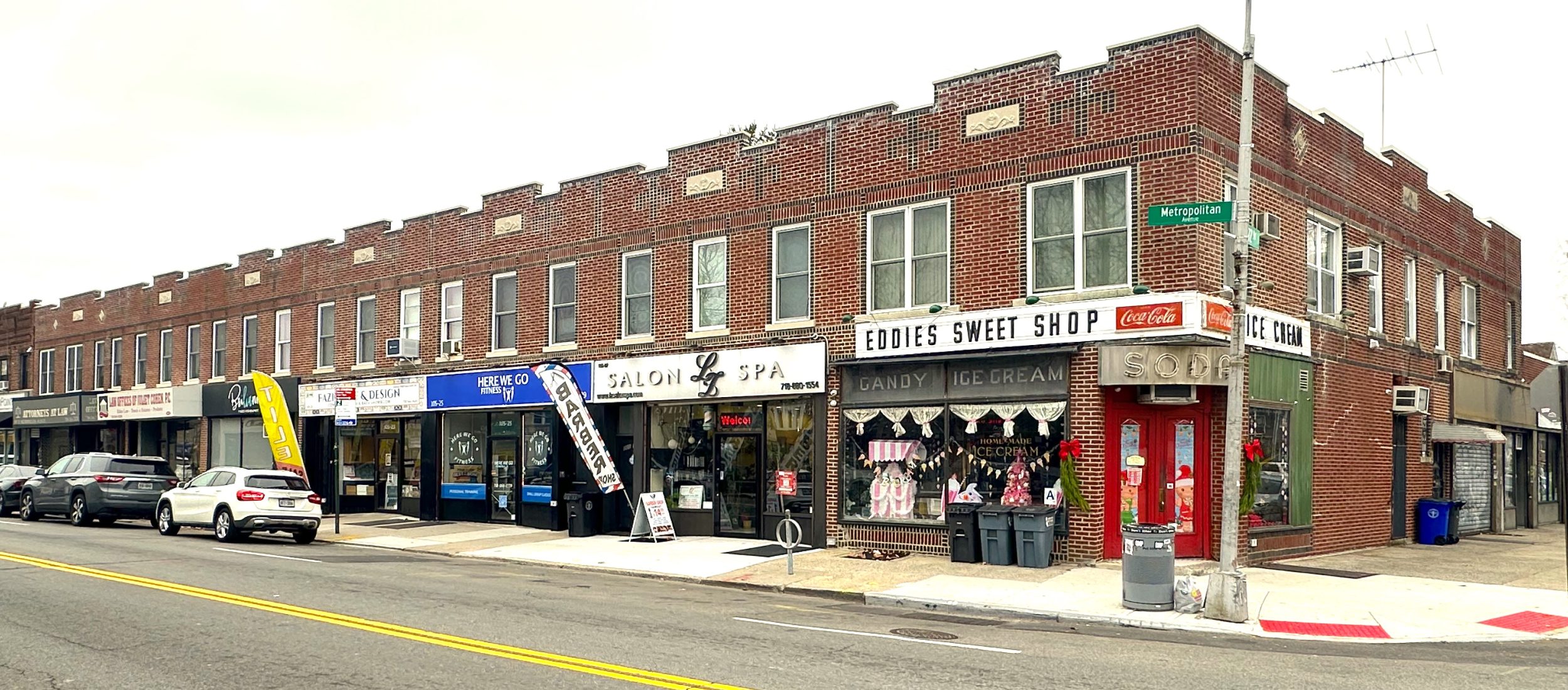
Restored Metropolitan Ave facades. Photo by Michael Perlman.
As project manager, Gaetano shared what the public may not realize about the restoration process, which ties into what the job scope truly entailed and that additional steps were applied on their behalf, in order to replicate the façade precisely while being structurally sound. “We added steps to ensure the walls’ structural integrity that was not achieved previously. We also worked in such a way, where it looked like not much was going on, but many things were happening behind the scenes.”
“Though historic projects may seem to be repetitive with their work scope and challenges, we do run into different challenges and variations of progress on every project. Each job is unique in its own specific way. They are never cut and dried,” said Gaetano.
The Fazio family has strong roots in Forest Hills since 1961, and all brothers were raised in Forest Hills. “Our parents never left, and we are all still here,” explained the brothers. “My parents worked to the core, always provided for their family, and they always invested back into their neighborhood,” said Gaetano.
The Fazio success story is built upon a close-knit family and related values. Their construction business originated in May 1987. Their parents, John and Marie Fazio, had a furniture store in Forest Hills as of 1971, where the brothers got their start when they were younger. John Fazio Cabinet Maker was the shop’s original name, which evolved into Fazio Furniture later on. The brothers explained, “We did small home improvement projects in our neighborhood, and this inspired us to get into construction as a profession. We learned the carpentry trade from our dad, which gave us the practical experience.”
Gino, a Douglaston resident who graduated from Pratt Institute with a Bachelors in Construction Management, offered advice to younger generations hoping to enter the field. “Only do it if you have a real passion. Try to learn the practical experience first and go to school. With both the practice and theory, you can go very far.” John, a C.W. Post graduate, resides in Port Washington, and Gaetano, who graduated from Fordham University and achieved a Masters at Adelphi University, lives in Roslyn Heights. The brothers were graduates of Our Lady of Mercy grammar school and Archbishop Molloy High School. Their parents continue to call Forest Hills home.
Besides restoration work, Fazio Construction specializes in many new buildings, as well as renovations in healthcare facilities, schools, and places of worship. “We have been completing many projects for the Diocese of Brooklyn over the years,” said Gino.
Old-world architectural details are increasingly rare, but do not have to be. “Being in construction, we have an appreciation for architecture and the classic look. We put a lot of effort in recreating the façade from over 100 years ago. We did not have to and spent extra money in doing so, but we love the neighborhood and felt obligated to keep the same look.” Gino and John explained that they have pursued other preservation projects throughout the boroughs, and would pursue additional.
Fazio Construction extended outreach to Vestacast, which replicated the two varieties of cast stone medallions at their 17,000 square-foot facility at 56-15 58th Street in Maspeth. Their firm consists of 40 in-house employees within a formal laboratory setting, where they test daily mixes for air-entrainment, compressive strength, and water absorption, reflecting Cast Stone Institute’s requirements.
“It’s always an honor to bring back the historical beauty of all our projects, as the premier cast stone and glass fiber reinforced concrete manufacturer in the New York City and surrounding area,” said Vestacast President Thomas P. Caruso. “We produce ornate replacement elements for our restoration clients, and fully comply with the NYC Landmarks Preservation Commission’s rigid standards.”
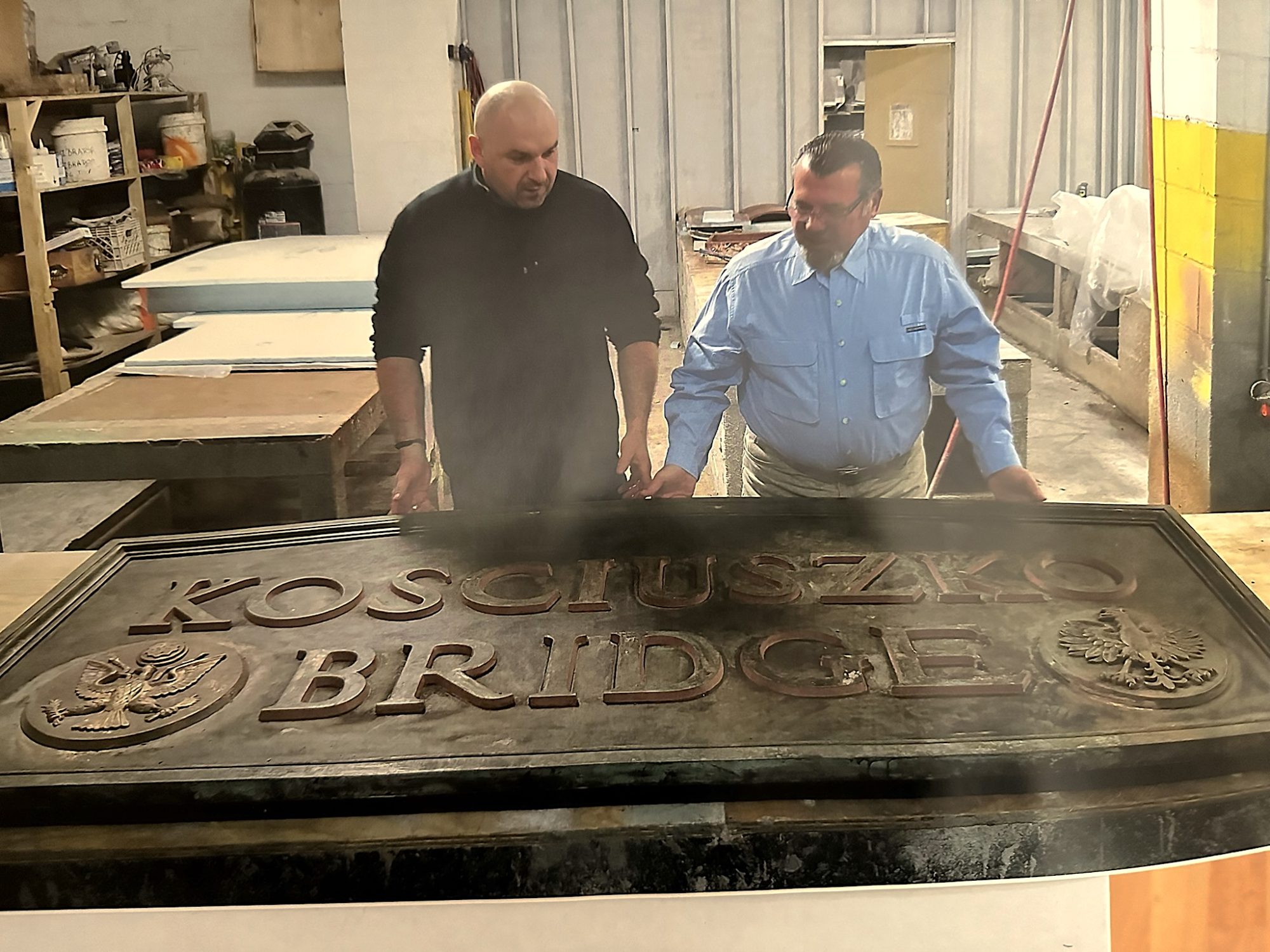
Vestacast partners Peter Kaminski & President Tom Caruso.
Vestacast originated in 2007 by Tom Caruso and Peter Kaminski, who were employed for 14 years in management positions by a NYC exterior restoration company. “Having long lead times when sourcing our replacement cast stone units, we began fabricating stones for our own use,” said Caruso. That motivated them to branch out as a team. Since then, they are a recipient of the New York Landmarks Conservancy’s prestigious Lucy G. Moses Awards, in addition to being awarded by the Cast Stone Institute’s annual Cast Stone Excellence Awards.
Caruso outlined typical restoration steps, such as after the Fazio team delivered model stone medallions to their facility. “A full scan of the models is used to produce shop drawings. Upon approval of the shop drawings, we will fabricate negative molds of the model’s profile. Our artisan will restore the model stones to their original condition. The use of liquid rubber and other compounds are used to produce the molds. We will then produce color samples to match the original color and texture. Upon approval, we will cast the new stones from those molds with the chosen color design mix. The new stones are demolded and then go through our quality control department before releasing the product to our clients.”
To restore and maintain your building façade and interior, contact Fazio Construction at 718-326-2266 and Gino@fazioconstruction.com, as well as Vestacast at 718-326-4676 and TCaruso@vestacast.com.